

Ernst Ludwig Kichner
«The New Art is Here»

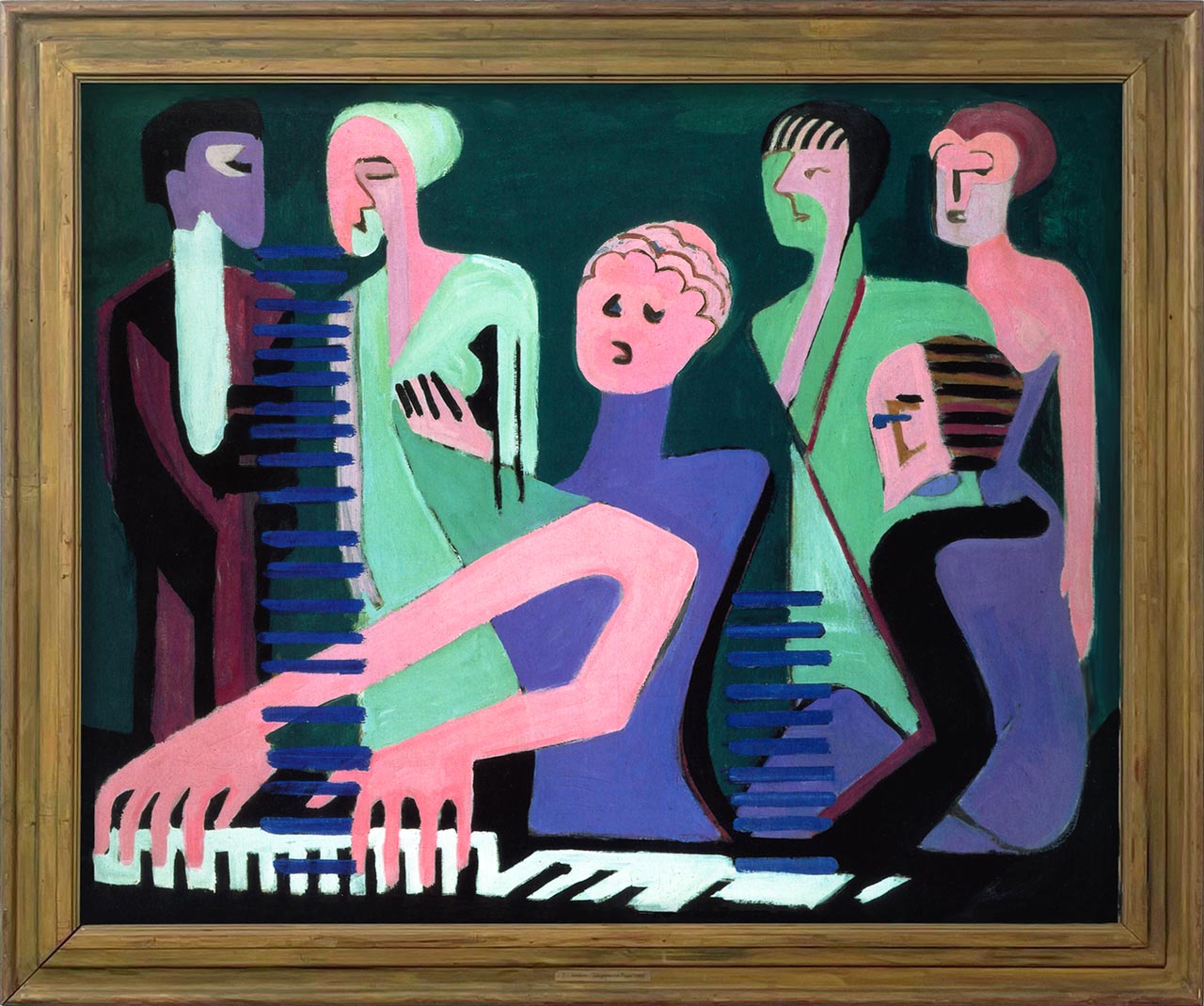
Oil on canvas, 120 x 150 cm.
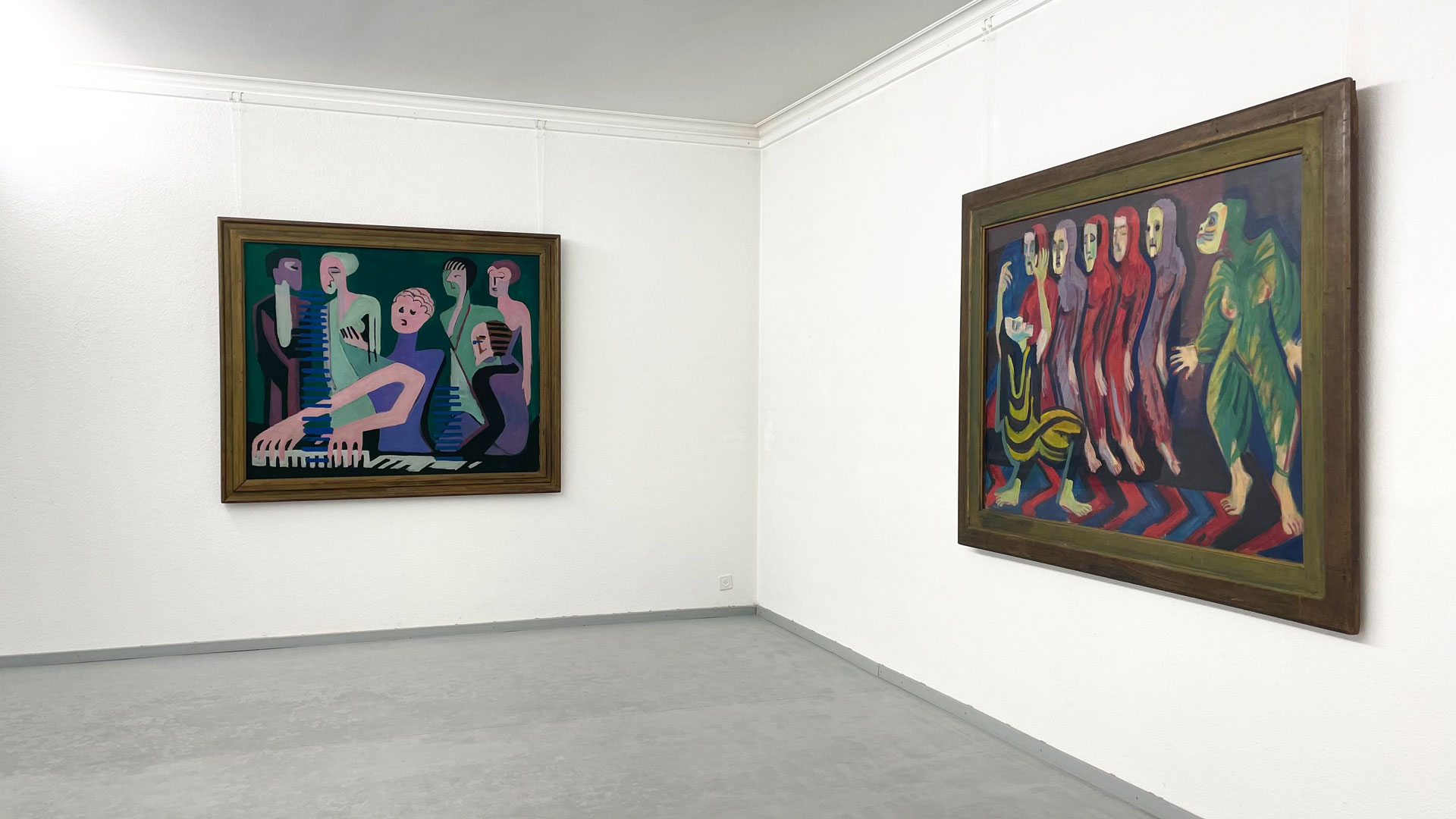
This artwork is part of the exhibition "Dance & Music"
at upcoming TEFAF Maastricht 2023

Ernst Ludwig Kichner:
«The New Art is Here»
2022/23
Galerie Henze & Ketterer
Wichtrach/Bern, Switzerland
Henze & Ketter is proud to be administrators of the Ernst Ludwig Kirchner Estate since the mid-1950ies. Therefore we have the honour and the privilege to contribute to most international museum shows to the theme of “Brücke”, Ernst Ludwig Kirchner and Expressionism. In our own gallery, a selection of works from our collection is made accessible to the general public through permanent exhibitions with alternating hangings.
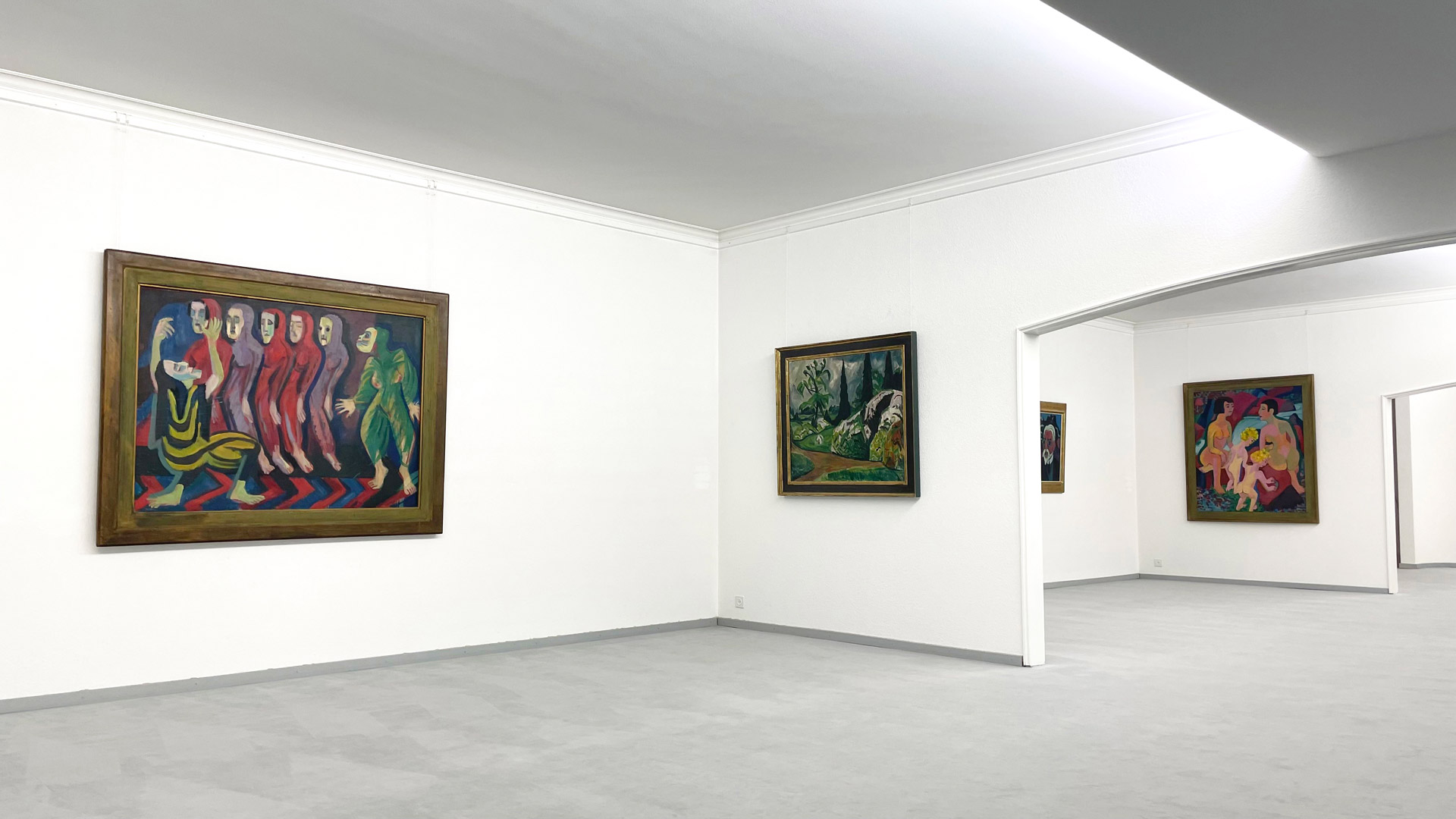
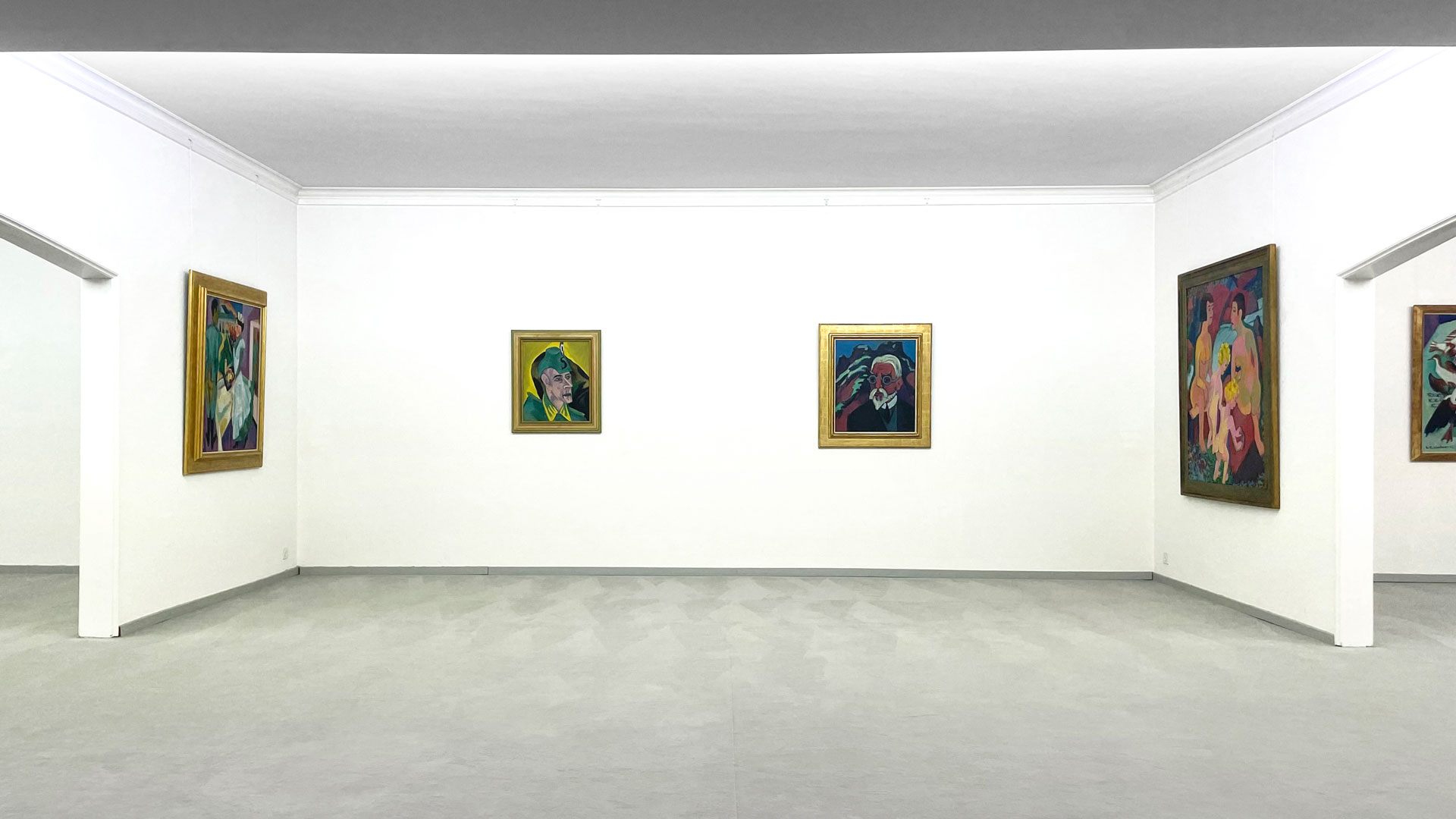
In the main room of the gallery space in Bern we present a display of paintings by Ernst Ludwig Kirchner. The selection of paintings from 1912 to 1930 spans from Kirchner's expressionist style influenced by the "Brücke" years in Dresden and city life in Berlin, to his new style developed in Davos in the mid 1920s – where Kirchner's title giving quote «The New Art is Here» comes from.
The online exhibition takes the physical exhibition as a foundation and put the works on display in chronological order. The online exhibition acts as a visual timeline that gives in-depth insights and connects and contextualizes historical events, artistic developments and the personal life of Ernst Ludwig Kirchner.
1912
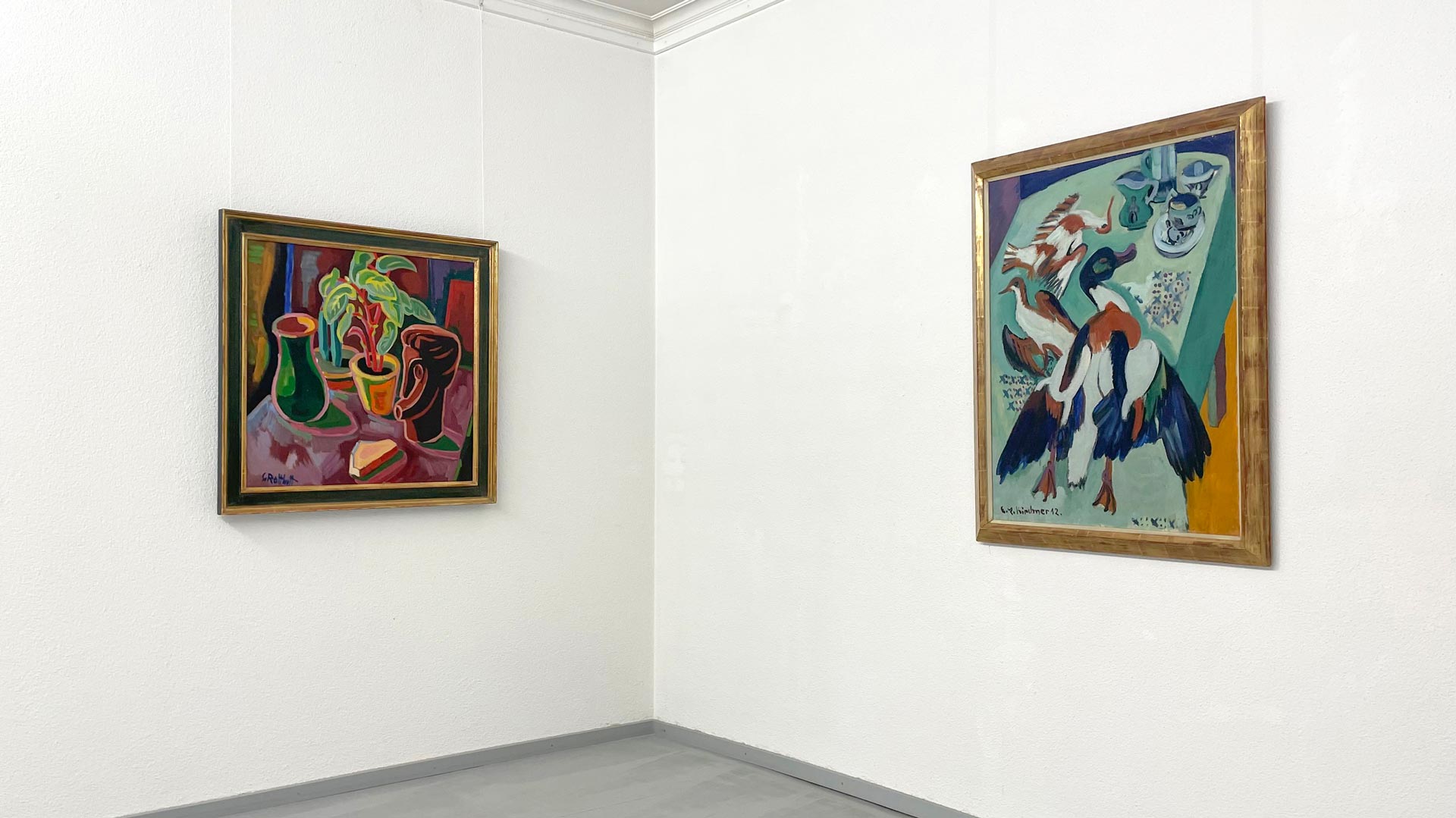
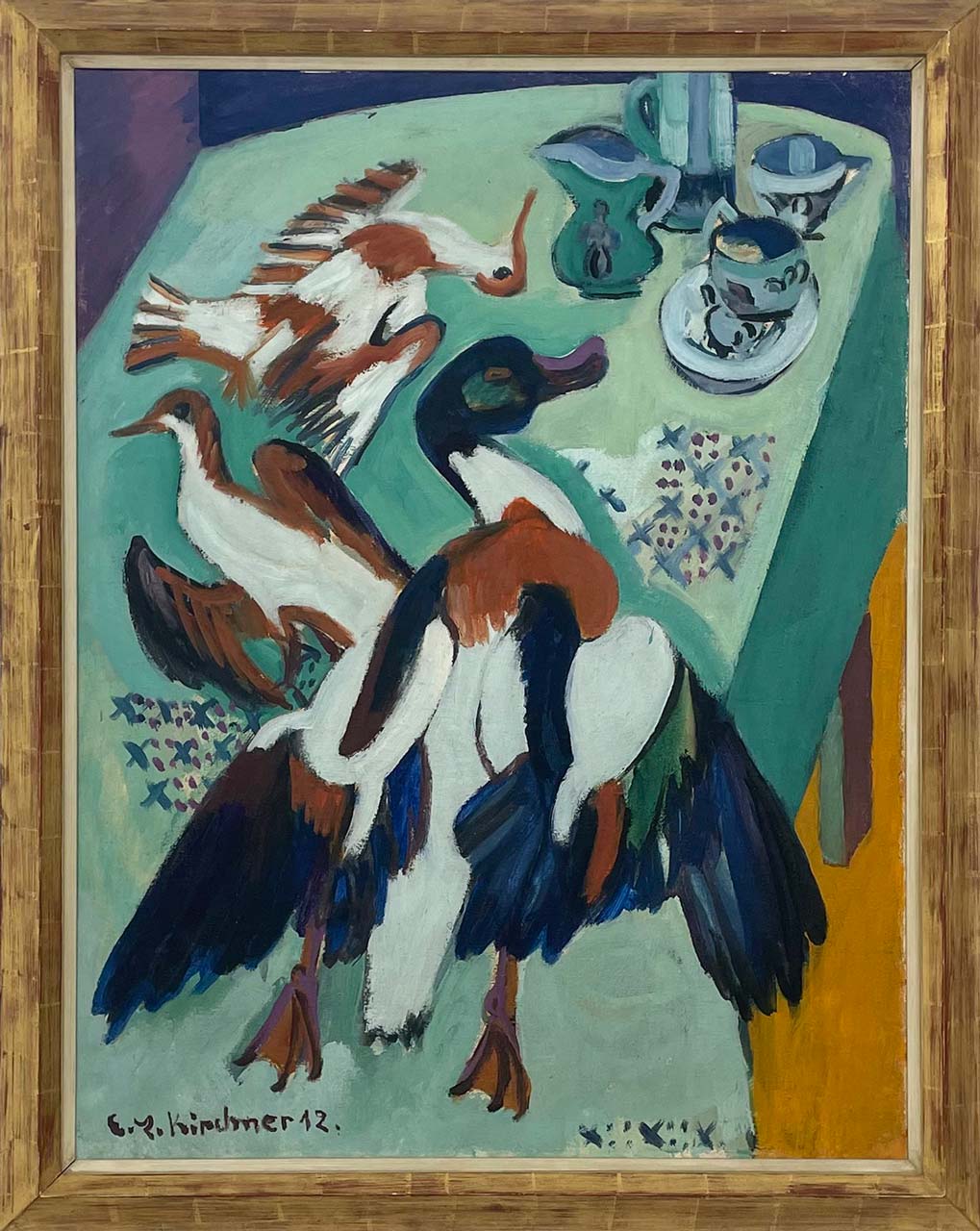
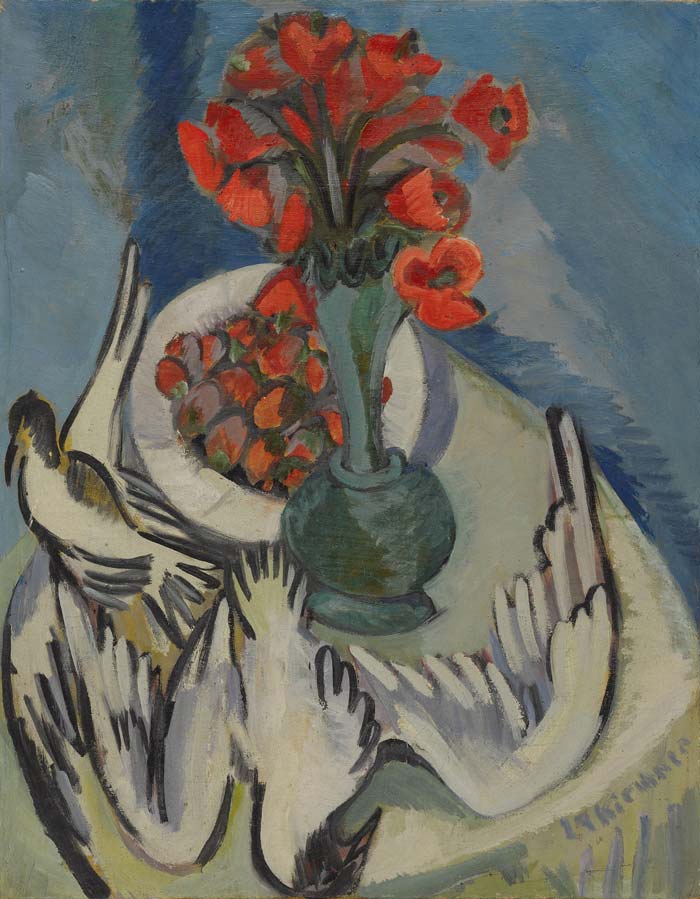
Hunting Still Lives on Fehmarn
The 'Lebensreform' Movement
Still Life Duck and Sandsniper
1912
Oil in canvas
100 x 74 cm
Work provenance
This painting, exhibited as early as 1919 by Kirchner's art dealer Ludwig Schames (see image while scrolling) in his Frankfurt Kunstsalon, was acquired from Kirchner's estate by the Düsseldorf art dealer Wilhelm Grosshennig in 1957 and in 1965 became part of the collection of Wilhelm Reinold, a member of the Commerzbank board of directors in Hamburg who died in 1979. It belongs to the numerous paintings which Kirchner, after they had been sent to him from his Berlin studio to Davos, "restored" there around 1920, partially painting over them.
Hunter on the island of Fehmarn
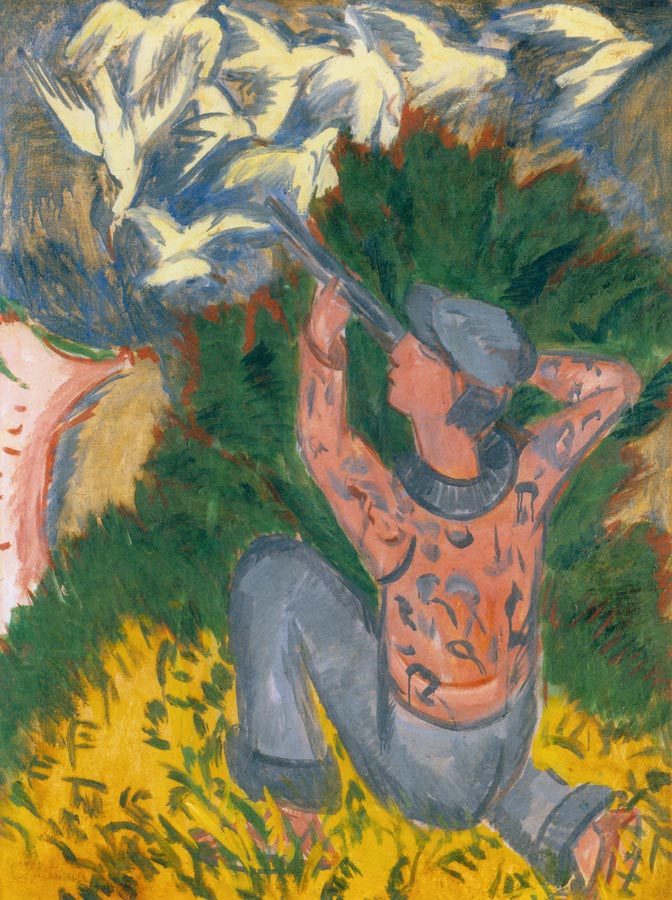
The only sport that Kirchner was actively interested in was shooting, later in Davos especially archery. He came into contact with it for the first time when he met a "Seagull hunter in the woods" (see image while scrolling) in the summer of 1912 on Fehmarn, which he immediately depicted in all techniques, as well as in some still lifes of his hunting prey.
The duck as the main motive of the still life is actually a shelduck (Tadorna tadorna). The shelduck breeds in the western Baltic Sea, i.e. on Fehmarn, where Kirchner spent four sommers from 1908 - 1914.
The time on Fehmarn represent an important biographical phase in the life of Ernst Ludwig Kirchner, characterized by a fascination with unspoiled nature and the simple and sensual life. Historically, Kirchner was influenced in this respect, like many artists of his time, by the "Lebensreform" movement and the free body culture. Nudity in the great outdoors was a new sensual experience and at the same time stood for liberation from outdated conventions, prudery and double standards.
The still life genre
Although it might seem outmoded, the still life in the painting of modernism has often retained its importance. After all, Kirchner created more than sixty still life paintings, although in the hierarchy of genres, which Kirchner, despite all modernity, knew exactly and also demanded for the assessment of his art, it was on the lowest rung. In addition to the usual flower or fruit still lifes, he also painted two hunting or animal still lifes in 1912 on Fehmarn, including this one.
1914 /15
World War I.
Kirchner's Fateful Years
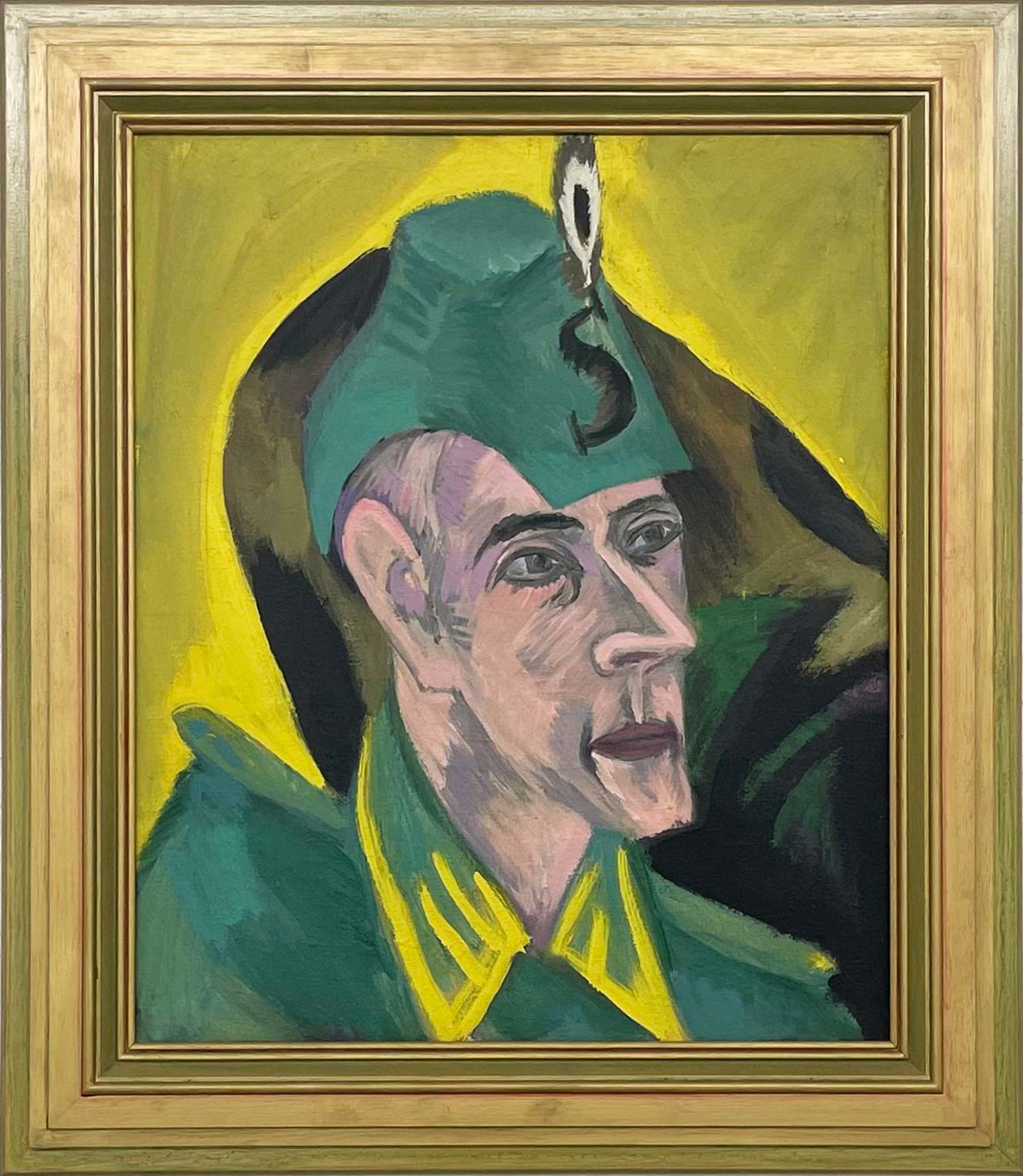
Portrait Hugo
1914
Oil in canvas
60 x 50 cm
Ernst Ludwig Kirchner met the forest warden and dancer Hugo Biallowons in 1914 as a close friend and companion of the archaeologist and art historian Botho Graef. Already in the same year he created the painting "Portrait Hugo".
The early war death of Hugo Biallowon at Verdun in 1916 shook Kirchner very much. Botho Graef died of a broken heart a few months later. The loss of these two pillars of his mental stability through the horrors of the First World War, ultimately led to existential anguish and to Kirchner's collapse, illness and long stays in sanatoriums. His artistic production during this time is all the more remarkable. His most important works were created during these difficult, fateful years.
Chronology of further events - from Berlin to Davos
1915/16
In September Kirchner was discharged from service due to a mental illness. At the beginning of November he is written unfit for service until a possible recovery. In 1916 the artist saw various visits to German sanatoriums in Königstein im Taunus and Berlin.
1917
In January Kirchner came to Davos for the first time. On April 9, his friend and mentor Botho Graef dies of a heart attack. In summer Kirchner moves into the Rüeschhütte on the Stafelalp together with the foster sister Hedwig.
After his Dresden and Berlin years, Davos and with it the Swiss Alps became his new home and source of inspiration.
1921/23
Modern Alpine Landscapes and Lifelong Friendships in Davos
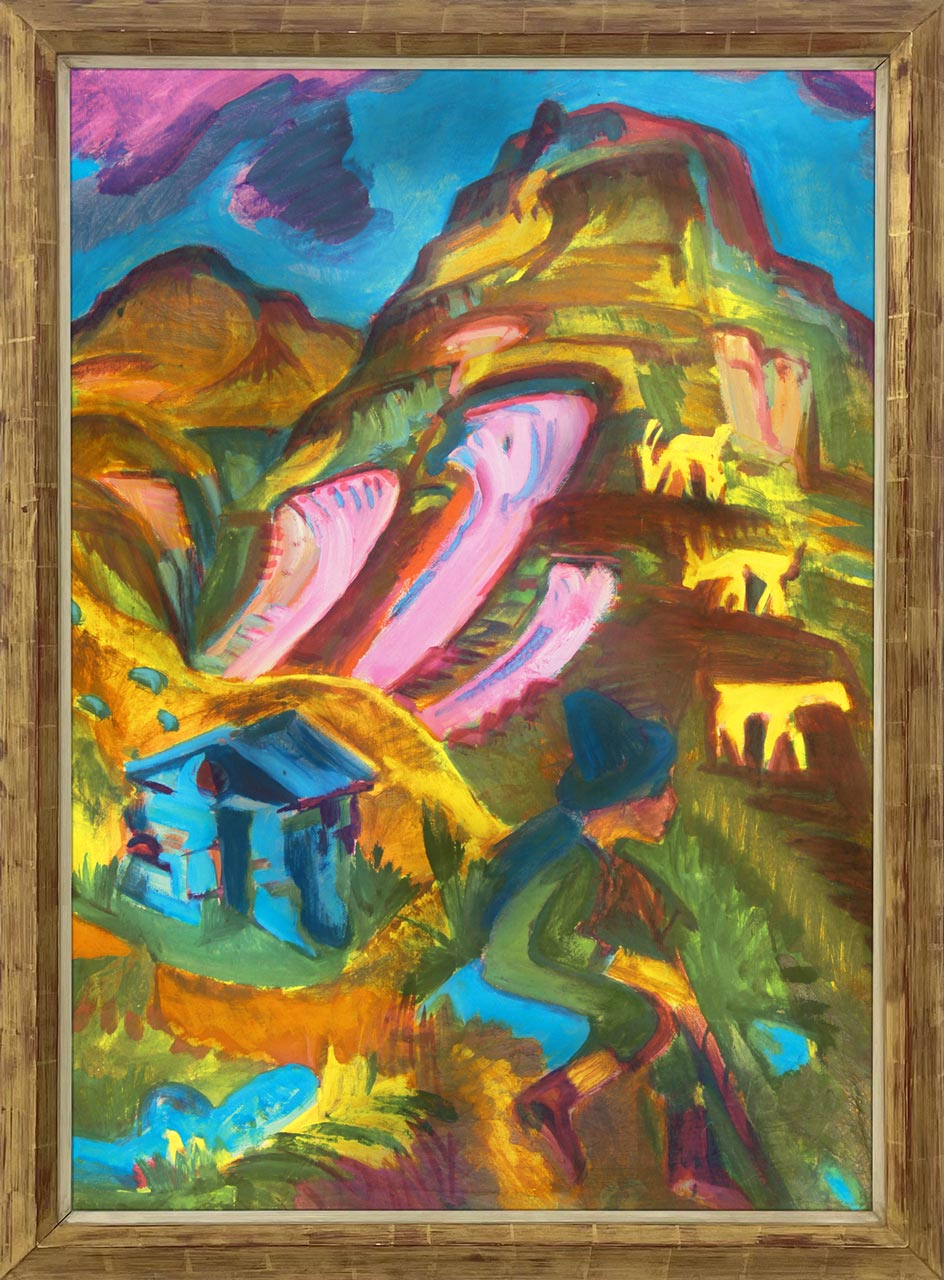
Shepherd with Goats
1921
Oil in canvas
120 x 90.5 cm
This painting occupies a special position in Kirchner's oeuvre: While the shepherd sitting in front acts as a repoussoir figure in front of a mountain landscape staggering towards the depths and upwards behind him, the yellow goats on the right flank of the mountain appear too large in scale and thus too close. They appear like a picture-parallel sign taken out of the depth of the picture, like a picture within a picture, Kirchner's "hieroglyph" of mountain goats. It forms the resting pole, the reference point of calm and serene peasant life in the grandiose-heroic mountain world in a fierce color harmony of green and yellow-brown tones as well as blue and old pink.
Kirchner's great fascination, his constant questioning of man's relationship to his environment, whether in the aggressive big city or the equally constantly challenging nature of the high mountains, once again finds a (provisional?) answer here. For it would be a mistake to ascribe the depiction of peasant life in Kirchner's Davos landscapes to the idyllic or even to pure staffage: One of the reasons for his remaining in Davos even after the end of the First World War was his experience of this peasant life at inhospitable altitudes of high empathy and careful handling in and with nature, which he observed, often described in his diary and repeatedly depicted in all techniques.
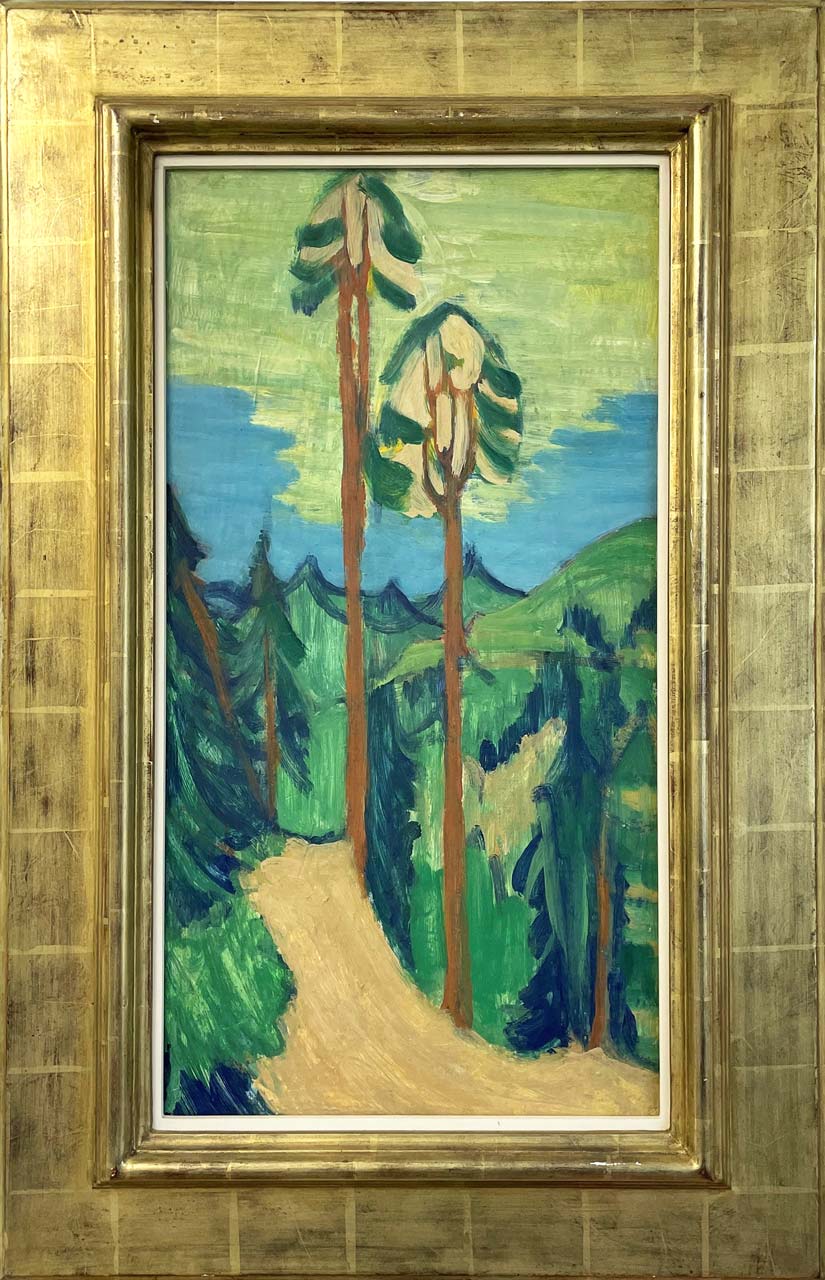

High Pine Trees in Front of Hilly Landscape
1921-23
Oil in canvas
70 x 37 cm
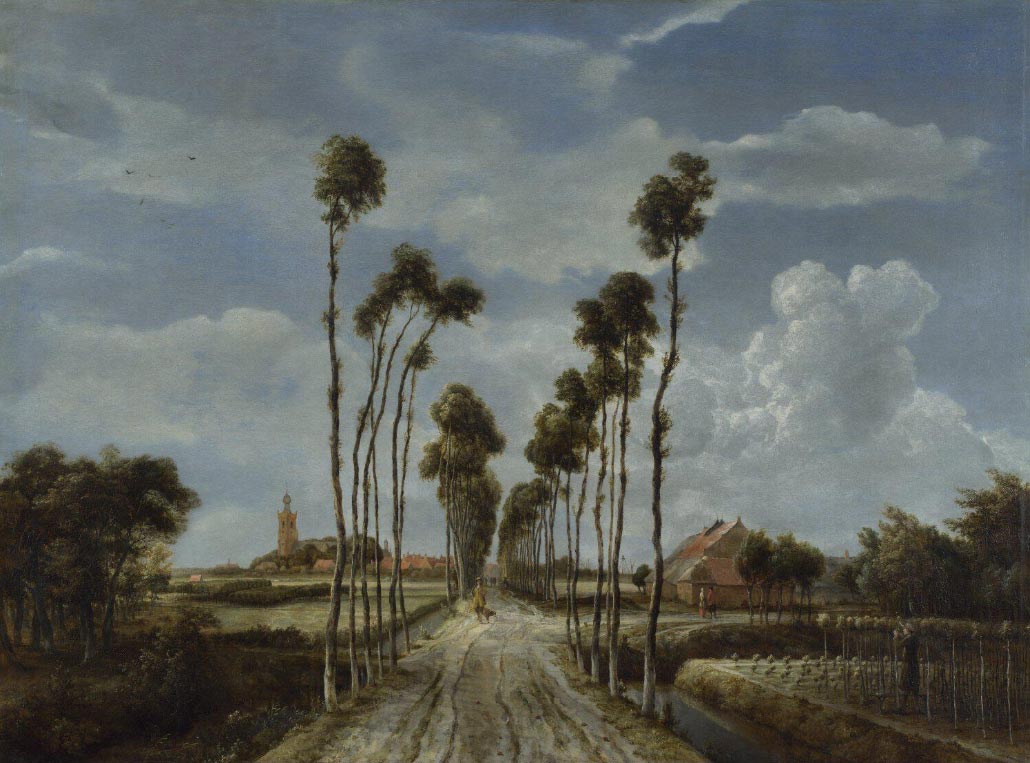
Spiral, tall, lanky trees have been known to art history at least since the famous . Such single or in a few specimens together standing tall trees, which carry only at the very top a small crown, there are in some quantity also in the work of Ferdinand Hodler. In this case, because this composition is really a special case in Kirchner's landscape painting, we may nevertheless assume that Kirchner had Hobbema and Hodler in mind when he observed this motif in the Davos landscape and captured it for himself.
After all, he had become the fourth great painter of the alpine landscape in modernism in the succession of Segantini, Giacometti and Hodler, which he knew very well. For this reason he had to devote himself to this special theme of solitary trees on tall, slender trunks. A task that he solved brilliantly and entirely in his own spirit. The taller of his two heroes even pierces the upper edge of the picture, as is usually the case with Kirchner: Kirchner's Davos landscape pure, in violent forms of green and brown tones under an equally violent blue-white sky.
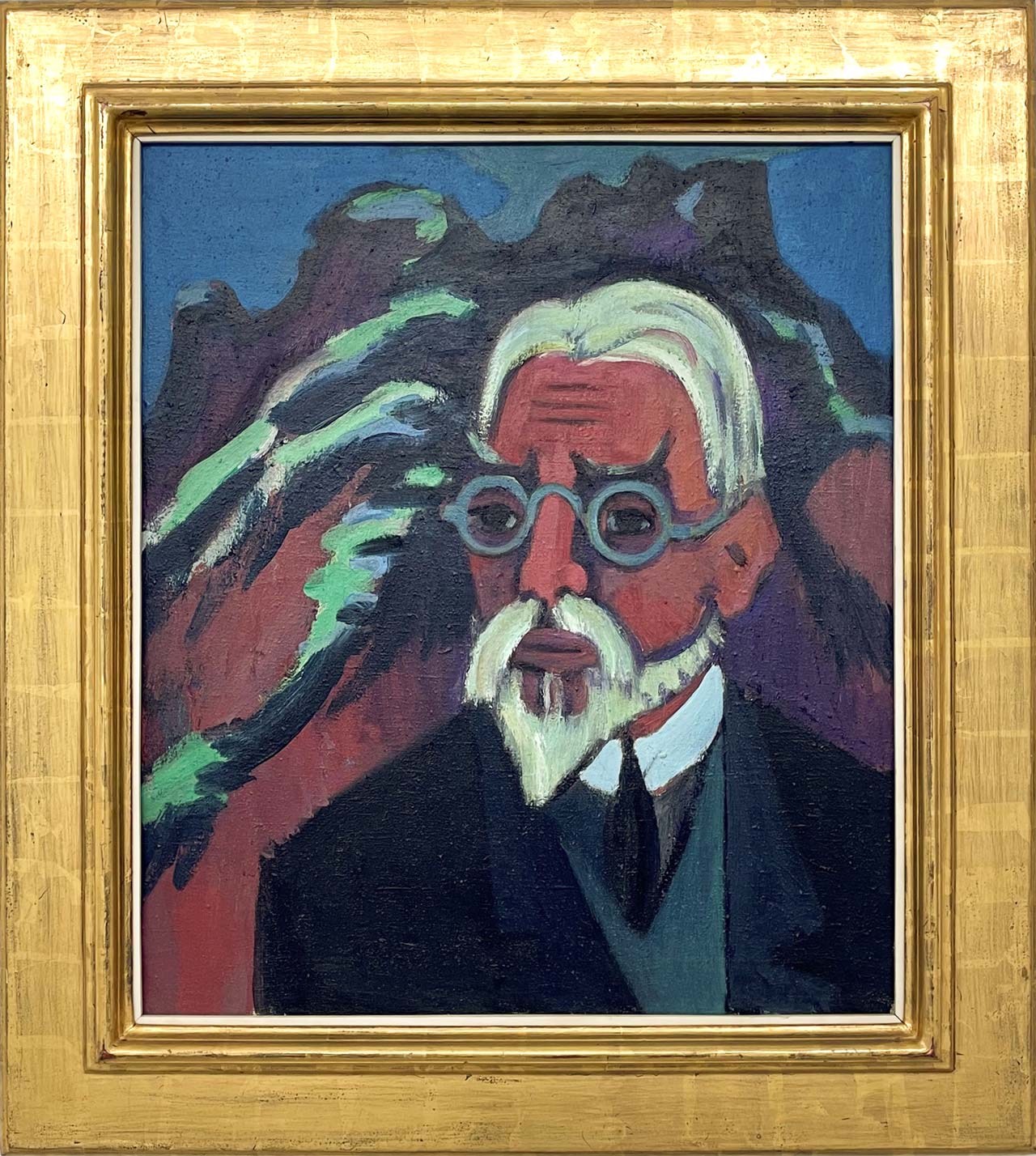
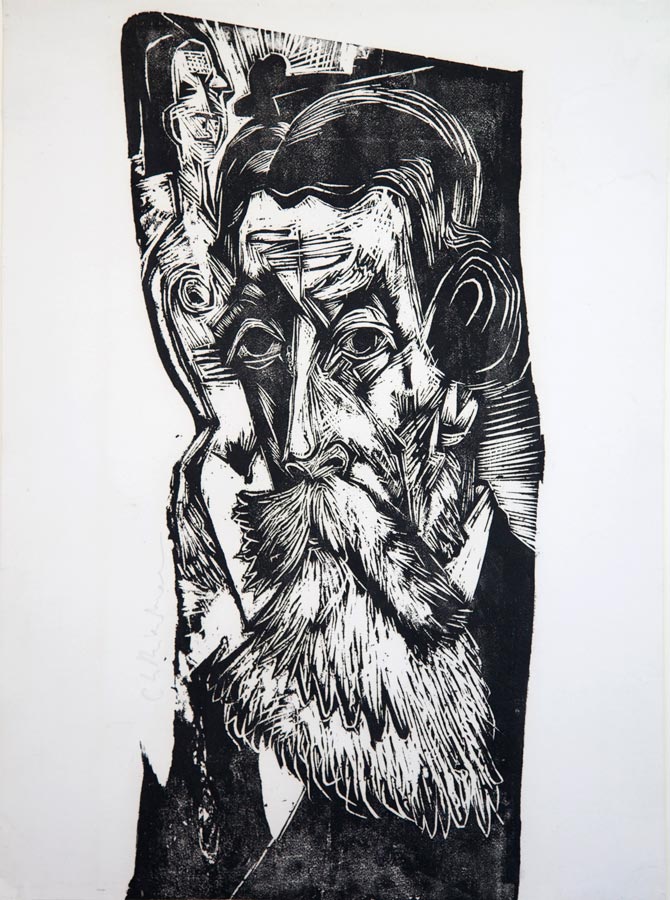
Portrait Bosshart
1921-23
Oil in canvas
70 x 60 cm
With white hair, moustache, goatee and glasses, the bust portrait of Swiss poet Jakob Bosshart (1862-1924) stands from right to left looking out of the picture in front of indeterminate mountain landscape. The sixty-year-old looks distinguished with tie, tight white collar, vest, jacket and correctly combed hairstyle, one of the many, very different personalities who came to the Davos valley and its side valleys for longer stays because of the healthy climate and often also settled there.
Bosshart moved to Clavadel not far from Kirchner's "Haus auf dem Wildboden" in 1922. A chance encounter soon led to friendship and collaboration between the two.
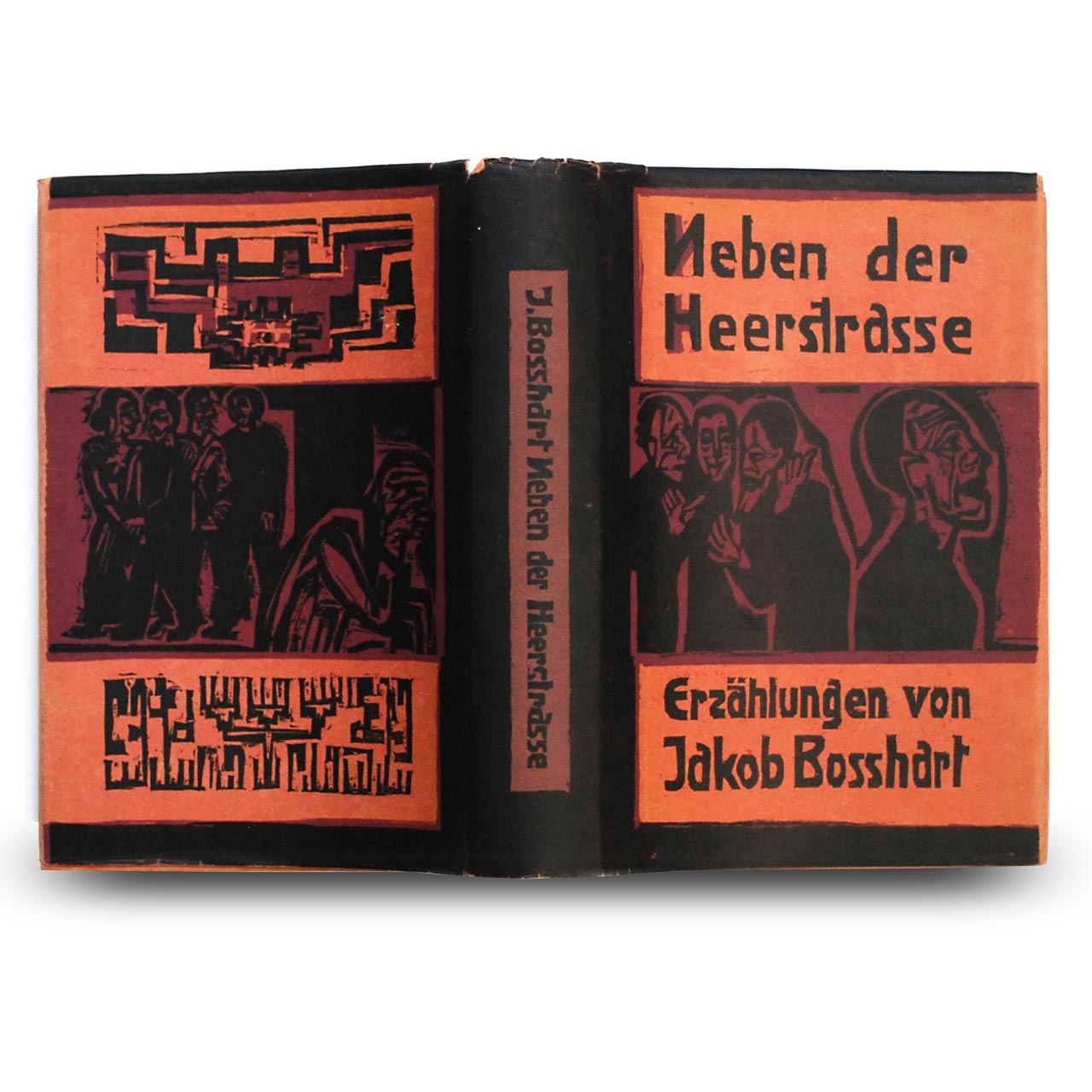
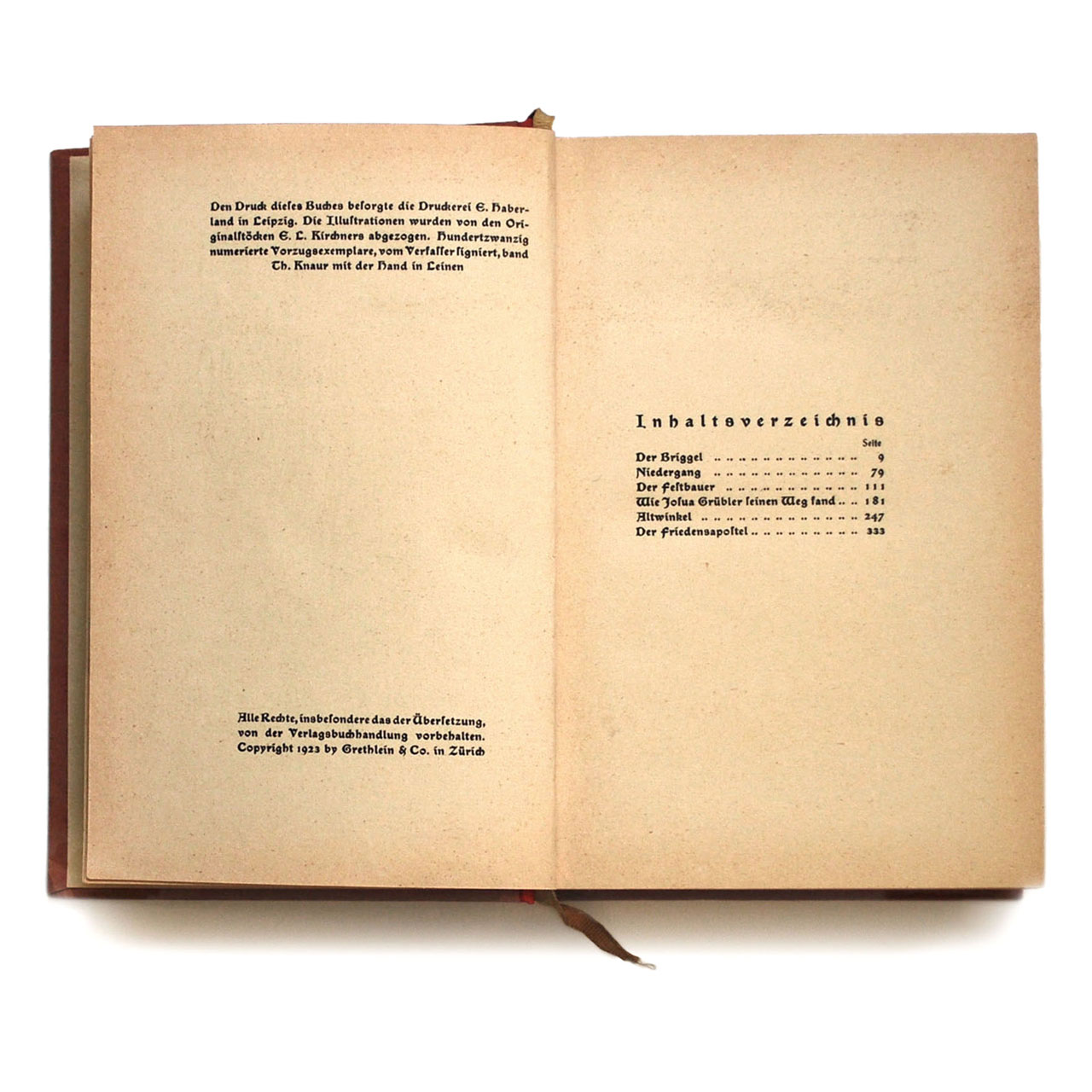
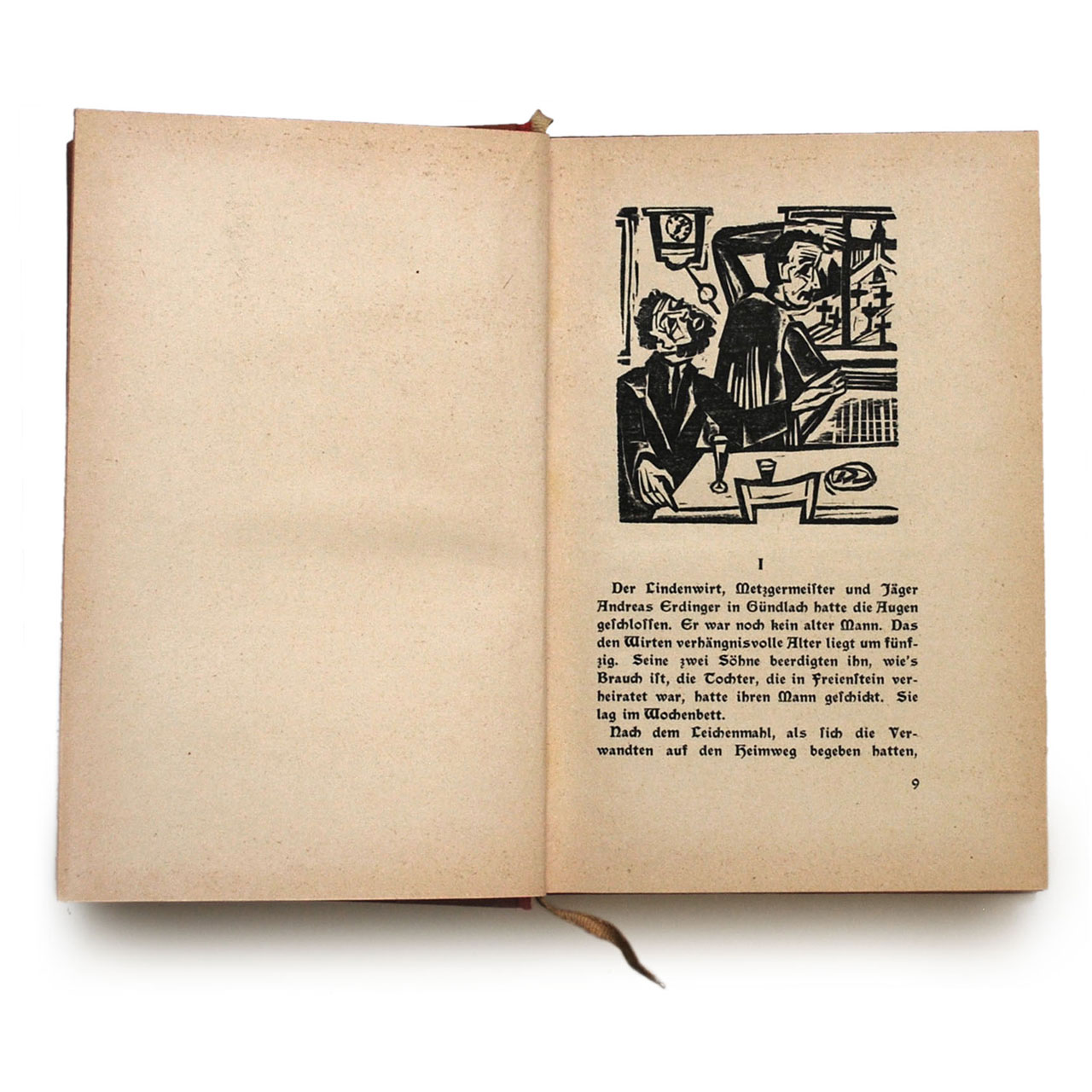
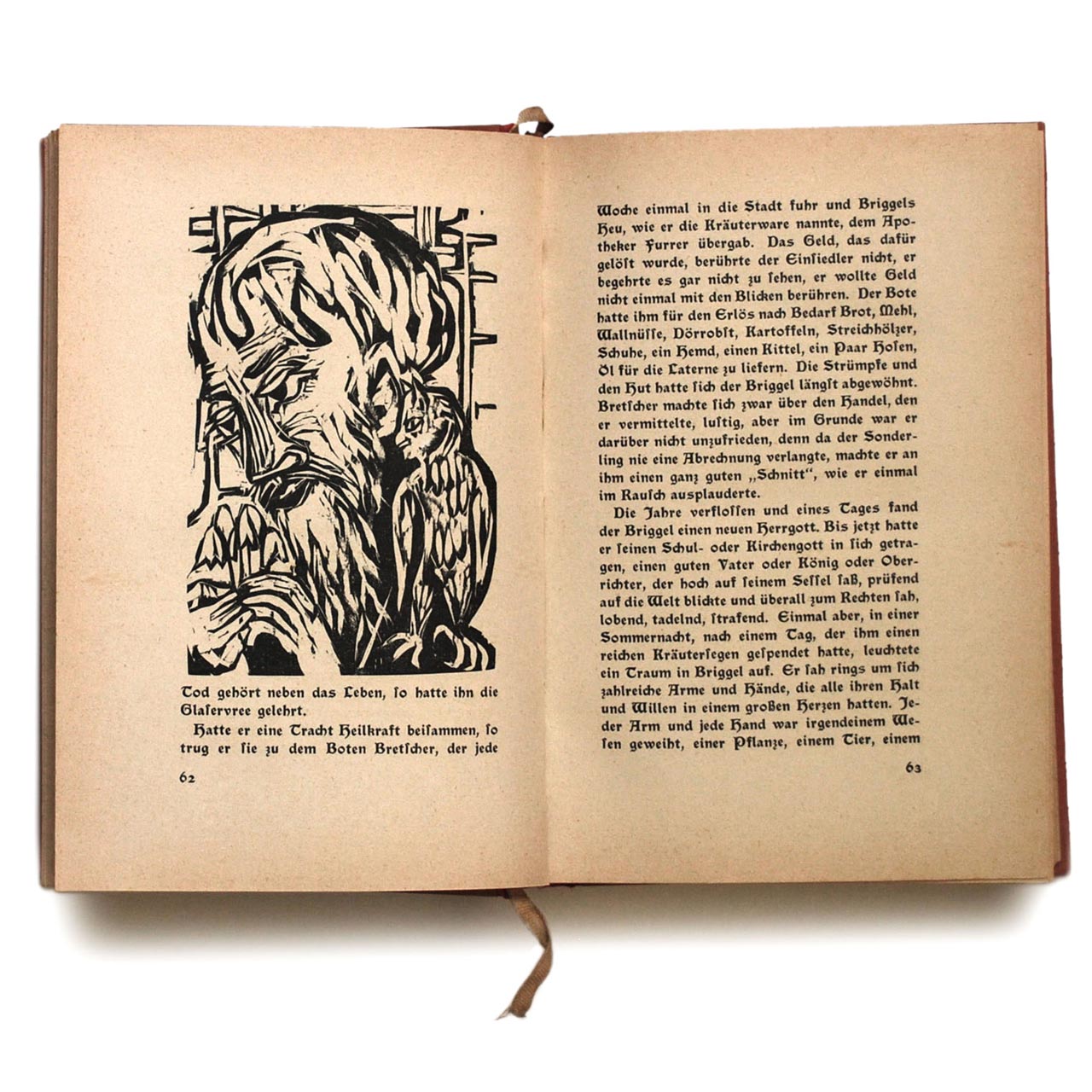
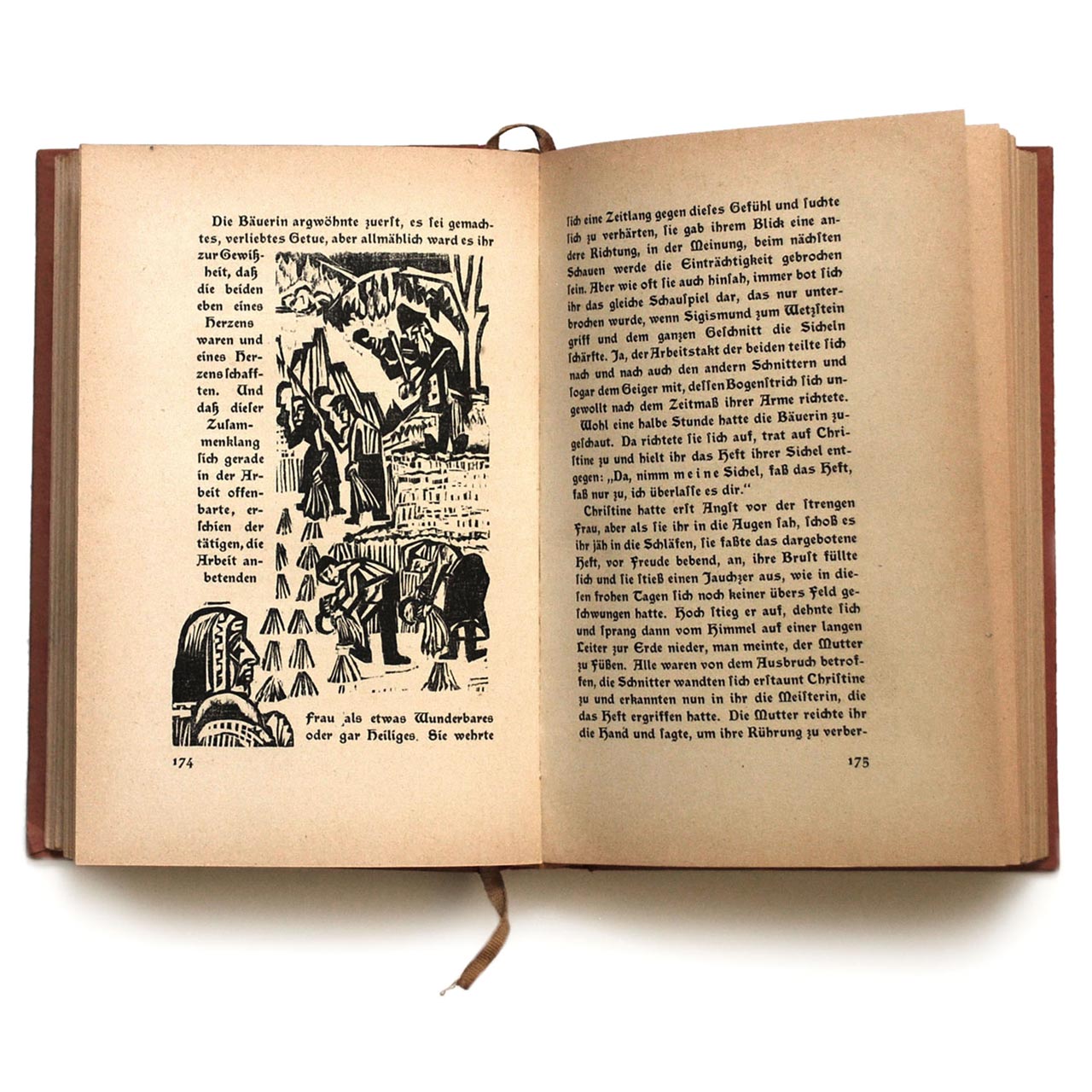
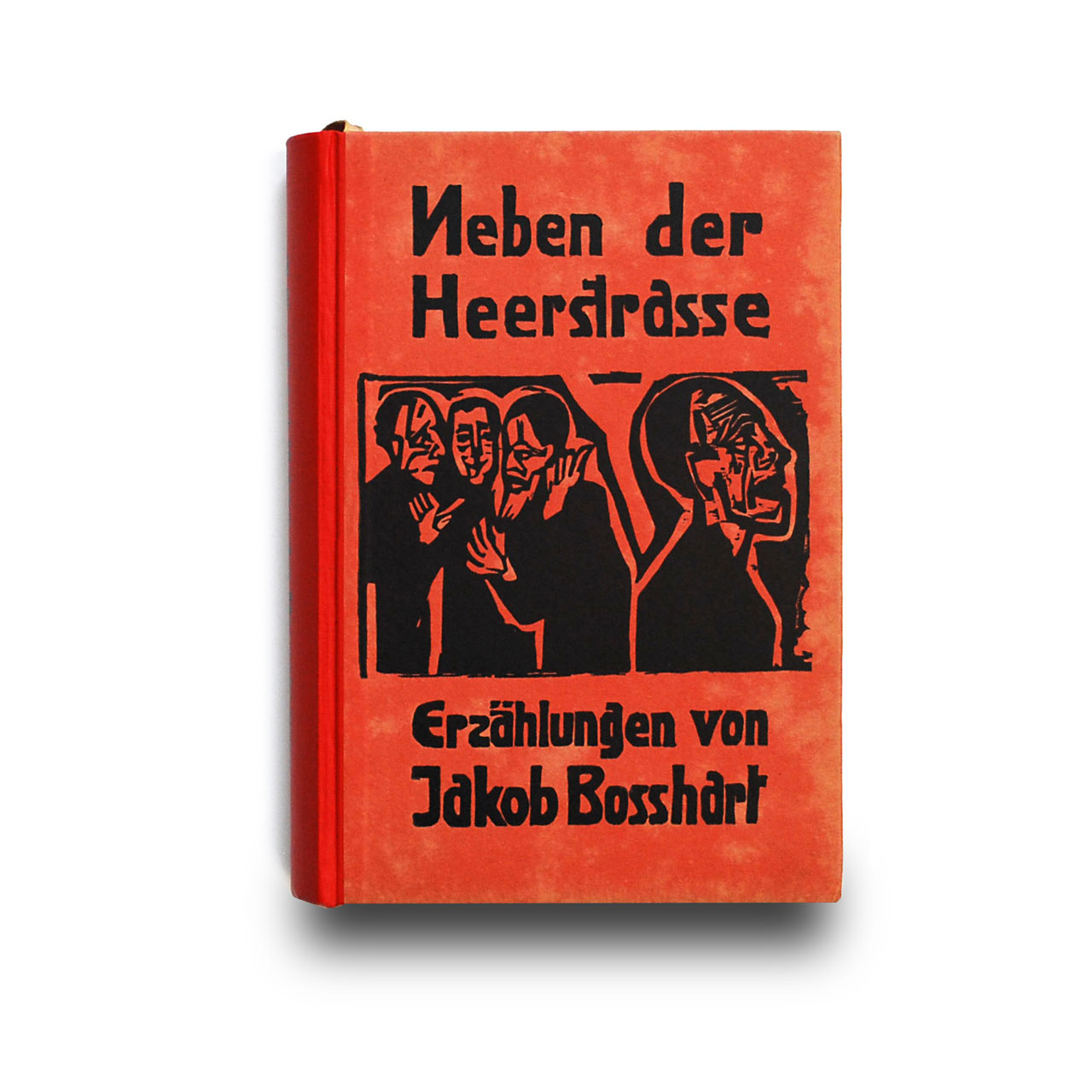
Kirchner created woodcut illustrations for Bosshart's volume of stories "Neben der Heerstrasse," published in 1923, and portrayed the poet in paintings, woodcuts, and etchings.
Bosshart's novellas, written between 1917 and 1922, feature peculiar characters off the beaten track. The protagonists are predominantly village people struggling with a variety of moral conflicts, often triggered by the challenges of modernization.
Kirchner's affinity for Bosshart's texts was likely related to his own interest in the vernacular traditions and folk culture of the area.
1925
Free Bathing Scenes at the Stutzibach The Development of a Painting
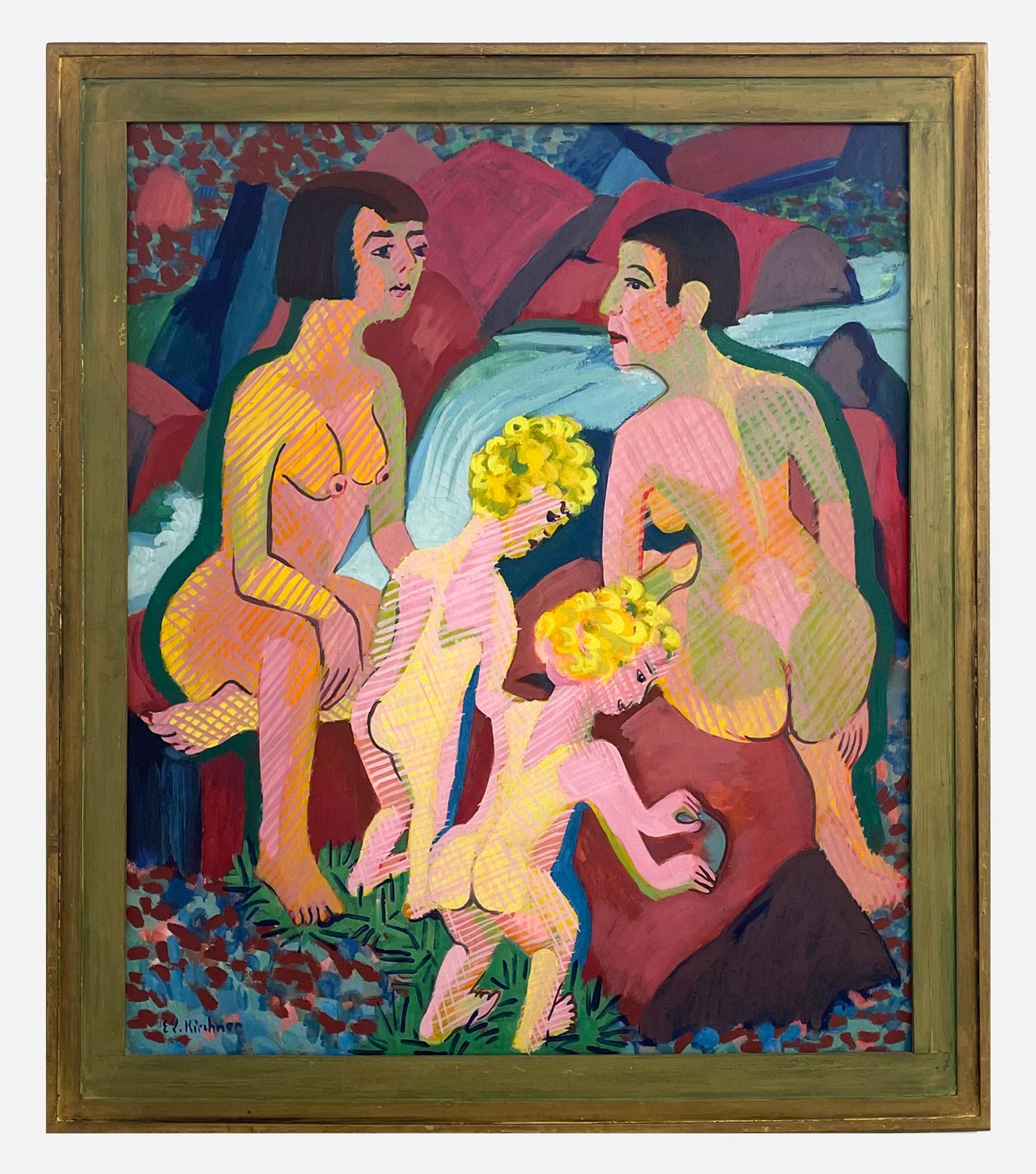
Bathing Women and Children
1925/32
Oil in canvas
130 x 110 cm
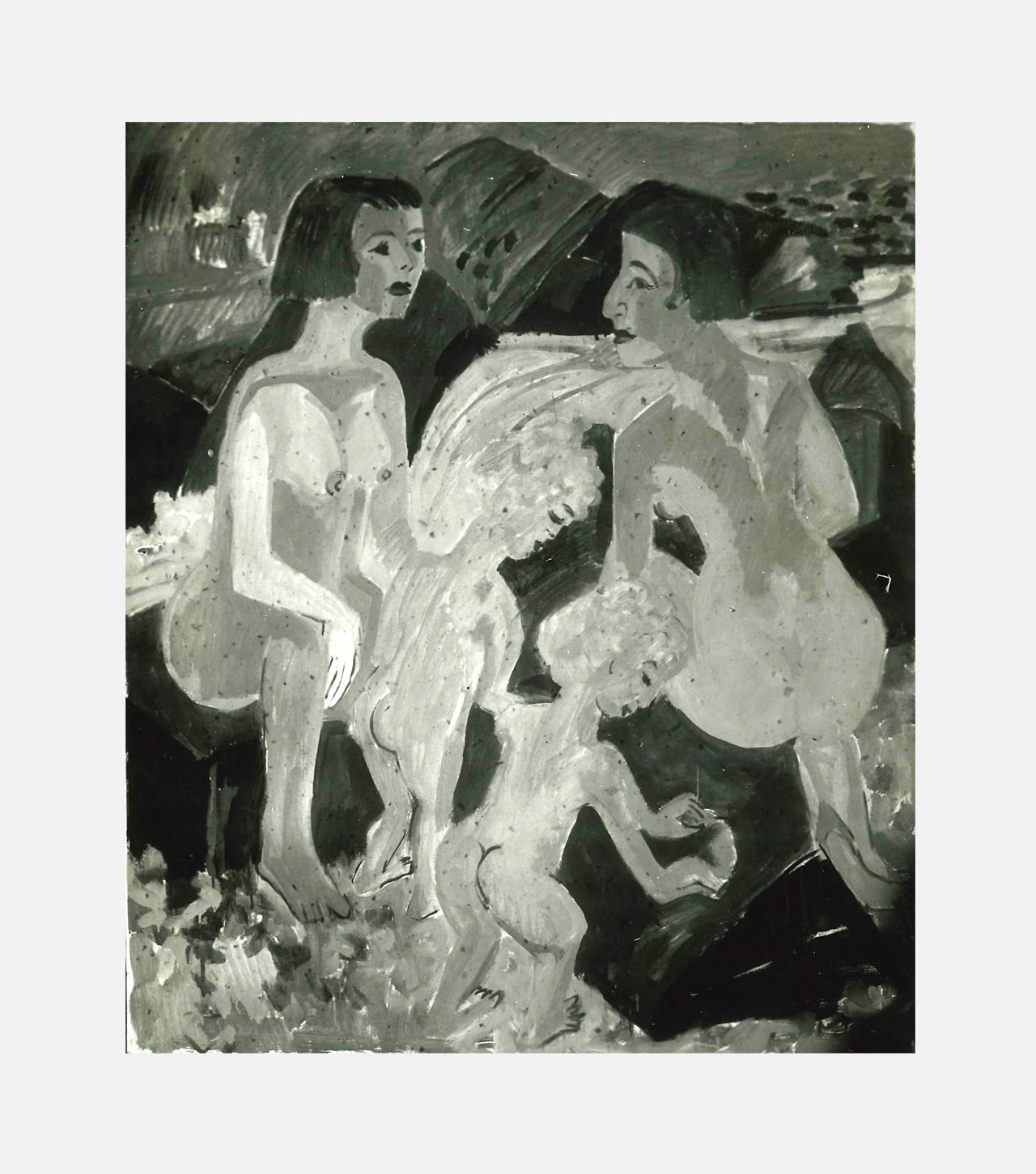
The (black and white) photograph that Kirchner probably took of the painting soon after its completion in 1925 and pasted into his photo album Volume III, which is preserved in the Kirchner Museum Davos, shows the painting still without the overpaintings he made after 1927. These are most obvious in the roughening of the naked bodies.
Kirchner reports on the creation of the painting in letters to Albert Müller and Ernst Gosebruch on October 28 and 29, 1925. In 1926 it was exhibited in the Kirchner exhibition at the Galerie Paul Cassirer in Berlin and shown in its first state in the catalog. In the 1937 exhibition at the Kunsthalle Basel, it was then in its second state, as can be seen from a photograph Kirchner enclosed with a letter to Erwin Friederich Baumann dated November 11, 1937.
It is not clear when Kirchner revised the painting, but this seems to have been done in two stages: First, he made "corrections" to the bodies: The left nude received an undercut left leg. The right one got a left leg bent to the right and a right arm placed down against the right leg. The physiognomies as well as Erna's profile and hair were accentuated. Later, he laid a rhombus framework over the bodies in accordance with his art-theoretical considerations in connection with a looming professorship in Dresden, which he entrusted to his "Davos Diary" in 1927.
« Just now stands a painting with large nudes and children on my easel. A motif from the summer. It was very nice I also come up with new things and the drawings that we made outside are an great asset for me. »
About Free Bathing Scene- Kirchner's central theme
After the summer stays at the Moritzburger ponds 1909-11 and the summer stays on the Staberhuk of Fehmarn 1912-14 Kirchner created in the Bachtobeln of Davos from 1921 (visit of thee dancer Nina Hard) a third time South Sea atmosphere on the water.
We are talking about the Sutzibach, which flows from Stafelalp to Frauenkirch. The large stones in the creek bed may have reminded Kirchner of the "beach at the stones" on Fehmarn, where so many bathing scenes were created in the summer months of 1912-1914 and South Sea was suggested by self-made dugout canoes with outriggers, grass huts, and so on.
Free bathing scenes in the studios of Dresden and Berlin, as well as the bathing scenes in nature that followed from 1909, are the central theme of Kirchner's art, constant stimulus of his art. Water plays the unifying central role in them, whether in the tubs of the studios, flat round bathtubs made of wood, or on the Baltic Sea to finally the streams on the alpine ridge of Davos, where in summer it can certainly become south warm.
1926/28
'The New Art is Here'
Mary Wigman & Ernst Ludwig Kirchner's Totentanz
at upcoming TEFAF Maastricht 2023
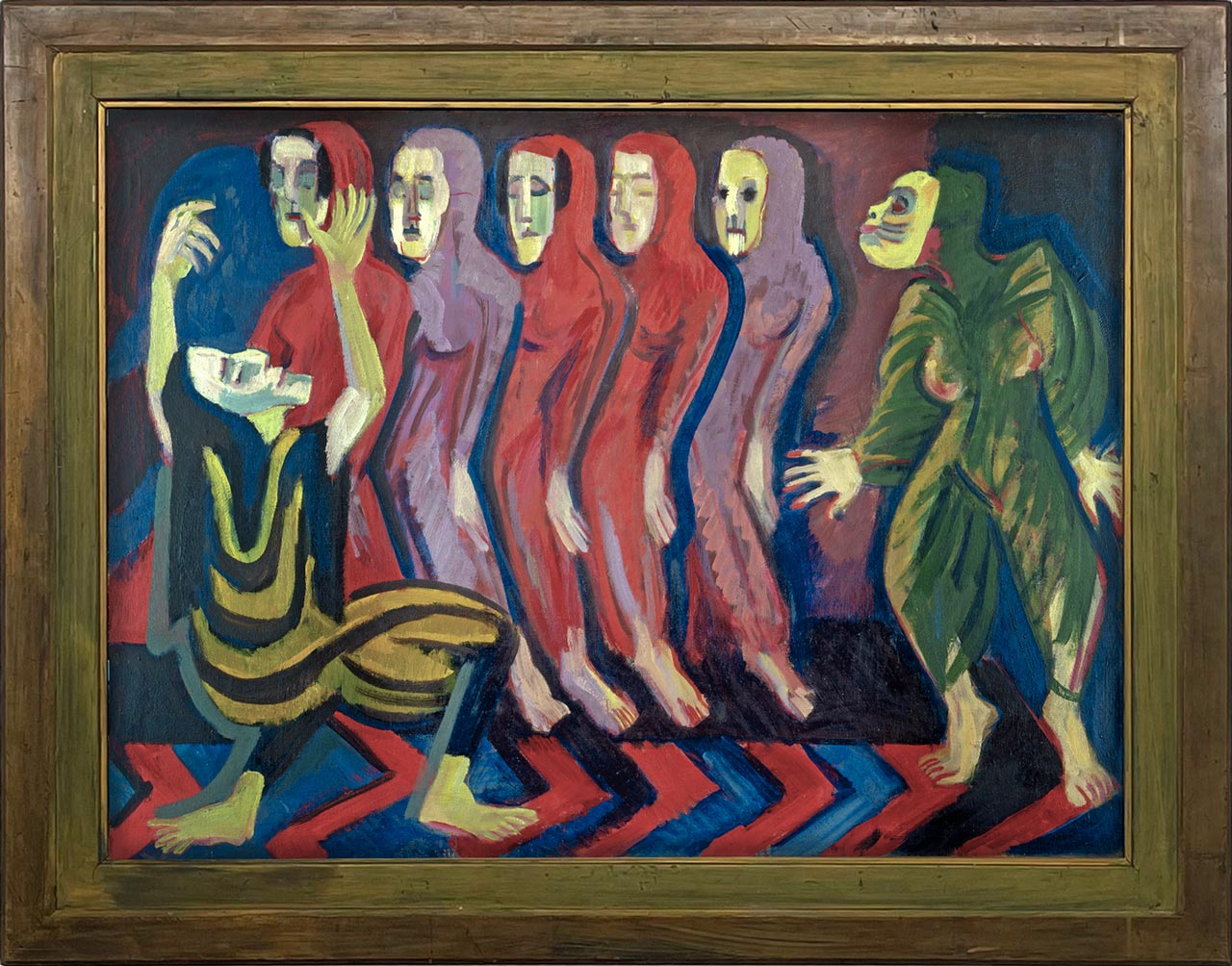
Totentanz
1926/28
Oil in canvas
110 x 149 cm
« Yes, what we suspected has become reality after all. The new art is here. Mary Wigman uses much of the modern imagery unconsciously, and the creation of a modern concept of beauty is as much at work in her dances as in my paintings. »
Theater Osnabrück, Reconstruction (Henrietta Horn, Susan Barnett, Christine Caradec, Katharine Sehnert).
Source: https://www.youtube.com/watch?v=83zYlsxF2FU
Mary Wigman's 'Absolut Dance'
& Ernst Ludwig Kirchner's 'Immediate Expression'
The dancer, choreographer and dance teacher Mary Wigman (1886 - 1973) founded her own school in Dresden in 1920, where she created a new style, the "Absolute Dance". This is a dance without a plot, in which therefore no story is told, in which rather rhythmically mental states are danced, mostly - gloomy - visions, parables and dream stories. As an immediate expression of the human condition up to the liberation itself of music and rhythm, it finally even becomes a pure moving image in space without reference to time.
Already these terms of Mary Wigman's dance art, which can be taken from the dictionaries, show the closeness to Kirchner's ideas, for example "immediate expression" or "pure moving image in space". The first term encompasses practically the entire theory of the "Brücke" artists in their program of 1906, and the second Kirchner's theories on his "New Style," which began in 1925. Therefore, it was hardly surprising that Kirchner, who was a dance, Tingel-Tangel and vaudeville enthusiast, created a large number of drawings during his stay in Dresden in January/February 1926 during Mary Wigman's rehearsals, from which this painting was later created in Davos.
Totentanz by Mary Wigman (1-4)
1926
Black and red chalk on brown paper
37 x 47 cm / each
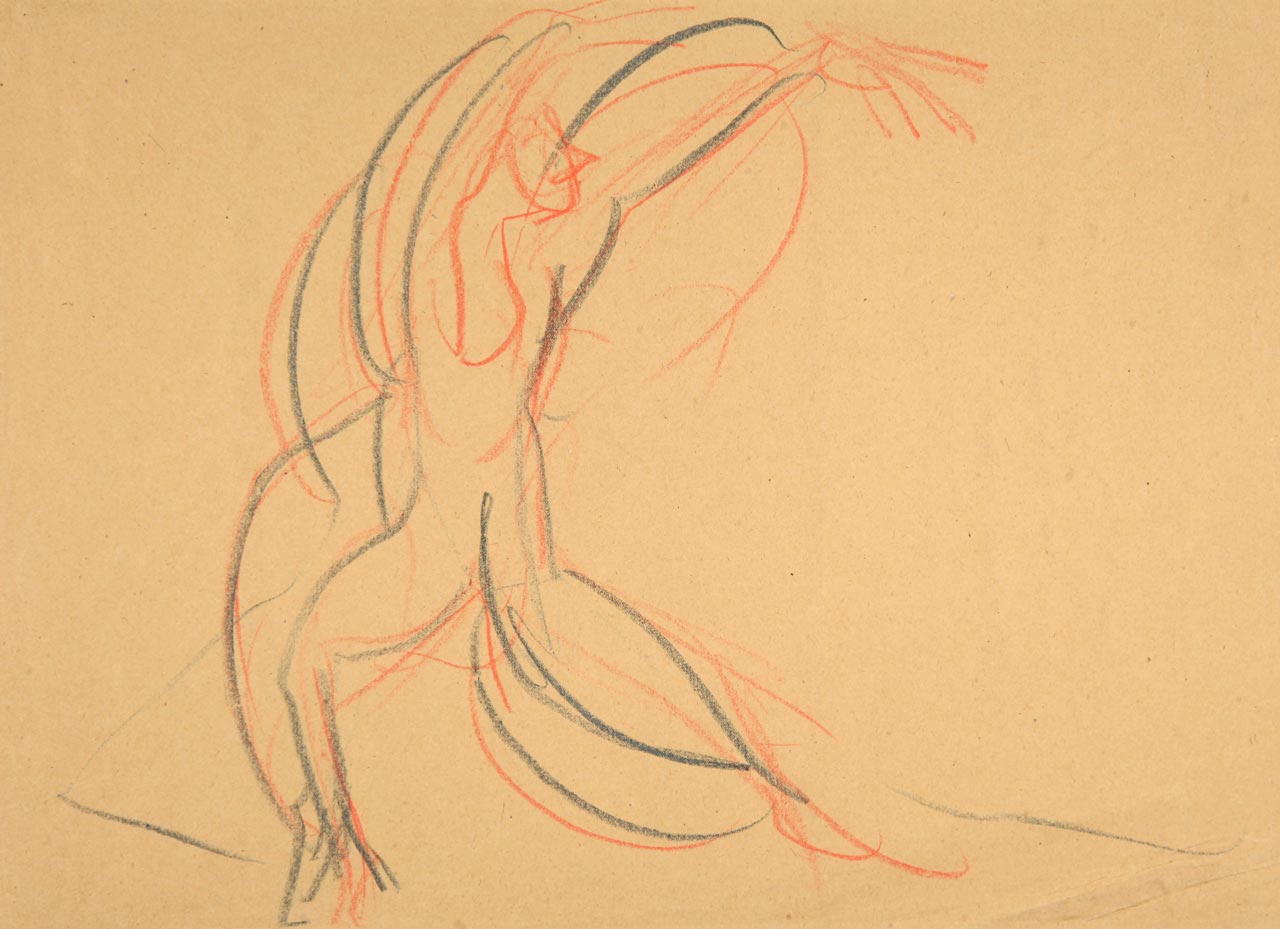
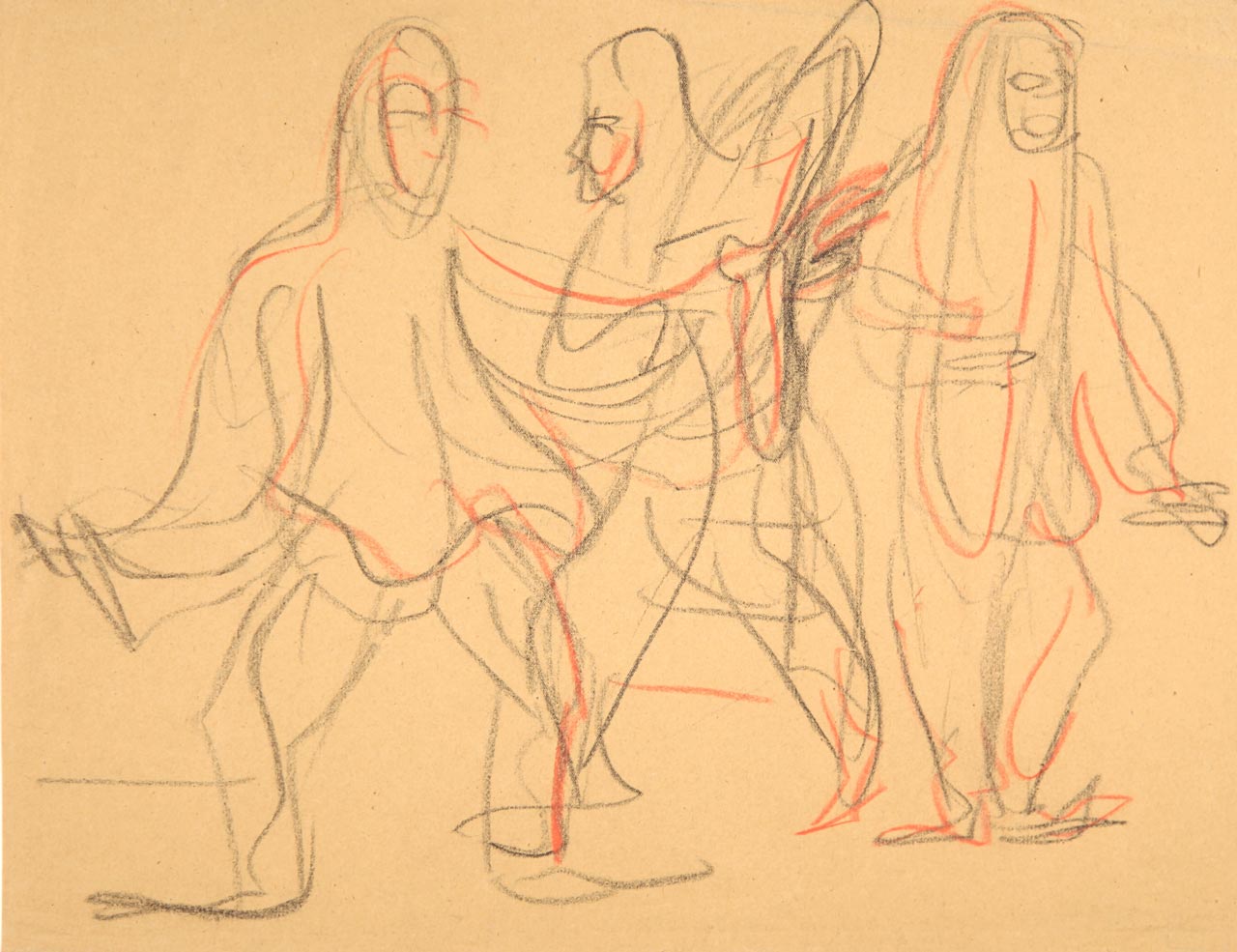
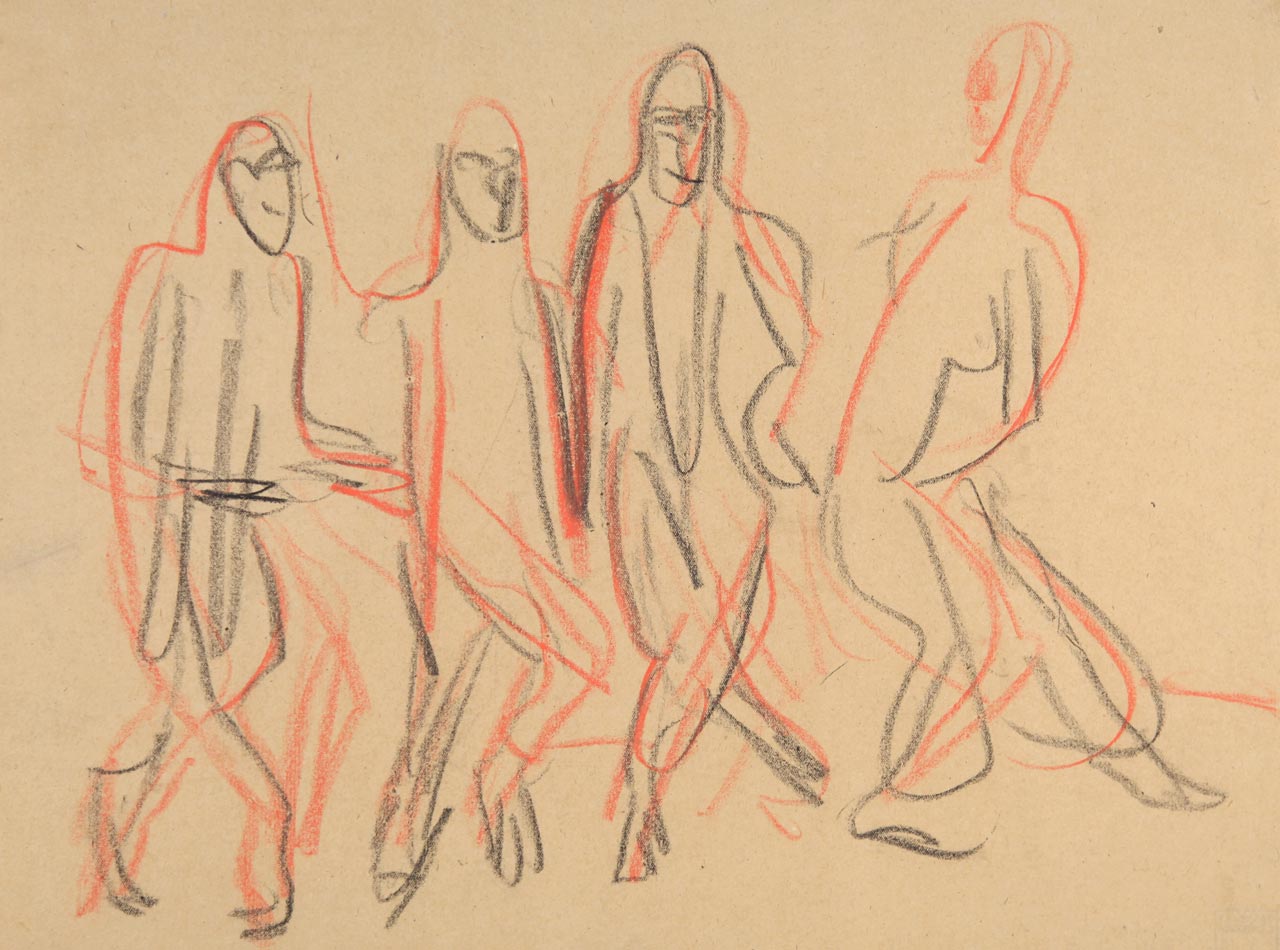
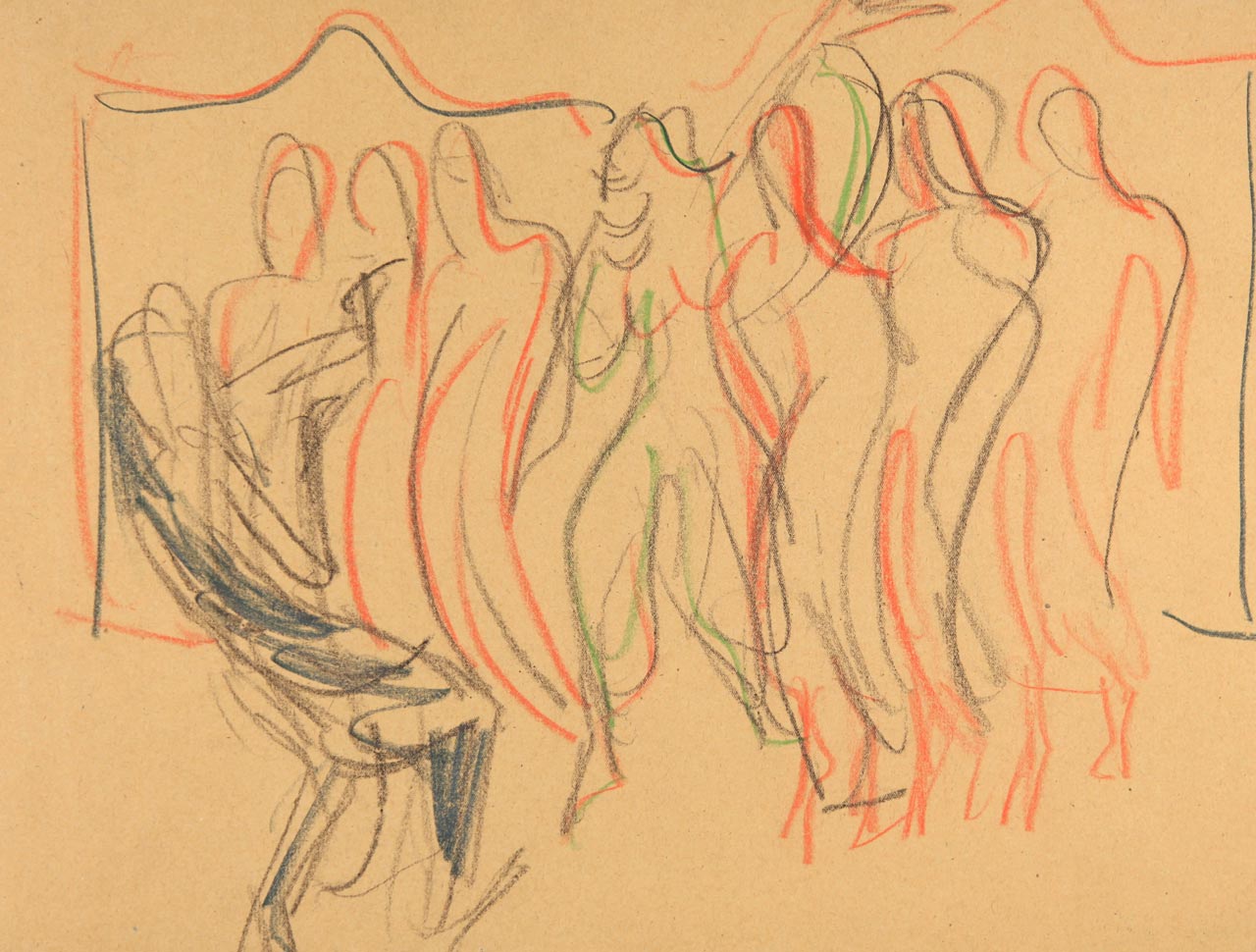
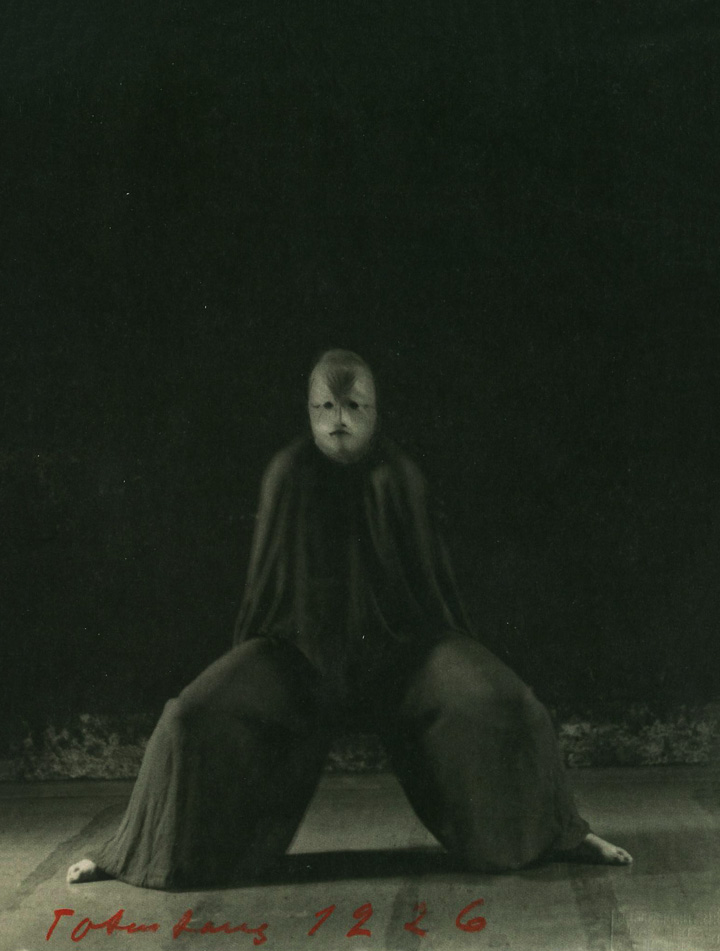
Photography by Ursula Richter, 22 x 16,6 cm
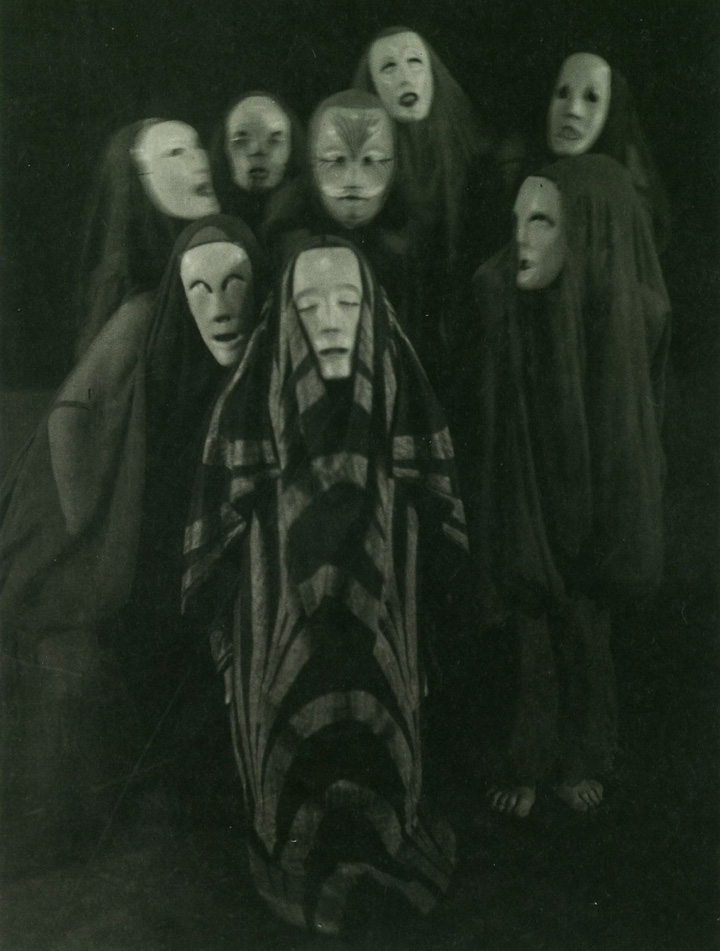
Photography by Ursula Richter, 18,5 x 13,5 cm
1927
The Later "New Style" Announces Itself
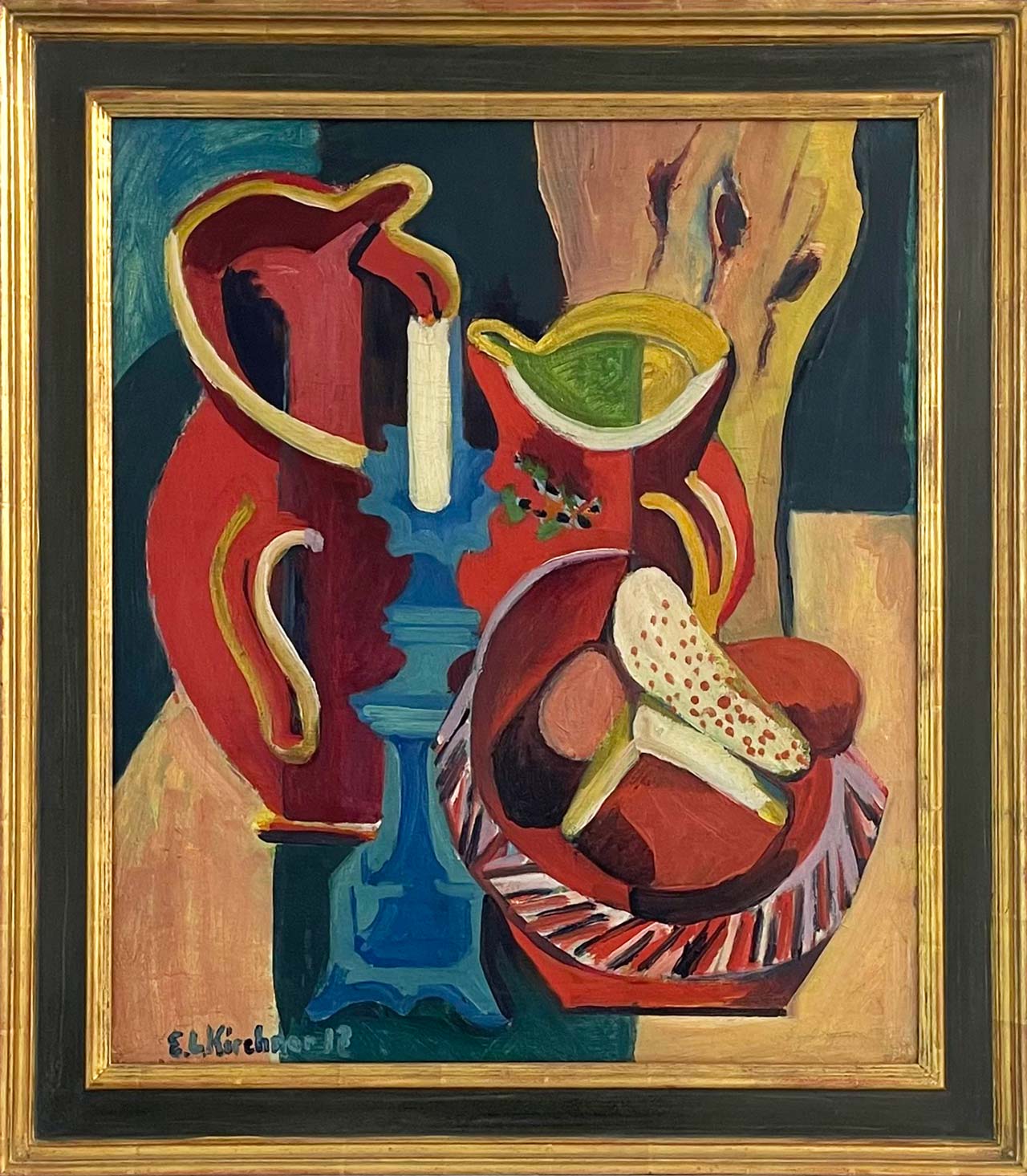
Still Life with Jugs and Candle
1927
Oil in canvas
70 x 60.5 cm
This still life fits seamlessly into the paintings of the year 1927 with its serene forms and curved contours, with its folded changes of perspective and two-dimensional dissonant color fields.
Three vessels of bold red, two pitchers, one filled, and a bowl with some fruit, crowd a blue candlestick with a white candle, on an ochre tabletop in front of a similarly colored wood, perhaps already carved, and a wall corner in various shades of dark blue. The colors are often intermixed with white, including in the brush signature at lower left, which Kirchner made with the lighter blue he used to outline the candlestick.
This is a programmatic work in which the volumes - for that is what the objects of a still life are all about - are projected into the surface. The later "New Style" announces itself.
1930
Ahead of its Time
Kirchner's 'New Style'
at upcoming TEFAF Maastricht 2023
Singer on Piano
1930
Oil in canvas
120 x 150 cm
Ernst Ludwig Kirchner expressed his fear for this painting in a letter written in 1936 to the owner, collector and friend Carl Hageman. Since its creation in 1930, the painting has been the subject of controversy and has been rejected in museum circles because of its "new style".
In an article published in the Frankfurter Zeitung by Count Baudissin, the Nazi successor to Ernst Gosebach at the Museum Folkwang Essen, the author frightens private collectors with his threat to track down the worst degenerations of art "in their private hiding places, to confiscate them, to order their surrender and also to make their prior destruction a punishable offense.
Kirchner's letter and request for the painting to be returned to him contains a remarkable description of the painting and the characteristics of its "New Style".
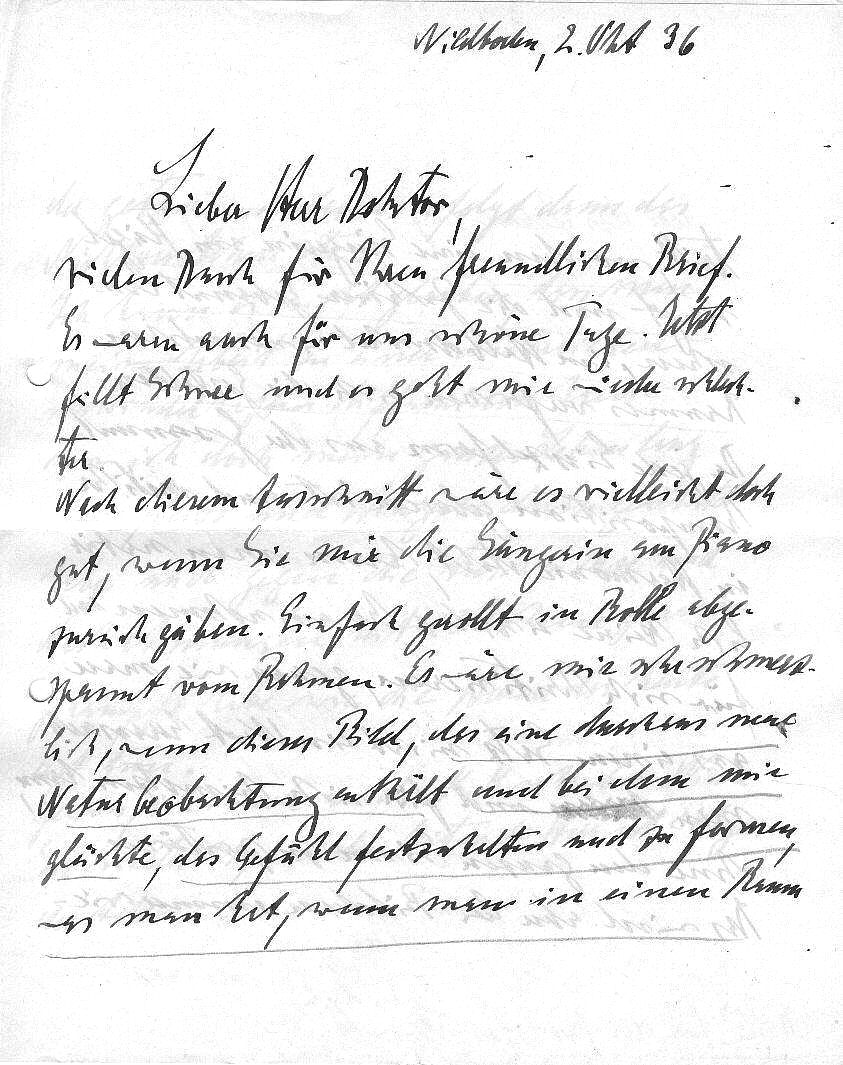
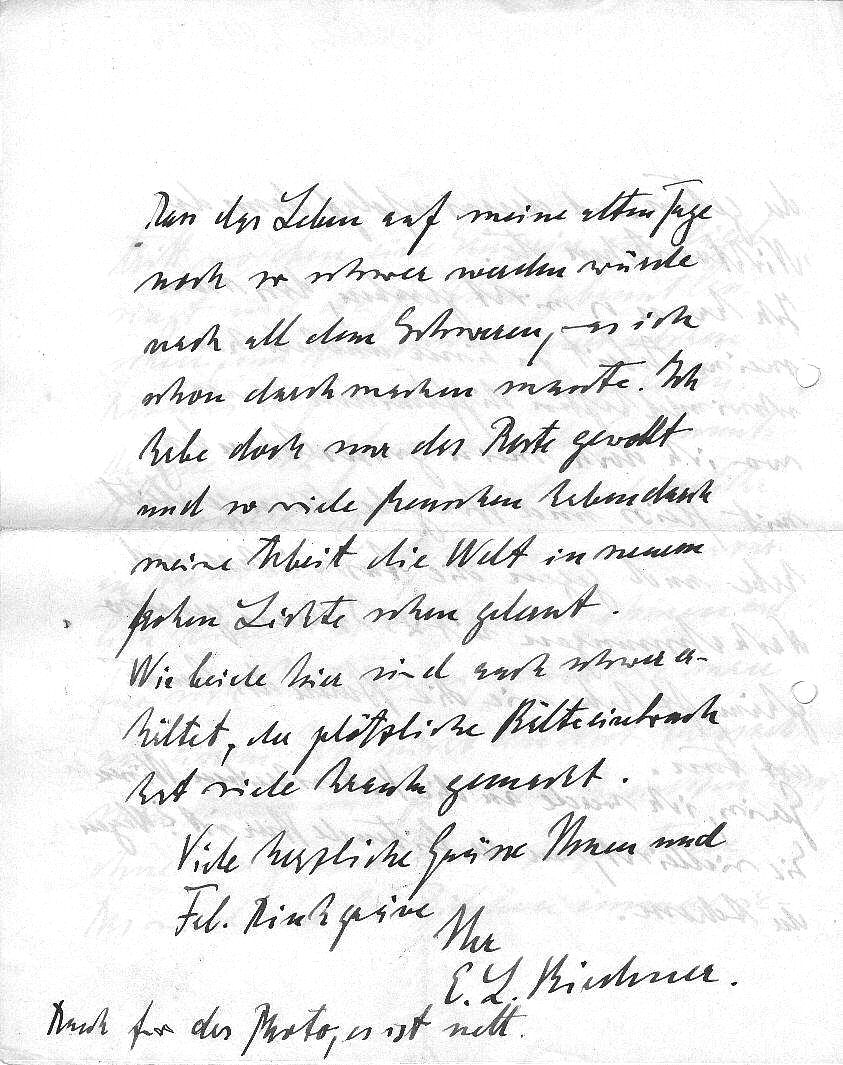
« After this excerpt [article], it might be good after all if you gave me back the "Singer on Piano". Simply rolled in roll unclamped from the frame.
It would be very painful for me if this picture, which contains a thoroughly new observation of nature and in which I succeeded in capturing and forming the feeling that one has when one enters a room where a singer is singing at the piano and the listeners are listening spellbound, in the semi-darkness of such a room the figures deform. Since each individual form is born out of the overall composition and is in harmony with it, one cannot, of course, take out an individual one and criticize it for itself, just as one cannot take out a word from a sentence and put it down for itself without destroying the whole meaning. But this is done again and again with pictures and from this then the non-understanding etc. follows. »
An Analysis from Today's Perspective
by Dr. Wolfgang Henze
The arms reaching out to the left, grasping the keys with their oversized rake-like hands, are in their light old pink the formal and colorful main accent of the composition, as they are visually with every pianist playing sleeveless. Both arms stretch out from the shoulders of the singer, who sings leaning back with her head raised.
Her figure is dissolved into color fields and through them connected with the equally structured figures of the listeners surrounding her in a two-dimensional form and color structure, which could also be an abstract composition of the time. But it is a very precisely seen quite concrete "singer on piano" with four standing and one sitting listeners, in close attention with this connected, yes, by formal and coloristic overlaps almost "connected".
Kirchner not only visualizes the piano playing, the singing and the listening. He even dares to make the tones elicited from the instrument via the keyboard visible in the two columns of parallel hatching rising above it at different heights. Just as he created in form and color not only a fully valid current work of art of the year 1930, but with this already points to the middle of the decade, when Alfred H. Barr in 1936 in his study "Cubism and Abstract Art" could draw a sum of this development, and beyond that even into the years after 1945 up to - for some certainly horribile dictu - the kidney table style. In the same way, he seems to look ahead in these sound columns to such sound visualizing displays in the mixing desks of today's sound studios.
2022
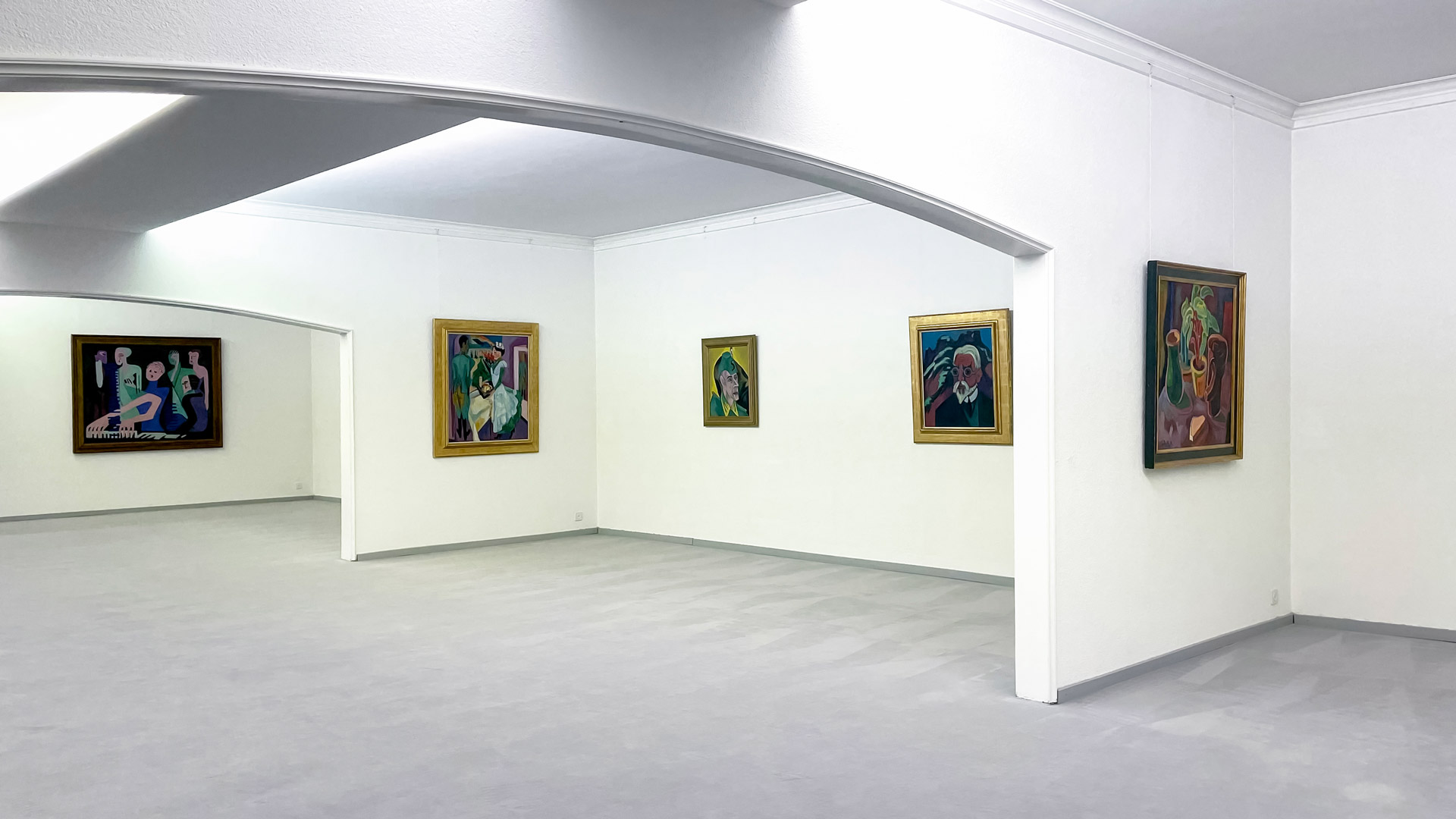
Exhibition Views at Henze & Ketterer
Berne, Switzerland