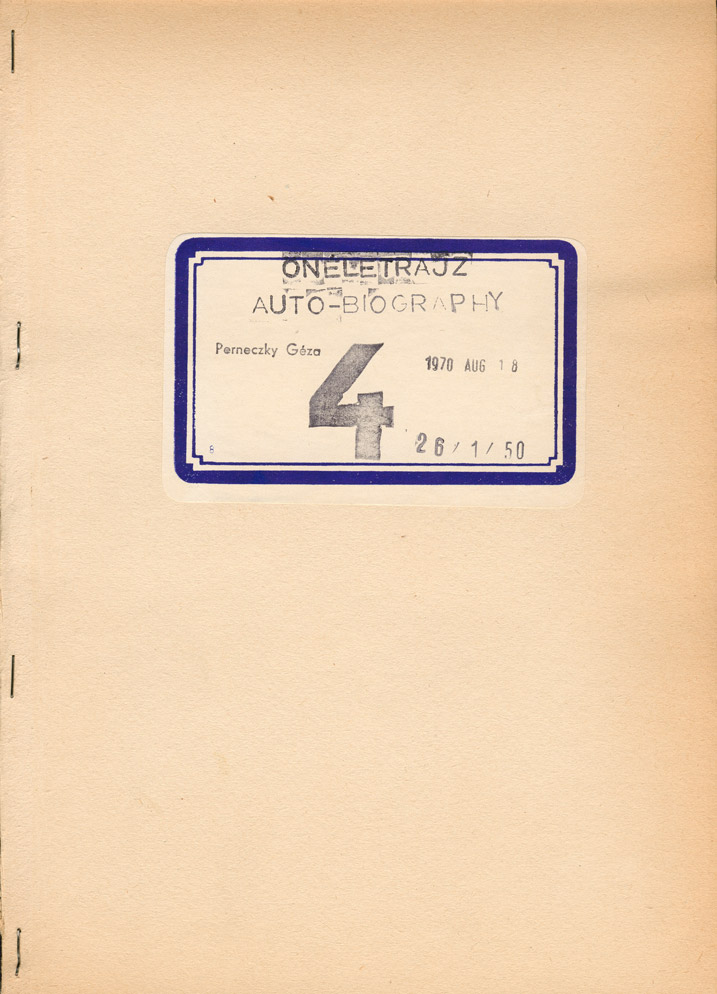
In spite of growing personal and political difficulties, my last year in Hungary remained productive. In addition to the exhibition reviews that I was writing for a literary journal, I was already becoming more and more active in the underground. I also published illegal material such as the Five Books (1970), a series of handmade, staple-bound booklets that I distributed among my friends and acquaintances at exhibition openings. These brightly colored pamphlets contained conceptual works that were not without irony and the occasional underlying political connotation. They were realized in the style of the artists’ books that were to become popular later on; in other words, they were emphatically mixed media and comprised original works and materials.
Navigate through the 5 Books:
5 Books Overview No 1. No 2. No 3. No 4. No 5.
During my first year in Germany, I lived in a former student dormitory that had lapsed into a temporary hostel for occasional transients or younger refugees from the Eastern bloc. Those who frequented it referred to it simply as the Hungarian House (Magyar Ház). In my shared room, I had a bed and half a table, on which I constructed a tiny stage out of squared cards, so that I could set up and photograph small-scale art installations. I used a 35 mm Praktica camera (a GDR brand) that I had brought with me from Hungary. Not far from the Hungarian House, I discovered a youth club. Its basement contained a neglected photo lab, where I was able to develop my photographs and make enlarged prints on paper.
Géza Perneczky, In the Underground Between East and West, in: Promote, Tolerate, Ban: Art and Culture in Cold War Hungary, Getty Publications (edited by Isotta Poggi & Cristina Cuevas-Wolf), 2018, p. 95-110