
Ernst Ludwig Kirchner
Three Naked Young Men
(Drei nackte junge Männer)
1932/36
Oil in canvas
65 x 50 cm
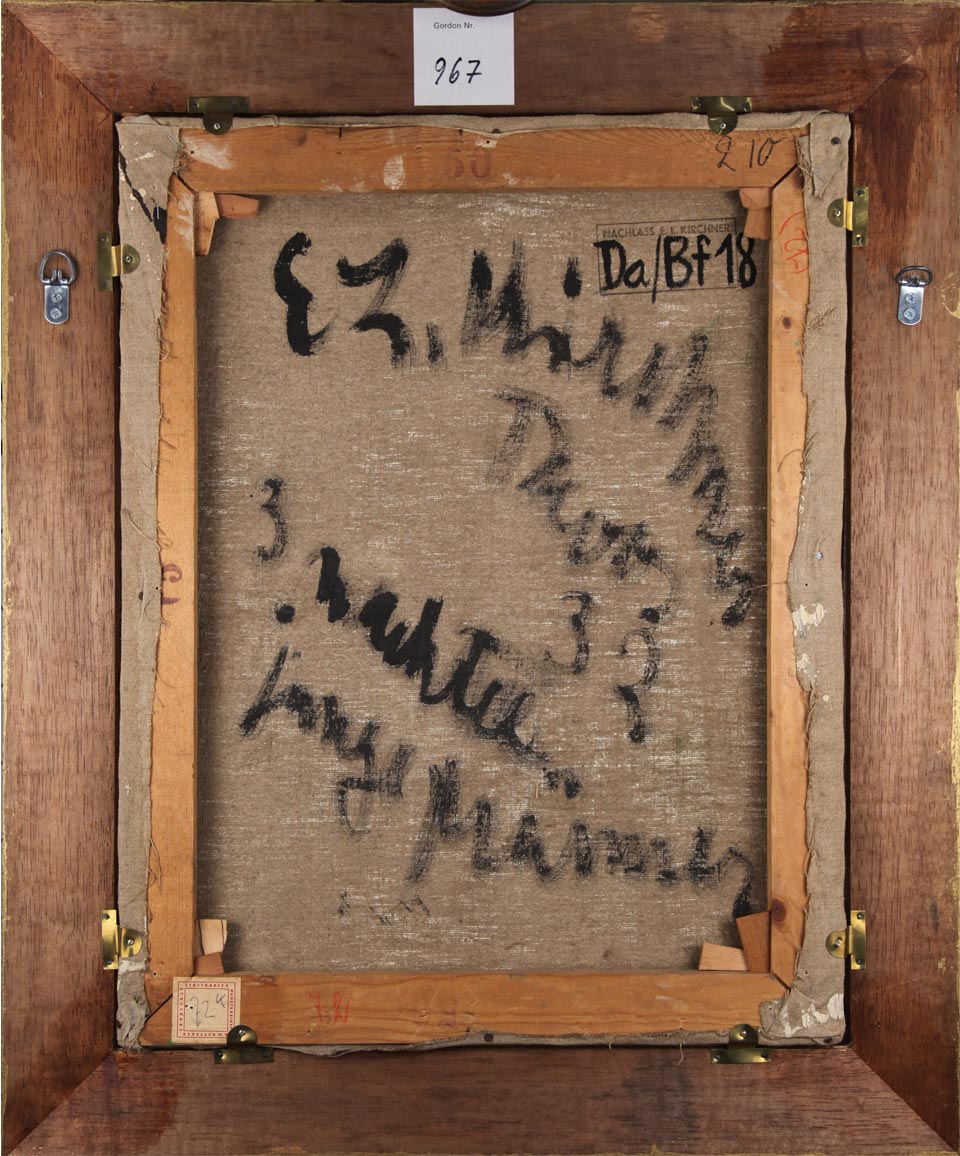
Gordon 0967
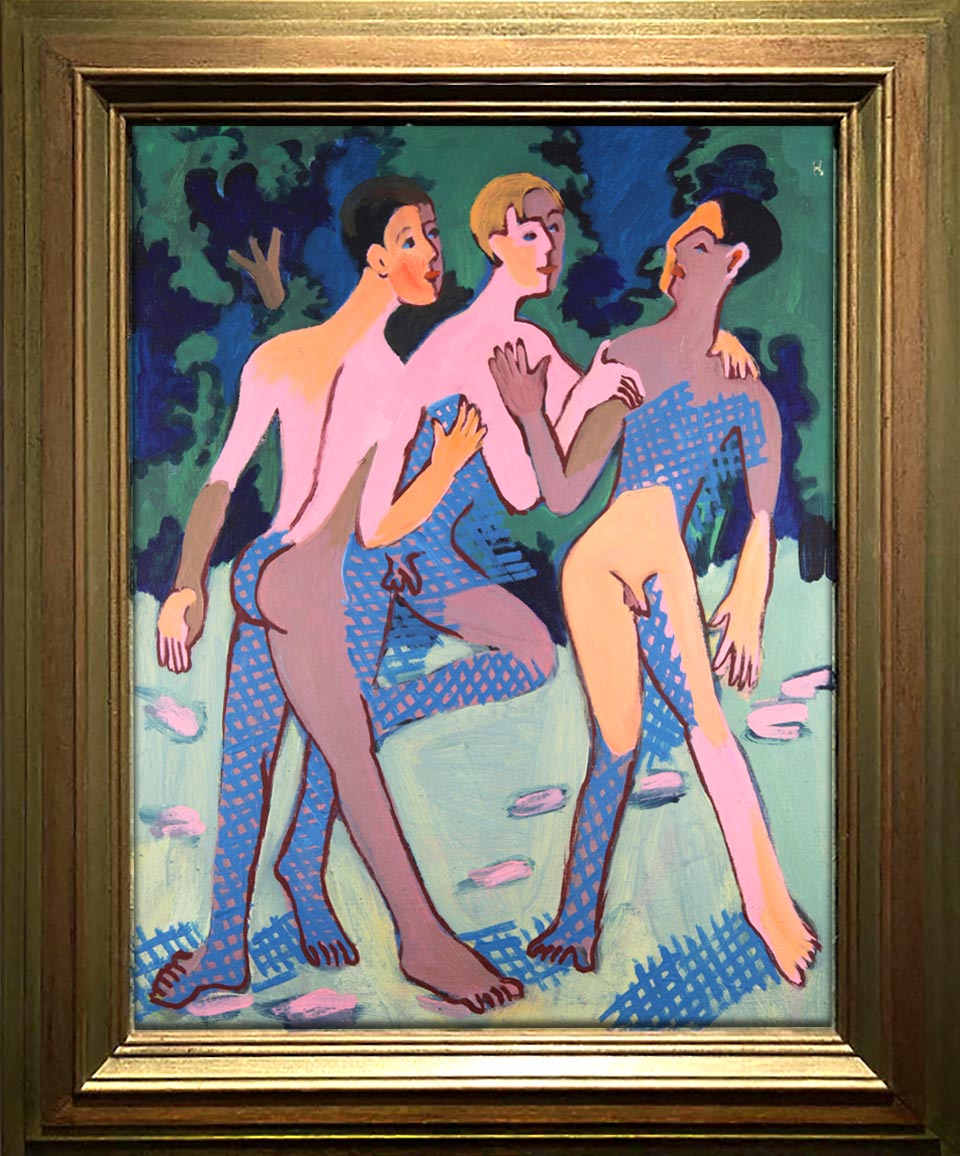
Kirchner's late style, which began in 1925, is characterized by a conscious departure from German Expressionism. Increasing abstraction, but at the same time naturalistic echoes determine the composition of this painting. The figures are no longer three-dimensional, as in his Expressionist phase, but two-dimensional. They also feature the areas of shadow painted in brown tones, characteristic of him in that late period, which are sometimes described as a kind of aura of the persons or as "air shadows." These superimposed color fields form independent planar compositional elements within the painting. The American art historian Donald E. Gordon mentions that the colorfulness of Kirchner's late work is reminiscent of Paul Gauguin.
For Kirchner, the unconstrained movement of the figure played a central role. Thus, even in Davos, he studied women, and in this case men, dancing and moving unclothed in nature. Despite the abstracting, formally strict composition, an almost paradisiacal lightness is reflected in the design of the Young Men of 1932/36. Contour lines and areas of color transition from one figure to another, playfully connecting the three women into a compositional whole. Despite all abstraction, this work also proceeds from the representational and from the immediate view.
Three Naked Young Men
1932/36
Oil in canvas
65 x 50 cm
Gordon 0967