
Ernst Ludwig Kirchner
Artists on Rings (and Trapeze)
(Artisten an Ringen (und Trapez))
1923/28
Oil in canvas
100 x 75 cm
Gordon 0746
1923/28
Oil in canvas
100 x 75 cm (canvas)
Original Kirchner Frame
Gordon 0746
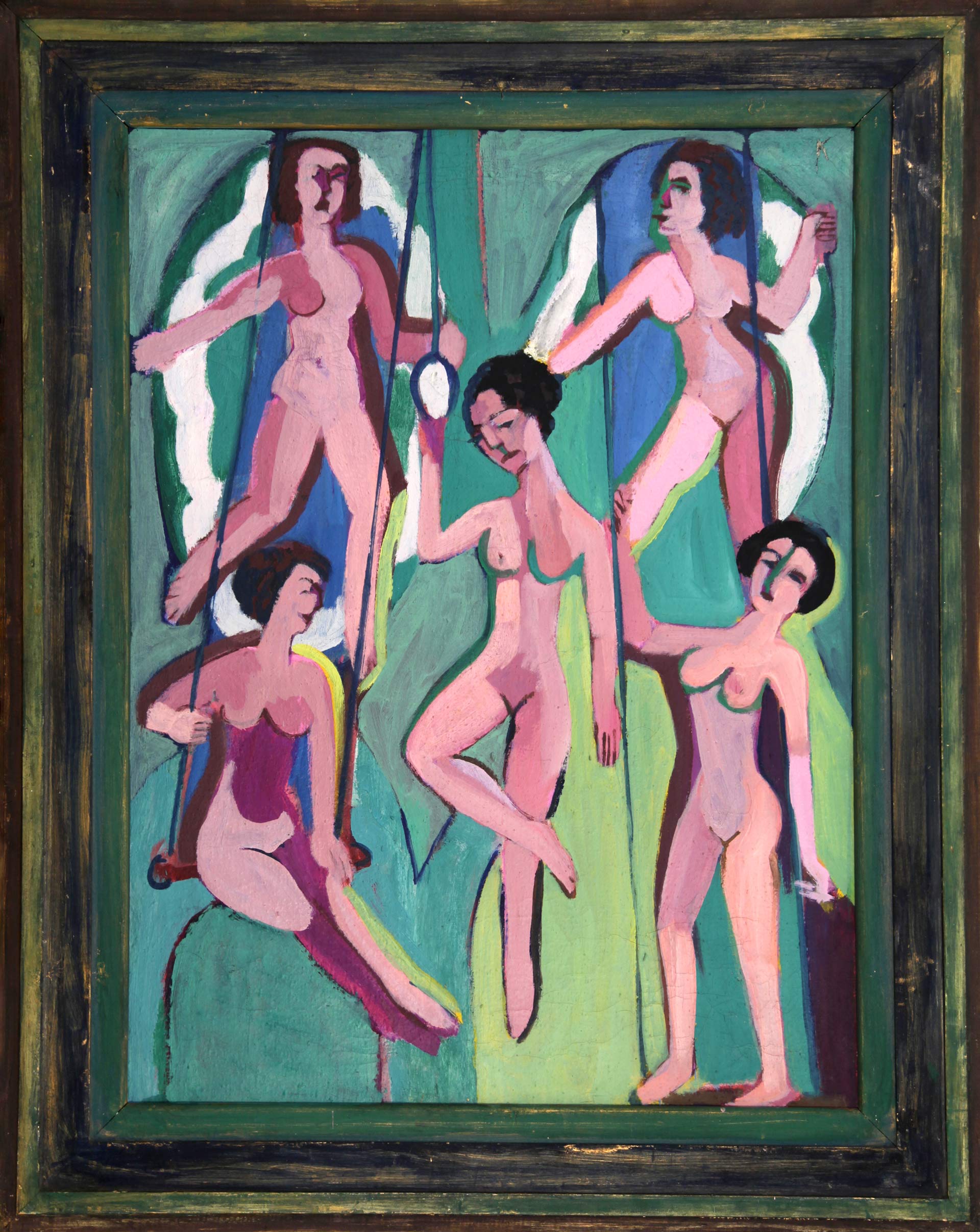
Kirchner's spectacular portrayal of acrobatic stage performers in Artisten an Ringen is an example of German Expressionist painting at its most exuberant. With its vibrant palette and its playful subject-matter, this composition radiates an overwhelming joie de vivre. In 1910 Kirchner was living in Dresden, where he frequented variety shows in local bars, and was compelled to use these performers and their acrobatic acts as one of the major motifs in his paintings and drawings during this period and also during his Berlin years 1911 to 1917. Also after his move to Davos these radiant themes should stay present in his work.
"Artisten an Ringen" exemplifies Kirchner's aesthetic concerns after his involvement with the avant-garde artistic collective Brücke. His primary concern during this period in his career was the representation of the human form in its most primitive or uninhibited state, and this painting essentially defines that aesthetic goal. Following the group's inception in 1905, the painters associated with Die Brücke, including Kirchner, Heckel, Nolde and Schmidt-Rottluff, were proponents of spontaneous, unmediated depictions of the body, divorced from the rigorous constraints of academic painting or the influences of artistic precedents. Kirchner was one of the group's founders, and he published the thesis that very generally defined its objectives. 'With faith in progress and in a new generation of creators and spectators we call together all young,' Kirchner wrote in the original Brücke manifesto, Programm, in 1906. 'As youth, we carry the future and want to create for ourselves freedom of life and of movement against the long established older forces. Everyone who reproduces that which drives him to creation with directness and authenticity belongs to us.'
Kirchner relishes the colour and movement of the cabaret acts, often building his pictures around intense juxtapositions of complementary colours.
The bright palette of Artisten an Ringen, as well as its playful subject-matter, may also reflect the earlier influence of Fauve artists on Kirchner. This painting remained in the artist's own collection throughout his life.
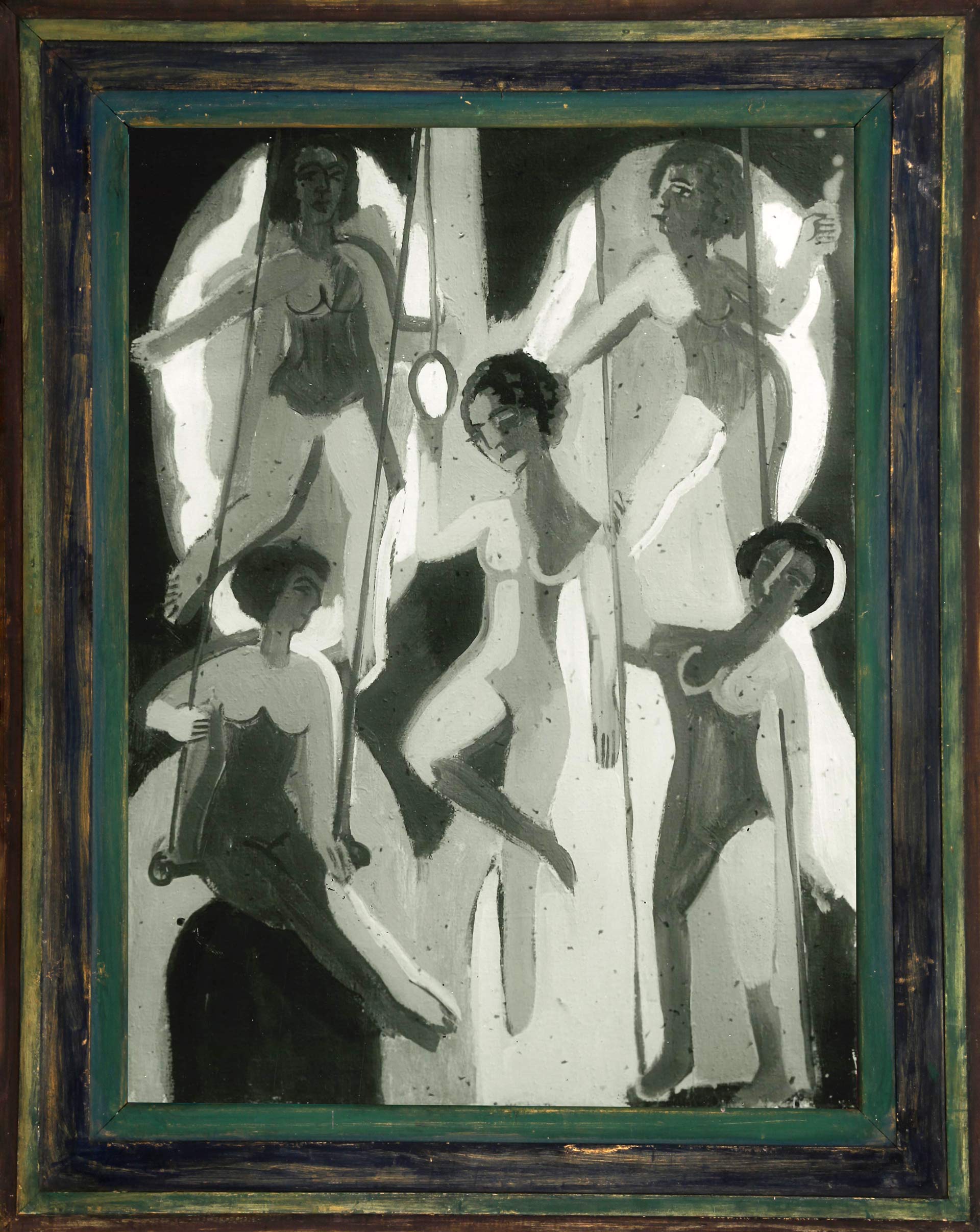
The online presentation of this painting two different states: one state is from 1923 (in balck/white), the other in color from 1928, where Ernst Ludwig Kirchner adapted certain parts of the painting to his "new Style" he started around 1925.
Provenance
Kirchner Estate (Davos 1938, Kunstmuseum Basel 1946, Stuttgarter Kunstkabinett Roman Norbert Ketterer 1954).
Literature
Kirchner, Ernst Ludwig: Photoalbum (Photos ausserhalb der Alben I-IV), dated there with "1923" (img. 746¹).; Gordon, Donald E., Ernst Ludwig Kirchner. With a critiical catalogue of all paintings, München/Cambridge (Massa.), 1968, p. 127, 382, cat.no. 746, img. p. 382.; Rathke, Ewald: E. L. Kirchner - Strassenbilder, Stuttgart, 1969, p. 14.
Artists on Rings (and Trapez)
(Artisten an Ringen (und Trapez))
1923/28
Oil in canvas
100 x 75 cm
Gordon 0746