
Ernst Ludwig Kirchner
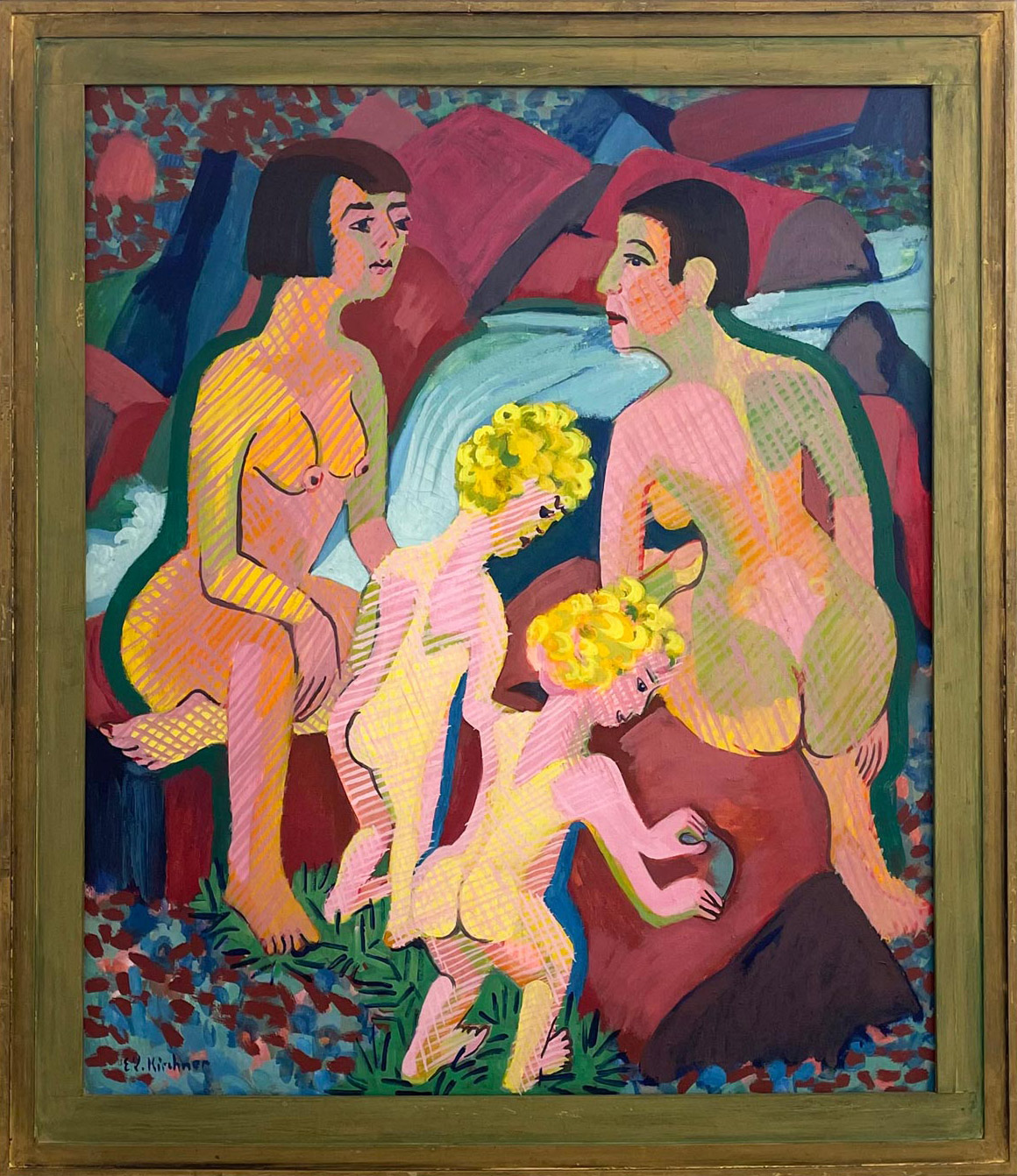
Bathing Women and Children
(Badende Frauen und Kinder)
1925/32
Oil in canvas
130 x 110 cm
Gordon 0825
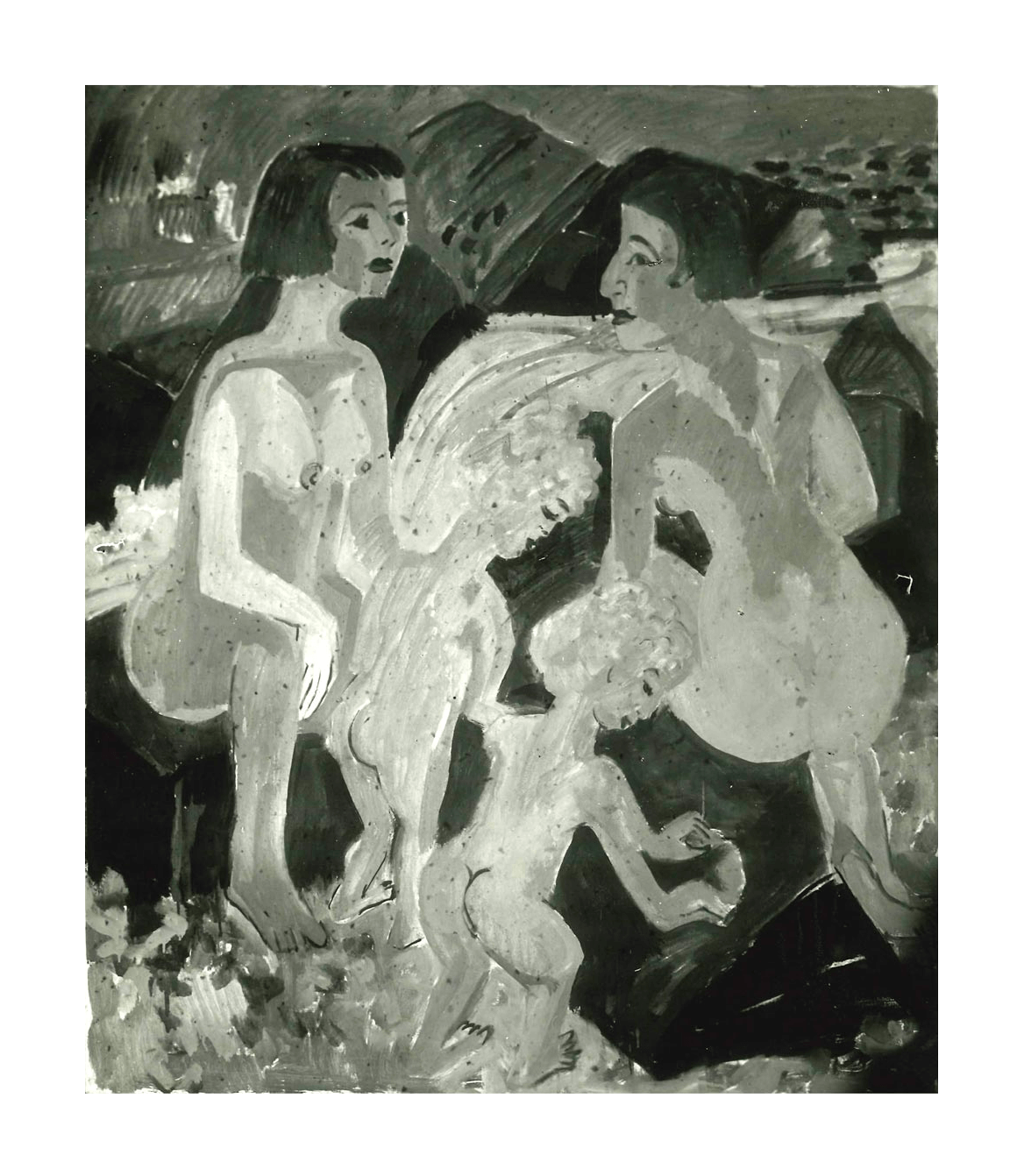
The (black and white) photograph that Kirchner probably took of the painting soon after its completion in 1925 and pasted into his photo album Volume III, which is preserved in the Kirchner Museum Davos, shows the painting still without the overpaintings he made after 1927. These are most obvious in the roughening of the naked bodies.
Kirchner reports on the creation of the painting in letters to Albert Müller and Ernst Gosebruch on October 28 and 29, 1925. In 1926 it was exhibited in the Kirchner exhibition at the Galerie Paul Cassirer in Berlin and shown in its first state in the catalog. In the 1937 exhibition at the Kunsthalle Basel, it was then in its second state, as can be seen from a photograph Kirchner enclosed with a letter to Erwin Friederich Baumann dated November 11, 1937.
It is not clear when Kirchner revised the painting, but this seems to have been done in two stages: First, he made "corrections" to the bodies: The left nude received an undercut left leg. The right one got a left leg bent to the right and a right arm placed down against the right leg. The physiognomies as well as Erna's profile and hair were accentuated. Later, he laid a rhombus framework over the bodies in accordance with his art-theoretical considerations in connection with a looming professorship in Dresden, which he entrusted to his "Davos Diary" in 1927.
About Free Bathing Scene- Kirchner's central theme
After the summer stays at the Moritzburger ponds 1909-11 and the summer stays on the Staberhuk of Fehmarn 1912-14 Kirchner created in the Bachtobeln of Davos from 1921 (visit of thee dancer Nina Hard) a third time South Sea atmosphere on the water.
We are talking about the Sutzibach, which flows from Stafelalp to Frauenkirch. The large stones in the creek bed may have reminded Kirchner of the "beach at the stones" on Fehmarn, where so many bathing scenes were created in the summer months of 1912-1914 and South Sea was suggested by self-made dugout canoes with outriggers, grass huts, and so on.
Free bathing scenes in the studios of Dresden and Berlin, as well as the bathing scenes in nature that followed from 1909, are the central theme of Kirchner's art, constant stimulus of his art. Water plays the unifying central role in them, whether in the tubs of the studios, flat round bathtubs made of wood, or on the Baltic Sea to finally the streams on the alpine ridge of Davos, where in summer it can certainly become south warm.
Bathing Women and Children
(Badende Frauen und Kinder)
1925/32
Oil in canvas
130 x 110 cm
Gordon 0825