
Geriatric Depression Scale Scoring
Learn how to calculate and interpret the score of a fully accomplished Geriatric Depression Scale with this guide!


What is the Geriatric Depression Scale?
Before we discuss the scoring for the Geriatric Depression Scale, let’s briefly discuss the scale itself.
Older adults can develop depression, and it shouldn’t be surprising that it is likely because they’re at the age when they will likely contemplate the life they’ve lived.
Were they able to set out what they wanted to do in life? Did they have to sacrifice their dreams to have a stable life and are now lamenting what could have been? Are they still able to do what makes them happy, or did the wear and tear that comes with age finally take a toll on their bodies?
The Geriatric Depression Scale is a nifty clinical tool used by geriatricians and mental healthcare professionals to assess elderly patients for the level of depression they possibly have.
It comes in two forms: the short form and the long form. The only difference between these two is that the former has fewer questions. The long form has the same questions as the short form, alongside others not asked by the short form.
Whichever version of the you use, you will encounter questions like the following:
- Are you satisfied with your life?
- Do you feel that your life is empty?
- Do you often get bored?
- Do you often feel helpless?
- Do you feel full of energy?
- Do you think that most people are better off than you are?
- Are you afraid that something terrible is going to happen to you?
- Do you prefer to stay home rather than go out and do new things?
- Do you feel you have more problems with memory than most?
- Do you think it is lovely to be alive now?
Printable Geriatric Depression Scale Scoring
Download the Geriatric Depression Scale Scoring to better assess geriatric clients.
How do you score the Geriatric Depression Scales?
Whether you’re using the short-form or long-form version of the Geriatric Depression Scale, how it’s answered remains the same. The person answering it will simply select between YES or NO for their answers. Each answer will score a 0 or a 1. The answer that will score 1 will depend on the question.
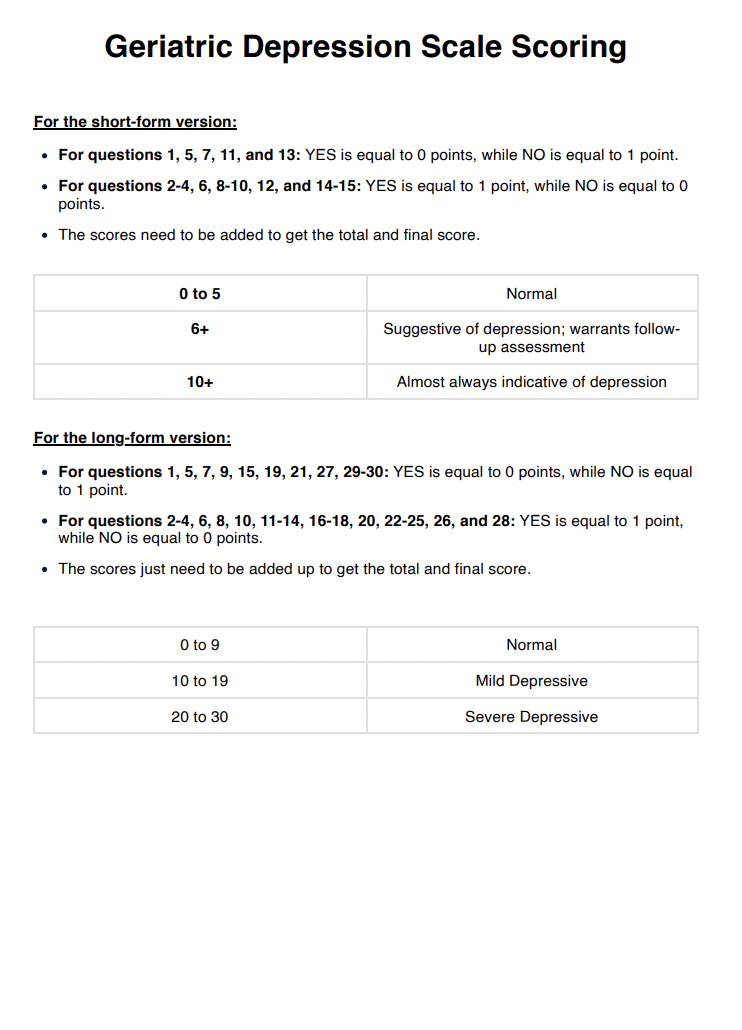
For the short-form version:
- For questions 1, 5, 7, 11, and 13: YES is equal to 0 points, while NO is equal to 1 point.
- For questions 2-4, 6, 8-10, 12, and 14-15: YES is equal to 1 point, while NO is equal to 0 points.
- The scores need to be added to get the total and final score.
For the long-form version:
- For questions 1, 5, 7, 9, 15, 19, 21, 27, 29-30: YES is equal to 0 points, while NO is equal to 1 point.
- For questions 2-4, 6, 8, 10, 11-14, 16-18, 20, 22-25, 26, and 28: YES is equal to 1 point, while NO is equal to 0 points.
- The scores need to be added to get the total and final score.
Both scale versions don’t require particular calculations, making this one of the most straightforward depression scales to score.
How do you interpret the Geriatric Depression Scale Scoring?
As with most depression scales, the Geriatric Depression Scale has score ranges and designations. Please refer to the following ranges and interpretations based on the version of the Geriatric Depression Scale you’re using:
For the short-form version:
A score of…
- 0 to 5 = Normal
- 6+ = Suggestive of depression and warrants a follow-up comprehensive assessment
- 10+ = Almost always indicative of depression
For the long-form version:
A score of…
- 0 to 9 = Normal
- 10 to 19 = Mild Depressive
- 20 to 30 = Severe Depressive
Do note that the Geriatric Depression Scale is not meant to diagnose elderly patients with depression. The scale is a screening tool. You will have to use other depression scales to check for consistency and cross-check all your findings with the criteria for depression indicated in the current edition of The Diagnostic and Statistical Manual of Mental Disorders.
Geriatric Depression Scale Scoring Example:
Now that you know which answers score 0s and 1s when using Geriatric Depression Scales, how the scores are calculated, and how the total scores are interpreted, here is an example of a cheat sheet containing the score calculations and designations:
If you have copies of the Geriatric Depression Scales, but they don’t have scoring sections, you can download our free Geriatric Depression Scale Scoring PDF template! Or, you can download our free PDF templates for the Geriatric Depression Scales! We have the short-form and long-form versions, so feel free to download whichever is best for your practice or if you want to assess yourself.
Download this Geriatric Depression Scale Scoring Example:
What are the benefits of the Geriatric Depression Scale Scoring Template?
This Geriatric Depression Scale Scoring template that we created is helpful because:
- It covers both the short-form and long-form versions of the scale
- It specifically tells you which answers will score a 0 and a 1 for each item for both versions
- It comes with score ranges and designations for both versions to help professionals and non-professionals interpret the scores.
It’s great to have if you have copies of either version of the scale, but your documents don’t specify which answers score a point and how to interpret the final score.
Why use Carepatron as your Mental Health Assessment app?
If you’re a mental healthcare professional reading this, we hope this guide enlightened you about how Geriatric Depression Scales are scored. We also expect our cheat sheet template for the scoring to help you record your findings when assessing your patients.
Now, while we have you here, we’d like to ask you for your time to check more of our platform. We’re pretty confident that our features will convince you that we might be just the number one mental health assessment app for you!
We won’t get into detail about all our features, but we’d like to highlight one related to this guide: our massive resource library. This library houses a collection of resources that cover various healthcare fields and topics, especially mental health.
We have tons of worksheets you can use to get to know your patient better, what’s troubling them, how they grapple with their problems, and how they apply concepts you teach them during therapy sessions.
We also have many mental health assessments, like both versions of the Geriatric Depression Scale. We also have other assessments that gauge depression, like the Center for Epidemiologic Studies Depression Scale (CES-D), Hamilton Depression Rating Scale (HAM-D), Zung Self-rating Depression Scale, and the Kutcher Adolescent Depression Scale (KADS-11), to mention a few.
Our guides for these have details on how they’re scored and interpreted; we also have cheat sheets, just in case you need them!
What’s great about our resource library is that all the PDFs are free, so feel free to download as much as you want and need!

Commonly asked questions

Mental healthcare professionals typically score the scale because they usually issue copies of the Geriatric Depression Scale to patients. If a non-professional gets a copy of it, even if they’re not taking therapy or something similar, they can answer and score the scale themselves. Still, they’re not allowed/supposed to diagnose themselves with depression.
No. The Geriatric Depression Scale is a screening tool, not a diagnostic tool. Mental healthcare professionals must conduct a comprehensive patient assessment and use other scales to check for consistency in possible depression severity and symptoms. Before diagnosing, they must cross-check all their findings with the most recent edition of The Diagnostic and Statistical Manual of Mental Disorders.
The scores can give the mental healthcare professional an idea of how severe a geriatric patient’s possible depression is.

Related Templates
