
8 Phases Of EMDR
Explore the 8 Phases of EMDR, a proven therapeutic approach for PTSD, anxiety, and more. Understand each phase's purpose in the treatment process.


What are the 8 Phases Of EMDR?
Eye Movement Desensitization and Reprocessing (EMDR) is a transformative psychotherapeutic technique developed by Dr. Francine Shapiro in the late 1980s. This evidence-based approach is primarily employed for individuals grappling with traumatic memories or distressing experiences. Central to EMDR therapy are its eight meticulously structured phases, each serving a unique purpose in helping patients navigate through their trauma, process it, and ultimately reduce its psychological impact.
The first phase, 'History Taking,' involves thoroughly exploring the patient's past and identifying potential targets for EMDR processing. The subsequent 'Preparation' phase focuses on establishing trust between the therapist and the patient, explaining the EMDR process, and teaching self-soothing techniques.
The third phase, 'Assessment', sees the therapist aiding the patient in selecting a specific memory for treatment, and identifying associated negative beliefs, emotions, and body sensations. 'Desensitization,' the fourth phase, involves the therapist guiding the patient through eye movements or other bilateral stimulation to reduce emotional distress linked to the targeted memory.
In the 'Installation' phase, the therapist strengthens positive beliefs the patient wishes to associate with the memory, replacing the initial negative ones. Phase six, the 'Body Scan', involves the patient scanning their body for any residual physical sensations linked to the distressing memory.
The seventh phase, 'Closure,' ensures the patient leaves each session feeling better than or as good as at the beginning, using self-soothing techniques if required. Finally, in the 'Reevaluation' phase, the therapist checks to ensure that the positive effects of previous sessions have been maintained and determines the next steps in treatment.
This explainer video offers insightful visuals and explanations for a more comprehensive understanding of these phases.
To learn more about documenting each phase, refer to our 8 Phases Of EMDR resources, which provide clear instructions and valuable resources for healthcare professionals delving into EMDR therapy.
Printable 8 Phases Of EMDR
Download this 8 Phases Of EMDR to conduct effective therapeutic treatment.
How does it work?
Phase 1 - History Taking
The therapist gathers comprehensive information about the patient's history, identifying potential targets for EMDR processing.
Phase 2 - Preparation
The therapist establishes a rapport with the patient, explains the EMDR process, and teaches self-soothing techniques.
Phase 3 - Assessment
The therapist helps the patient select a specific memory for treatment and identifies associated thoughts, emotions, and body sensations.
Phase 4 - Desensitization
The therapist guides the patient through sets of eye movements (or other forms of bilateral stimulation) to reduce the emotional distress linked to the memory.
Phase 5 - Installation
The therapist works to strengthen positive beliefs that the patient would rather have instead of the negative ones initially associated with the memory.
Phase 6 - Body Scan
The therapist asks the patient to scan their body for any residual physical sensations or tension linked to the distressing memory.
Phase 7 - Closure
The therapist ensures that the patient leaves each session feeling better than or as good as at the beginning, using self-soothing techniques if needed.
Phase 8 - Reevaluation
At the beginning of subsequent sessions, the therapist checks to ensure that the positive effects of previous sessions have been maintained and determines the next steps in treatment.
Our printable 8 Phases Of EMDR can be a helpful tool for therapists and patients to track progress throughout this process.
8 Phases Of EMDRs Example (sample)
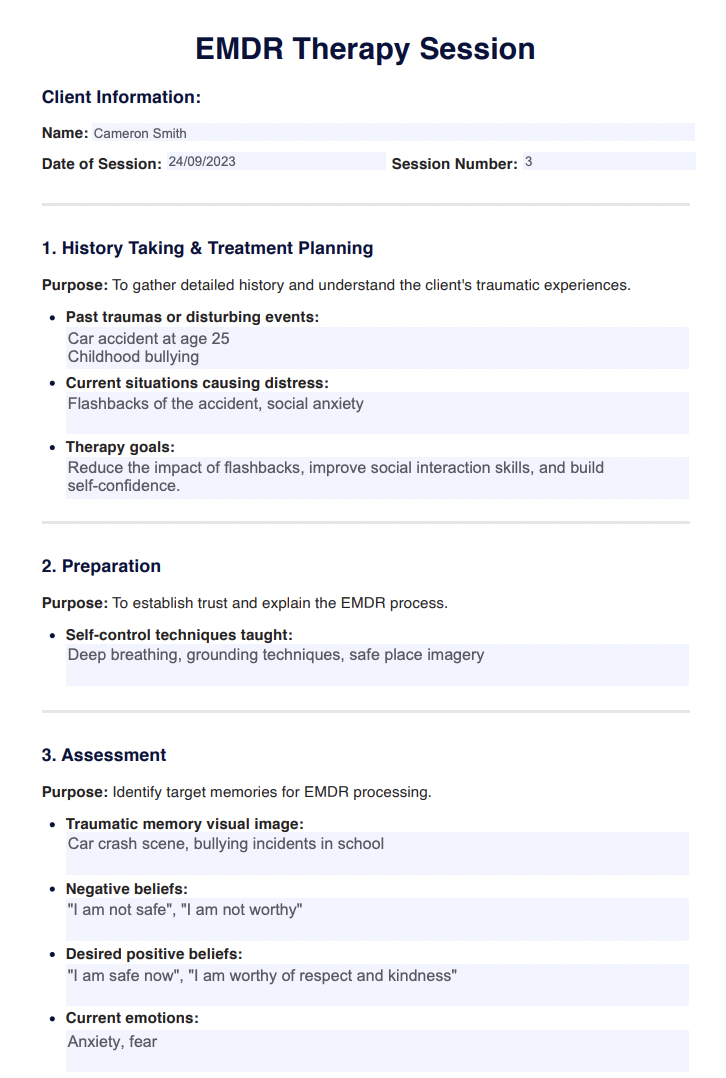
For instance, a patient who has experienced a traumatic car accident may start by discussing the incident and related memories (Phase 1). They would then learn coping mechanisms like deep breathing exercises (Phase 2) before identifying the most distressing part of the memory and associated negative beliefs (Phase 3). The therapist would guide them through eye movements while focusing on the memory, gradually reducing emotional intensity (Phase 4).
They would then work on reinforcing positive beliefs, such as "I am safe now" (Phase 5), before scanning for any remaining physical tension (Phase 6). The session would close with relaxation techniques, ensuring the patient feels calm and safe (Phase 7). In the next session, they would review progress and plan for future treatment (Phase 8). A detailed example is provided in this 8 Phases Of EMDR PDF.
Download this 8 Phases Of EMDR Example:
When Would you use this Form?
The 8 Phases of EMDR form is a valuable tool practitioners can strategically utilize in various therapeutic scenarios. Originating from Eye Movement Desensitization and Reprocessing (EMDR) therapy, this form is most commonly employed when treating patients grappling with Post-Traumatic Stress Disorder (PTSD). PTSD often manifests as a result of traumatic events such as accidents, abuse, or disasters, leading to distressing symptoms like flashbacks, nightmares, and severe anxiety. The structured approach of the 8 Phases of EMDR provides a practical roadmap for therapists to guide these patients through their trauma, helping them process and reduce the psychological impact of their experiences.
However, the use of this form isn't restricted solely to PTSD cases. Over time, research has shown that EMDR therapy – and, by extension, the 8 Phases of EMDR form – is also effective in treating other mental health conditions, including anxiety disorders, depression, and phobias. By carefully navigating through the eight phases, therapists can help patients confront and reprocess distressing memories associated with their condition, fostering a sense of control and reducing symptoms.
The 8 Phases of EMDR form serve multiple functions, making it a versatile tool in any therapist's arsenal. It guides therapy sessions, providing a structured approach to EMDR and ensuring that all necessary steps are followed. The form also aids in tracking treatment progress, allowing therapists and patients to monitor improvements over time. Furthermore, it facilitates clear and effective communication between the patient and therapist, enhancing mutual understanding and cooperation throughout the therapy process.
Ultimately, the 8 Phases of EMDR form is an invaluable resource for practitioners applying EMDR therapy. Whether it's used to treat PTSD, anxiety, depression, or phobias, this form can provide structure, promote progress tracking, and enhance patient-therapist communication, contributing to a more effective and efficient therapeutic process.
Benefits
Comprehensive Treatment
The 8 Phases provide a structured approach to addressing traumatic memories, ensuring all aspects are covered.
Enhanced Patient Understanding
The form helps patients understand the process and progress of their therapy.
Facilitated Communication
It is a communication tool between the therapist and patient, enhancing mutual understanding.
Progress Tracking
Therapists can easily track the patient's progress throughout the therapy.
You can access our Free 8 Phases Of EMDR form on our platform.
Research & Evidence
Since its inception in the late 1980s, Eye Movement Desensitization and Reprocessing (EMDR) therapy has been the subject of extensive research, with empirical evidence backing its effectiveness. The unique eight-phase approach to treatment, integral to EMDR, has been empirically validated through numerous studies and extensive clinical practice.
The American Psychiatric Association (APA), an authoritative body renowned for its stringent scientific standards, recognizes EMDR as an effective treatment for Post-Traumatic Stress Disorder (PTSD). The APA's endorsement is based on many studies demonstrating EMDR's efficacy in treating PTSD across diverse patient populations, ranging from combat veterans to victims of sexual assault (American Psychiatric Association, 2004).
Internationally, the World Health Organization (WHO) also endorses EMDR as a frontline treatment for children, adolescents, and adults who have PTSD. The WHO's endorsement, similar to the APA's, is driven by a robust body of research showcasing EMDR's ability to alleviate the debilitating symptoms of PTSD (World Health Organization, 2013).
Moreover, several meta-analyses – studies that aggregate findings from multiple individual studies – have confirmed the effectiveness of EMDR. For instance, a meta-analysis by Chen et al. (2015) found EMDR to be equally effective as cognitive behavioral therapy (CBT), a widely accepted treatment for PTSD.
The 8 Phases of EMDR form is backed by a wealth of empirical evidence, reinforcing its value in treating PTSD and other trauma-related conditions. This research, coupled with global recognition from prestigious health organizations, underscores the critical role EMDR plays in modern psychotherapy.
Commonly asked questions

Typically, trained EMDR therapists use the 8 Phases of EMDR in their practice.
They are used during EMDR therapy sessions to guide treatment and track progress.
Each phase represents a step in the EMDR process, from history taking to reevaluation. The therapist guides the patient through these steps to help them process traumatic memories and reduce their psychological impact.
Why use Carepatron as your 8 Phases Of EMDR app?
In mental health therapy, Eye Movement Desensitization and Reprocessing (EMDR) is a powerful tool. The structured approach of the 8 Phases of EMDR has proven effective in treating conditions like PTSD, anxiety, depression, and phobias. However, managing the process can be complex, requiring careful tracking and documentation. This is where Carepatron comes into play.
Carepatron offers a user-friendly, secure platform specifically designed for administering and tracking the 8 Phases of EMDR. It simplifies practice management by providing therapists with intuitive tools that streamline patient care and data management. Unlike other platforms, Carepatron requires no training, allowing healthcare professionals to focus their time and energy on what truly matters - their patients.
One of the key features of Carepatron as an 8 Phases of EMDR Software is its globally compliant security measures. Meeting worldwide security requirements such as HIPAA, GDPR, and HITRUST, Carepatron ensures your work remains safe and secure. This robust security framework gives therapists peace of mind, knowing their patient data is protected to the highest standards.
Moreover, Carepatron fosters collaboration, facilitating seamless sharing across your team, professional network, and clients. This feature enhances communication, ensuring everyone involved in a patient's care is on the same page, fostering a more comprehensive and effective treatment approach.
Lastly, Carepatron is a trusted name worldwide, supporting a global community of users. It delivers a beautiful, efficient experience daily, making it the ideal choice for therapists seeking an efficient, secure, and collaborative platform for administering the 8 Phases of EMDR.
Choosing Carepatron as your go-to 8 Phases of EMDR Software offers numerous benefits. From its user-friendly interface and robust security measures to its collaboration features and global recognition, Carepatron provides a comprehensive solution for EMDR therapists. Try Carepatron today.

References
- American Psychiatric Association. (2004). Practice guideline for the treatment of patients with acute stress disorder and posttraumatic stress disorder. American Journal of Psychiatry, 161(11 Suppl), 3-31.
- Chen, Y. R., Hung, K. W., Tsai, J. C., Chu, H., Chung, M. H., Chen, S. R., ... & Chou, K. R. (2014). Efficacy of eye-movement desensitization and reprocessing for patients with posttraumatic-stress disorder: a meta-analysis of randomized controlled trials. PloS one, 9(8), e103676.
- World Health Organization. (2013). Guidelines for the management of conditions specifically related to stress. Geneva, WHO.
.jpg)
Related Templates
