
SOAP notes are an effective format for capturing and recording clinical notes regularly used by Speech therapists and other healthcare practitioners.
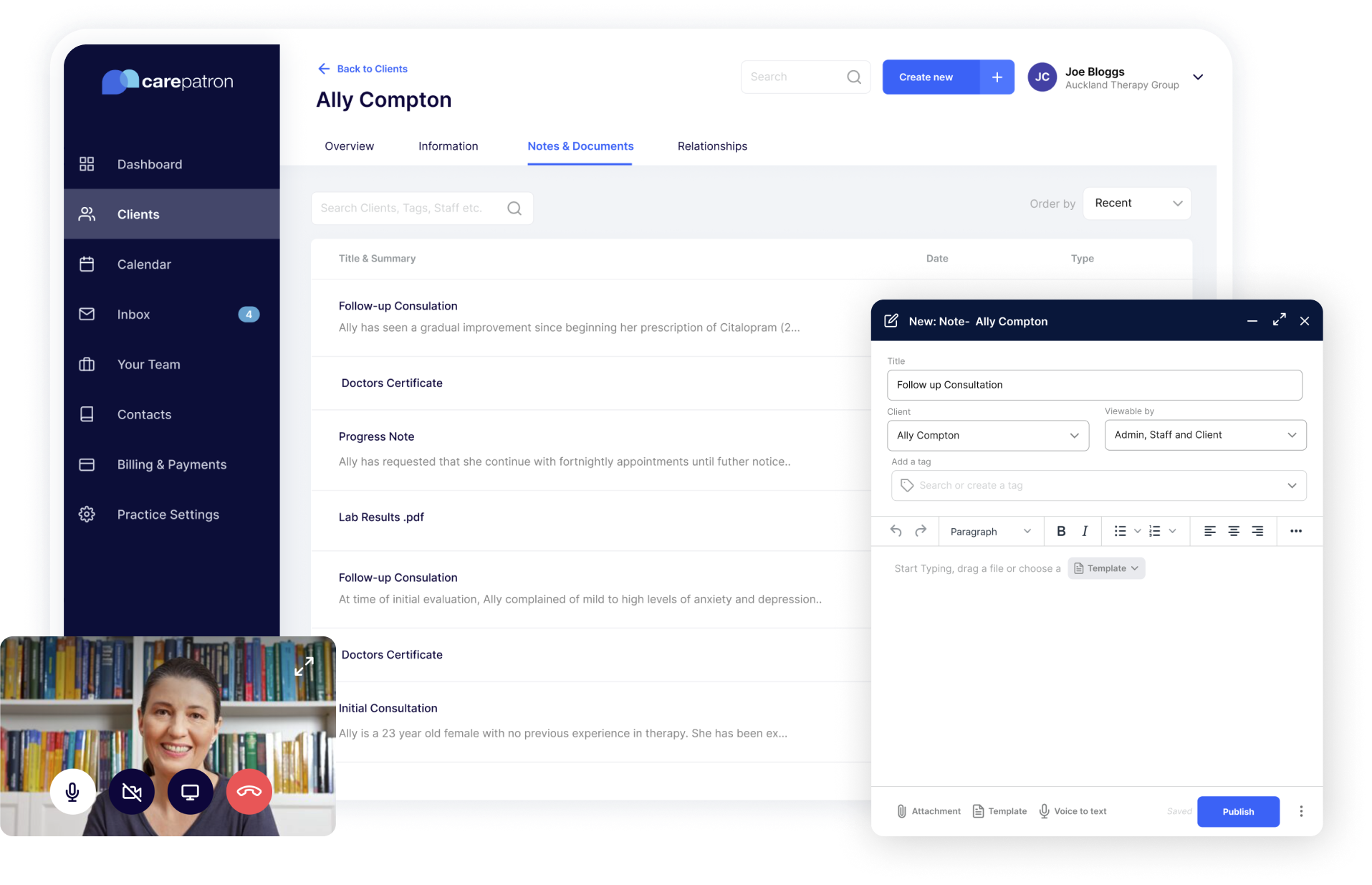

Take control of your schedule and calendar from your desktop or mobile app. Use automated appointment reminders and our fully integrated video calling tool to maximize your productivity.

Take control of your schedule and calendar from your desktop or mobile app. Use automated appointment reminders and our fully integrated video calling tool to maximize your productivity.

Carepatron online or mobile payments make it easier for your clients to pay for your bills. You save time a massive amount of time while getting paid twice as fast. What a great way to improve your day and cashflow!

As every speech therapist should know, SOAP notes are one of the most important aspects when it comes to managing your client's information and recording their progress. They provide an overall general picture that aids in further treatment for future appointments and can help report on everything covered within your speech sessions. They usually cover four essential domains, including the following:
This section outlines the client’s state from their perspective. Using the client’s point of view, you can evaluate information such as their behavior, medical status, and current state of mind. Keep in mind that this is relatively brief, and all information recorded is supported with quotes.
The objective section contains all the factual information pertaining to your client. This means that all data should be able to be easily verifiable by other speech-language practitioners, and concerns numbers, percentages, and scores. Anything that can be measured scientifically or medically should be recorded, as well as whether their goals are being met.
This is a synthesis of the previous two sections, and outlines specifically whether the client has made any progress in regard to their goal, and if not, what barriers are preventing them from doing so. It’s always a good idea to compare performance from previous sessions and make a note of how the client is responding to their exercises.
In the final section, it’s important that you outline the future course of action for the client. This means identifying the next steps they should take, why these are recommended, and if there are any changes that should be made. One of your final notes should be a set date and time for you to meet with them again if necessary.
If you’re familiar with any healthcare discipline, you may know what SOAP notes are. However, you may not realize how exactly they work within speech language therapy clinics. In the context of speech therapy, SOAP notes are essential for speech therapists to demonstrate their credibility, and record all relevant information involving the client. It’s a way of standardizing notes and ensuring that you are implementing appropriate intervention techniques that work to aid progress in the client’s condition. Especially considering the fact that SOAP notes can be used during legal proceedings (in the case that you are sued for malpractice), it’s of utmost importance that you have noted it as a clear paper trail. You can demonstrate your line of thinking, justify the exercises and interventions given to your clients, and showcase your expertise. It’s essential protection, which is why many clinics incorporate teletherapy to elevate the credibility of their notes. Additionally, recordkeeping also works to provide more accurate insurance. Clinical documentation serves as sufficient evidence for medical necessities and can ensure that you are reimbursed appropriately; which is essential for the growth of your practice.


While every SOAP note can look a little different depending on your practice’s needs and resources, as well as CPT codes, it’s important that you’re aware of the essential components that can elevate the quality of your documents. These enable you to cover all essential details to capture the client's condition while maintaining and upholding high-quality documents.
Remember that length requirements can vary depending on the client, the state of their condition, as well as according to what formats and abbreviations you choose to use. This can become tricky rather fast, so it is recommended that you have a standardized template that you can customize. This allows you to maintain consistency across clients, which is always welcome.
It’s important that you manage your time well, as creating notes for each client can add up rather quickly. You want to ensure that you are able to be present for each client’s session, whilst also jotting down all critical details efficiently to avoid wasting time. As a result, each SOAP note document should be no more than 1-2 pages long, and each section should be 1-2 paragraphs in total.
Always keep the purpose of a SOAP note in mind when drafting one. We acknowledge that this can be difficult to do, especially with the number of documents you’re likely to make. It can become very easy to lose sight of the goal, and focus on your primary objective. While you may have your own goals, I’m sure you can agree that the main purpose is to provide practitioners, therapists, and relevant external bodies with the client’s present progress.
To help you become better acquainted with SOAP notes, we’ve provided a couple of examples that follow our assessment guide for speech language therapy. Using these progress note examples can help you improve speech therapy outcomes, and produce high-quality documents.
Subjective: Sarah attended a session with me following circle time. Sarah came to me excited and happy, with a stuffed animal in her hand. She was smiling and seemed very content.
Objective: This session focused on the generalization of voiceless back ‘k’ in word positions with carrier phrases. ‘K’ words included catch, kluck, cat, cabin, keep, etc. 75% (18/24) of the time, Sarah produced an accurate k sound when given an appropriate throat tap clue. As a result, 25% (6/24) times, Sarah produced k sounds without cues. The k-word was targeted in other exercises, where Sarah produced k efficiently from model and gestural cues.
Assessment: Repetition and gestural cues helped Sarah accurately record k sounds, and as she was strongly encouraged with the context provided in scenarios with her stuffed animal. She could maintain new understanding and learning concerning her back tongue placement after a model was given in structured activities. Carrier phrases enabled greater comprehension and speech production.
Plan: We will continue with Sarah’s initial plan as identified in the previous session. A list of k words will be emailed to her mother to be in use at home, in addition to carrier phrases. Visual cues will be introduced, and Sarah will be seen next Wednesday to continue with progress.
Subjective: John was alert and positive when I met with him in my session today. John had an improved appetite as he “ate more than last week.” John had good, positive energy.
Objective: John currently is still eating a puree diet, which mainly consists of thin liquids. Today, we focused on how to eat safely, and what swallowing exercises can be done to promote better eating mechanisms. We used 20x repetitions of swallowing exercises, with minimal modeling cues, to increase airway protection and tongue base retraction. Using CTAR exercises, John also conducted minced and moist solid trials and could swallow without intensive aspiration.
Assessment: John improved gradually, with increasing accuracy across his exercises. He could swallow with little assistance and could tolerate more advanced textures beyond the puree while safely swallowing. John still displays mild oropharyngeal dysphagia and would benefit from further treatment.
Plan: Continue therapy as usual. John will also complete a customized Home Exercise Program, 3x daily, with the next session being next Friday.

Speech-language therapy SOAP notes not only keep your practice legally compliant, but also ensure that you are able to fully capture and represent your client’s current state and progress. You can effectively record all essential information, without wasting time, and synthesize treatment plans and interventions that treat clients' speech and voice difficulties. You can hit all your KPIs, grow in your knowledge, and increase your clinical outcomes.
Further reading:


%20small.jpg)