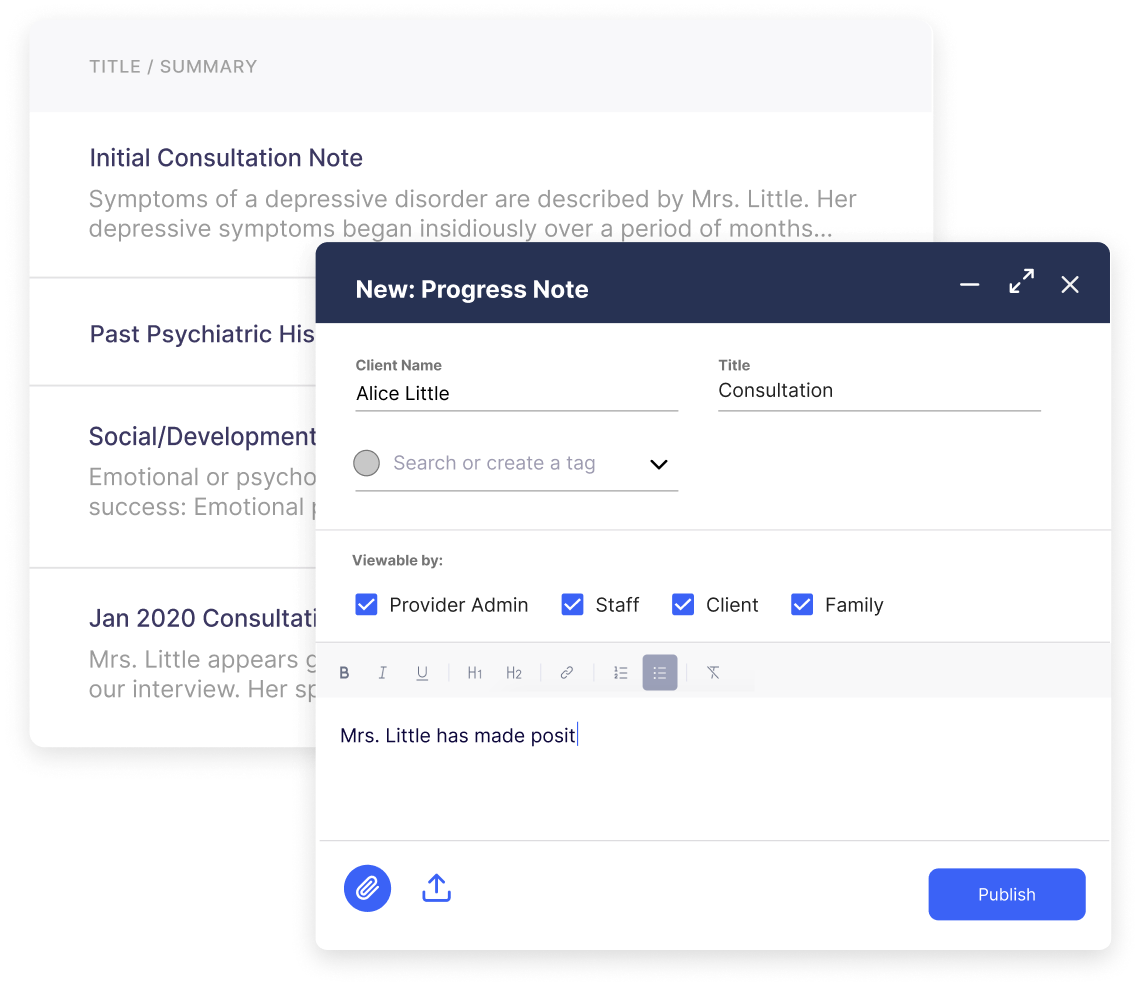
SOAP notes are a form of progress notes that allow Occupational Therapists to document interactions with their clients. It enables a clear and concise way to quickly capture information to understand other healthcare professionals and teams.

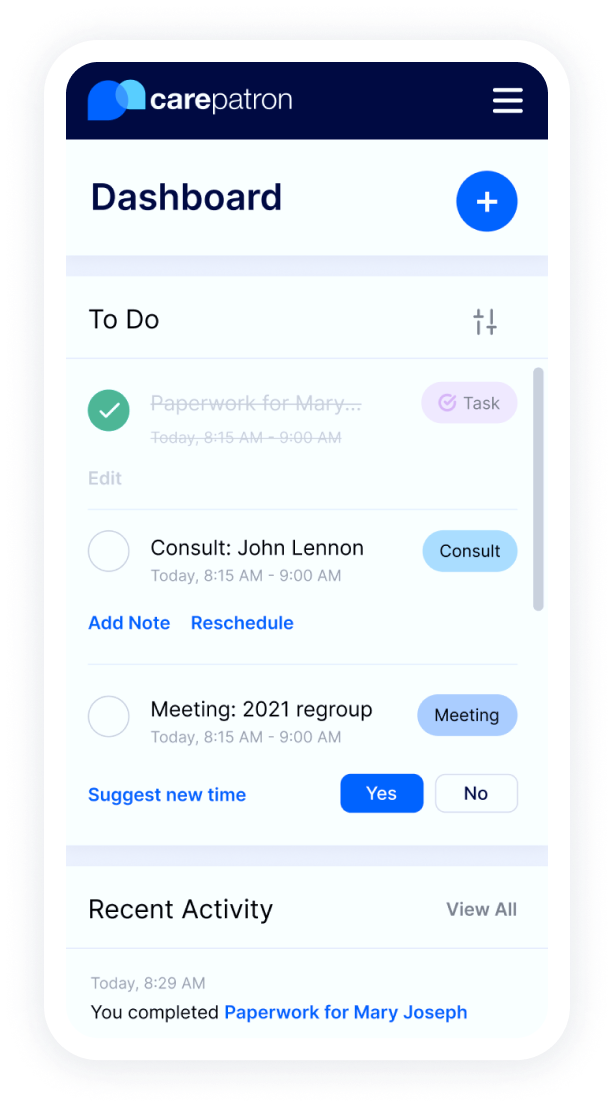
Take control of your schedule and calendar from your desktop or mobile app. Use automated appointment reminders and our fully integrated video calling tool to maximize your productivity.

Store all your patient information, clinical notes, and documentation safely in your secure clinic system. We autosave, so you'll never lose work again.

Carepatron online or mobile payments make it easier for your clients to pay for your bills. You save time a massive amount of time while getting paid twice as fast. What a great way to improve your day and cashflow!

SOAP notes are a form of progress notes that allow practitioners to document each interaction with their respective clients. It allows for a clear and concise way for information to be viewed and in an accessible format that other healthcare professionals and teams can quickly come to understand. SOAP notes provide an excellent overview of a patient’s health issues and represent the state of their health in an easy way to interpret. Because of their versatile nature, which is also applicable to any healthcare specialty, especially occupational therapy, makes a great way to organize clinical documents.
Not only this, but SOAP notes are a legal requirement for healthcare business practices if a regulatory, policy, or law issue were to arise. SOAP notes hold healthcare practices accountable for their actions and attribute responsibility to specific individuals who compose each note. They allow for transparency in the clinical process of observation, diagnosis, treatment plans, and ensuring that practices maintain a high standard of care. Thousands of healthcare professionals use SOAP notes. With platforms such as Carepatron providing a place to support clinical notes for powerful healthcare practices, they are the best method to use.
There are various ways that SOAP notes can be implemented within the area of occupational therapy. The best way is to use the SOAP method and adapt it to the context of OT.
SOAP notes for occupational therapy can differ from practice to practice depending on specific goals. However, there are four main components for occupational therapy SOAP notes that you should be including, which are:
Touching on these components will ensure that your progress notes touch on all critical aspects required to paint a good picture of occupational therapy patients. Being concise with detail, especially for exercises, will elevate the quality of your notes with greater clarity in information.


There are various approaches to writing SOAP notes for occupational therapy. However, there are essential factors you need to consider.
There are multiple aspects that you should DO to write a practical SOAP note:
It is important to note there are also DON’Ts, which are features you should carefully avoid:
To help guide you in this process, we have created a pediatric SOAP note example within the area of occupational therapy so you can understand what to expect.
Subjective
Lisa states she has been having “ some knee pain,” rating it a “4/10” following her knee replacement one month ago. She states she has decreased radiating symptoms in her knee and has been taking ibuprofen to manage it. She says, “I can now manage stairs somewhat well, though it could be better.”
Objective
Lisa has been having improvements in her pain and mobility with the following exercises of partial squats (3x10), standing hip EXT with yellow theraband (3x10 reps), hamstring stretch in standing step (3x40 sec), and standing up to 8” surface x 20 reps.
Assessment
Lisa displayed solid improvements in her knee mobility following exercises she has been regularly doing and improvements, which are shown today. Because stairs remain somewhat tricky for her, and single-leg stability is 7 seconds, she would benefit from stabilization exercises to improve balance.
Plan
It is best to continue her exercises, increasing each one with an additional set of reps. This would solidify her progress, and in regards to her stability, she has been provided with stabilization exercises to start with. If mobility does not improve next week, this will be reconsidered.
SOAP notes are a great documentation method for occupational therapy and provide a concise way to support practitioners’ development of patient treatment plans. As a takeaway, there are some things you should remember before integrating SOAP notes into your practice.
Firstly, you need to know that writing observations as they come, from the subjective section to the plan section, should flow naturally. OT SOAP notes do not need to be separated, and doing this will allow for logical understanding from other clinicians. Other healthcare professionals must be able to interpret your notes, and while they don’t need to be understood by the public, you should be using universal abbreviations if required. You should also use enough detail for other healthcare professionals to replicate your exercises if desired, and your documentation needs to demonstrate a sense of medical necessity. This means that the need for treatment of the patient should be able to clearly show in your notes, so healthcare professionals know your client requires OT.
If this is overwhelming, many platforms, such as Carepatron, provide therapy software for healthcare practices to make this process easier. Carepatron supports occupational therapists by supplying free SOAP note templates and examples to help you develop effective treatment plans, and guide you through the clinical documentation process. In no time, you’ll be able to integrate SOAP notes into your clinical practice at ease and work towards providing patients with the highest standard of care.
Regardless of what you choose, we hope that your knowledge of SOAP notes has been consolidated through learning their importance. They are an immensely useful tool, and harnessing them in the right way will certainly drive success for your practice.
Further reading: