SOAP notes are a form of the progress note that outlines patient symptoms through a subjective and objective lens and allows for a treatment plan to be established. Healthcare professionals widely use and recognize them and are the perfect way to document communication between practitioners and clients.

Take control of your schedule and calendar from your desktop or mobile app. Use automated appointment reminders and our fully integrated video calling tool to maximize your productivity.

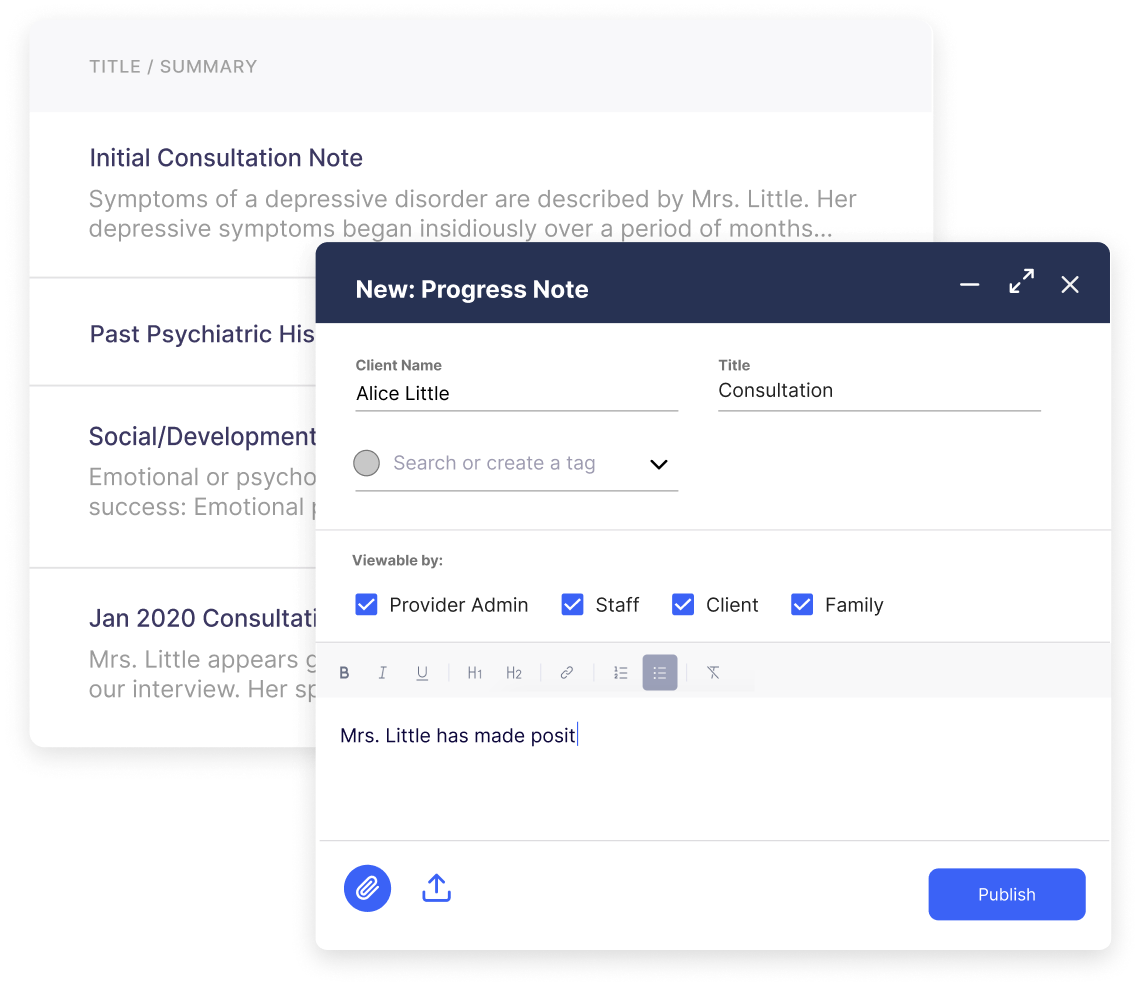
Store all your patient information, clinical notes, and documentation safely in your secure clinic system. We autosave, so you'll never lose work again.

Carepatron online or mobile payments make it easier for your clients to pay for your bills. You save time a massive amount of time while getting paid twice as fast. What a great way to improve your day and cashflow!

SOAP notes are a form of the progress note that outlines patient symptoms through a subjective and objective lens and allows for a treatment plan to be established. Healthcare professionals widely use and recognize them and are the perfect way to document communication between practitioners and clients. Not only this, but they are also a legal requirement for counseling practices. While the notes may differ for each course, the content is virtually the same in focusing on four main components.
Clinical notes can be made easy with platforms, such as Carepatron, providing templates and formats to adapt to your practice seamlessly. However, to solidify and consolidate your understanding, we have provided some examples of how to write efficient SOAP notes for counseling.
While this can differ across practices, there are vital components that you need to include to ensure your SOAP notes are efficient and able to be understood by any healthcare professional.
SOAP notes are an absolute necessity for counseling, and while somewhat tedious, they prove worthwhile in being able to trace all communication points between the client and therapist. They allow for other therapists and healthcare teams to understand the scope of a patient’s mental health at a glance and also serve as a valid reference point for information. After all, therapists deal with many patients, and it can be challenging to record all information in an organizational format. SOAP notes are a perfect way to keep track of data and safeguard data with the proper preservation method.
While counseling SOAP notes are also legally required in the case of insurance, regulatory, or law issue, they are also beneficial for therapists in documenting patient health for future sessions. For instance, a therapist may be dealing with over 30 patients with various issues ranging from depression to substance abuse disorders. Mixing up information, or omitting important details, can very quickly result in ineffective and potentially harmful treatment sessions for the patient. SOAP notes minimize this risk and prioritize patient needs.


SOAP notes for counseling still maintain the above SOAP format. However, it is applied within the counseling context.
Subjective (S) - Includes information relevant to the client’s experience of symptoms, as well as their feelings through verbatim quotes. May include information from third parties to support the patient’s perception.
E.g., Ella states she has been feeling down, saying, “I feel sad and sleep throughout the day, honestly for no reason,” She expresses how this concerns her, “I remember when I used to love taking my dog out for walks, now I just feel nothing.”
Objective (O) - Contains factual medical evidence, such as vital signs, x-rays, and assessments. For counseling, this may be using scales, assessing sleeping and eating patterns, journal entry documents, blood pressure, etc.
E.g., Because Ella has been feeling low, I have conducted a Kessler-10 Depression Scale to highlight high items indicating depressive symptoms. Her sleeping tracker also shows she is sleeping more often than usual.
Assessment (A) - States conclusions from both subjective and objective sections to note progress and work towards a treatment plan.
E.g., Ella has shown depressive symptoms and no progress towards improving or alleviating these. She has no family history of depression.
Plan (P) - Works towards a course of action for the patient that targets future goals.
E.g., Ella and I have discussed techniques to combat her lack of motivation and scheduled further sessions, with the next one being next Tuesday. If symptoms do not improve within two weeks, we will seek other treatment.
For social workers, the SOAP note format is also a very similar process and structure. To help solidify your understanding, we have provided an example of a SOAP note for counseling within the social worker context.
Subjective
Johnny has not been fitting in his school, saying, “I don’t get along with everyone else. I sit alone and eat my lunch.” He says some classmates bully him and that they “steal my money and my stationery.” Johnny explains that this makes him feel “sad, and alone, even when I go back home.”
Objective
Johnny is having difficulty getting along with classmates due to bullying, and he is showing mild signs of depression. He has a flat mood, slumped position, and indicated that he is beginning to show a lack of positive emotion outside the school context.
Assessment
Johnny is showing signs of depression, and so to combat this, further sessions will be needed to equip Johnny with ways to cope. He needs to work on confidence to ignore bullies, to realize that this is not his doing, and this will not be a continuous occurrence for the entirety of his life. Intervention methods with the school could benefit him.
Plan
Johnny will attend another session with me next Wednesday to work on mood regulation techniques and his self-confidence. He has been provided with a journal to write entries and document feelings. He will continue to see me in hopes the symptoms improve within two weeks. The school will be notified if all parties are in agreement.
Here is another SOAP notes template for counseling and could be worked towards a counseling SOAP note template pdf document for your practice.
Subjective
Emma has been feeling depressed since the passing of her father two years ago, stating, “I thought I’d be able to go back to normal now, but I haven’t. I thought it’d get even just a little bit easier, but it hasn’t.” She specifies that it affects her day-to-day life and that “I feel like I just haven’t been myself in a long time.”
Objective
Emma is still suffering from grief and outlines symptoms of depression with feelings of apathy and loss of interest and mild detachment from self. She comes to me today in a slumped position, with a face wary of fatigue.
Assessment
This is Emma’s first counseling session with me, and it is clear that she has not been able to move past her grief. She needs productive goals to realize it is okay, and she needs to do so to prevent the worsening of her depression.
Plan
Emma will continue counseling with me every week, and we have worked on plans to get her outside every day and doing at least one productive activity to start. Emma has been shown other cognitive techniques to help combat negative thought cycles, and if symptoms do not improve within two weeks, alternative treatment plans will be developed.
SOAP notes for counseling are an excellent way to document a client’s experience and interaction with practitioners. They are a concise and straightforward way to structure relevant medical information concerning patients. They are a great reference point for counselors to refer to in regards to future treatment plans. SOAP notes contribute to the quality and standard of care and accountability within the healthcare sector.
Many business healthcare platforms, such as Carepatron, alleviate any stresses or confusion by providing SOAP note templates. This way, they can be easily integrated and streamlined into your healthcare practice, as well as stored securely. All information remains confidential and is held in one place for your convenience. Though, regardless of how you decide to conduct SOAP notes, you must consider the needs of your patients to ensure effective treatment plans.
Further reading: