Digital automation is used increasingly by health businesses to optimize their processes, with over 80% of practices utilizing some automation within their day-to-day operations.
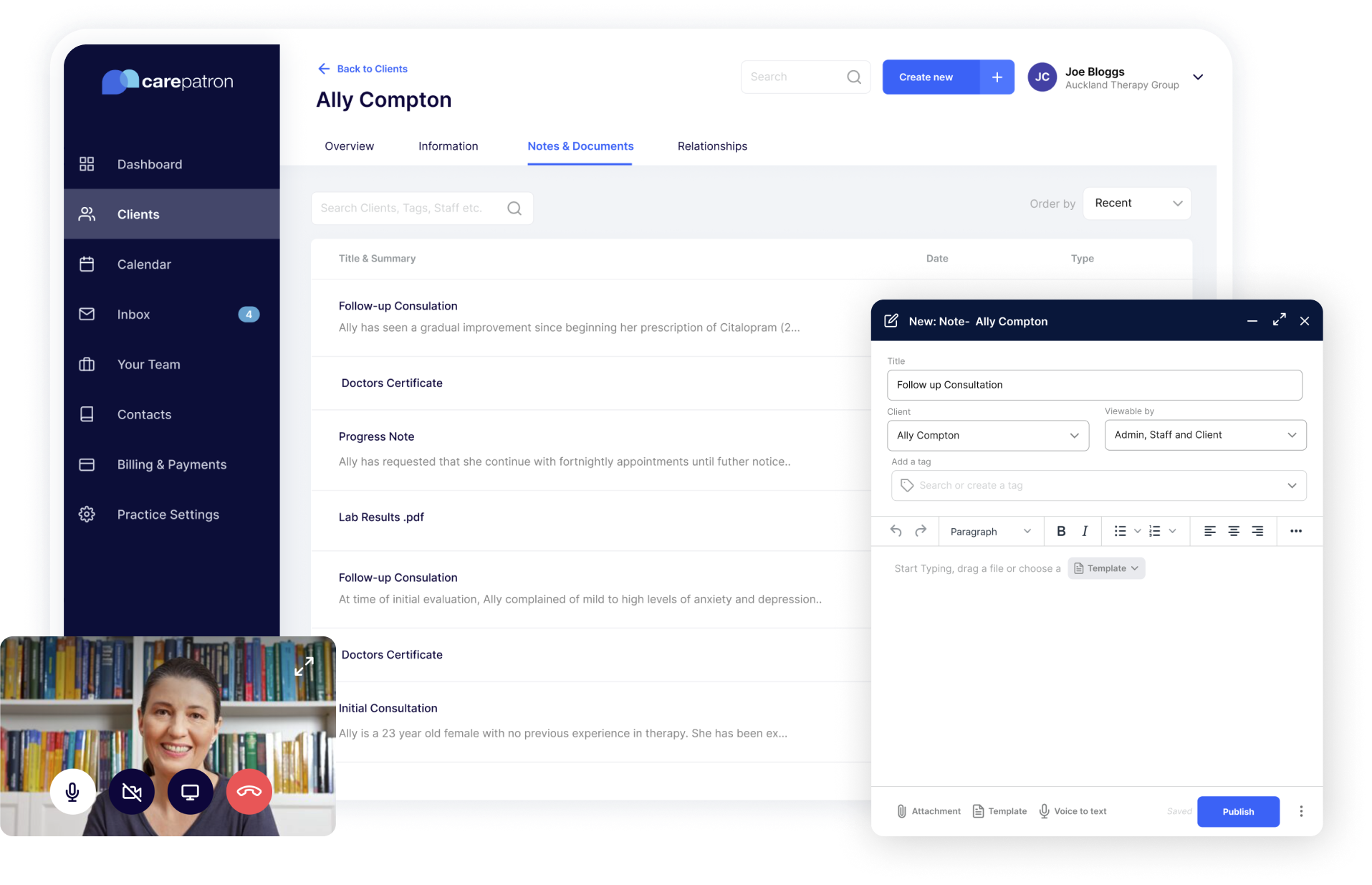

Always be in control of your schedule and to-do list with our mobile scheduling app. Eliminate no-shows from your day with automated reminders, which send professional email and SMS messages to your clients to ensure they turn up on time, everytime.

Conduct assessments, create treatment plans, capture chart notes, write progress notes, and share discharge notes in the leading Mobile Note software. Store your clinical medical history and intake documents. Use our custom therapy templates or voice transcription to maximize your productivity.

Accepting online payments makes it easier for your clients to pay for their services. It saves you a huge amount of time while reducing your clients' barriers to receiving the health treatment they need. Rapid mobile payments allow you to receive payment, then move on.

Digital automation is used in various business processes within the healthcare industry, with over 80% of practices utilizing its services within their day-to-day operations. Automation refers to the exclusive completion of activities through digital technology, such as robotic process automation (RPA) and artificial intelligence (AI), which allow for a higher level of efficiency and accuracy. With digital automation, you can cut business costs with a reduced need for human input, and you can elevate the overall quality of your business practice. With features such as a mobile health platform, and speech recognition for medical transcription, you can speed up processes and ensure that you are prioritizing patient needs.
Especially in this time of the global pandemic, the healthcare industry is contaminated with productivity issues that make it largely inefficient. Because healthcare intensely relies on labor and in-person services, provider and payer operations can spill into other economic sectors, which can cause a multitude of issues. Digital automation can alleviate much of these stresses, as it provides solutions to burnout, as well as providing ways to minimize job losses and declines in operating margins. Technology can automate various business processes to optimize the user experience and create smoother transactions, such as fast online payment processing, and automated notes that can be dictated through speech recognition software. Because of this, many healthcare practices are beginning to adopt and incorporate automation into their operations, with it eliminating monotonous and repetitive tasks. Automation also increases productivity through its ability to follow up on payments, create optimized booking schedules, and quickly transcribe any medical information that needs recording. This allows for faster, and more accurate, clinical notes, as well as a more streamlined approach when it comes to managing client-sensitive information. Mastering automation can boost the quality and coordination of care across your practice, and ensure that patients are receiving the highest level of care.


Digital automation can be incorporated to improve and further develop a vast number of healthcare features, including some of the following:
Mobile health systems are the perfect way to connect with clients and staff from the comfort and ease of your own pocket. You can work anywhere with mobile health apps and platforms, with all medical data contained and securely stored in one location. Patients can book appointments, view payment information, as well as consult with specialists all from their compatible mobile device, and practitioners can continue to develop these relationships through streamlined processes. Healthcare professionals can easily engage and communicate with the right people at any time that best suits their needs, making mobile health systems a great option.
Automating your business through appointment scheduling software is the perfect way for you to resolve and prevent potential bottlenecks that can occur with collecting patient data. Patients can easily be sorted into an optimized schedule that allows you to see as many as your resources allow, with patients also able to book appointments themselves! You have easy rescheduling and canceling options, as well as the ability to simplify the registration process. Clients can be scheduled according to their diagnosis, specialist availability, as well as other details, with insurance and personal information all pre-collected and recorded.
Billing and payments are a large component of healthcare businesses and the healthcare industry, and are worth over $400 billion. Automation can decrease administrative costs that detract from your business revenue, and can work towards eliminating capital expenses and speeding up transaction processes. Patients can make payments online, with easy access to chase up any outstanding payments, and with bank-level encryption, it’s never been easier to manage finances online.
Within healthcare centers, billions of phone calls are sorted and handled throughout a given year, and this can often be a lengthy process. Especially considering that only 20% of these calls are resolved within one point of contact, this can be an intensely repetitive cycle. Using automation, you can streamline contact center operations and save almost 4 minutes per call, and around 50-70 cents per interaction. Using insights from data, you can sort inbound and outbound calls to capture valuable information in minimal time. Patients can access information easily with voice-automation systems directing them towards solutions, and you can spend more time doing what you do best; helping patients.
With medical personnel shortages across the world, and the pandemic only contributing to the acceleration of this, it is important that improvements are made to clinical operations. With less staff, clinicians find it difficult to balance their responsibilities within the restraints of their resources, and while automation technology isn’t an instant fix, it can help alleviate stress for healthcare professionals. Automation can collect necessary patient data before they are seen, authorize their identity, and properly navigate and supply the right medical record documents and information.
Because of the fluctuation in healthcare provider quality and method of delivery, especially with the surge of the COVID pandemic, it is important now more than ever to implement proper operational solutions. Automation can provide accurate streamlined approaches to help practitioners make more educated decisions on where to invest and focus their medical efforts.
Automation is the way of the future when it comes to healthcare, as not only can it accelerate growth through operational transformation, but it can also help healthcare practices realize their full potential. Automation can result in more streamlined workflows that balance all essential business processes such as appointment scheduling, online payments, medical billing and coding productions, as well as clinical document storage and management. It is highly cost-efficient and allows you to gain a competitive advantage over other healthcare practices, as well as boost the quality of care you provide your patients. You can ensure that you are meeting the immediate needs of patients, whilst being efficient across your practice to ensure HIPAA compliance, and high coordination of care.
Further reading: