Feedback captured at the right time allows you to identify areas of improvement for your life coaching business. Great templates and surveys help to make this process fast and efficient.
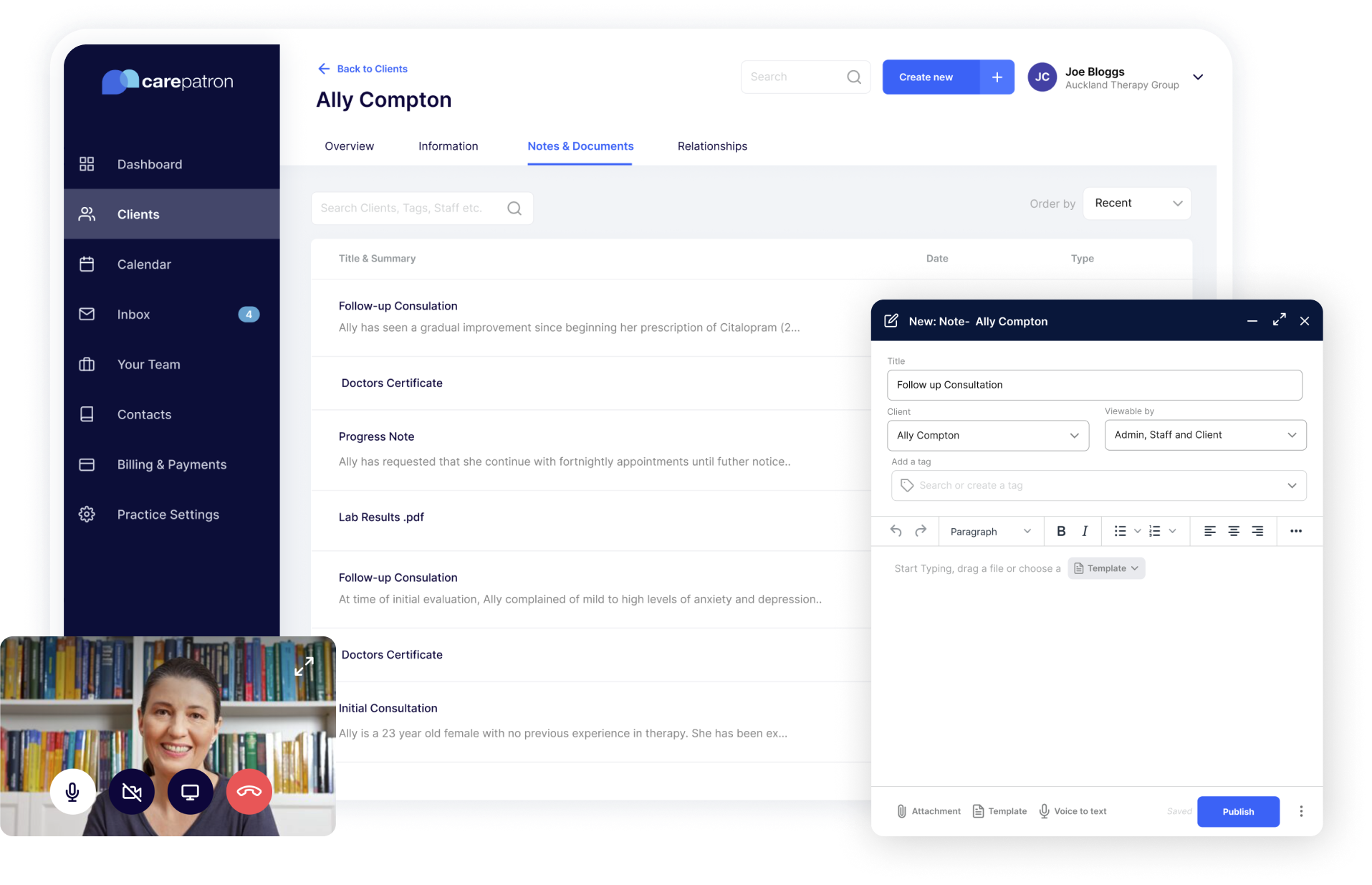

Take control of your schedule and calendar from your desktop or mobile app. Use automated appointment reminders and our fully integrated video calling tool to maximize your productivity.

Store all your patient information, clinical notes, and documentation safely in your secure clinic system. We autosave, so you'll never lose work again.

Carepatron online or mobile payments make it easier for your clients to pay for your bills. You save time a massive amount of time while getting paid twice as fast. What a great way to improve your day and cashflow!

A coaching session client feedback survey is one of the most important ways that you can identify areas for improvement within your business. These forms are typically given to clients following appointments, allowing them to comment on their experiences at your business. Making the decision to customize feedback surveys is really no different from the customization of appointments; it shows that you truly care about the experience of your clients and are invested in generating good health outcomes. Fortunately, this is an area of business that has grown in popularity in recent years, meaning tools and resources are abundantly available to assist in the creation of effective life coaching feedback forms. All in one life coach software is often integrated with various surveys, allowing you to access these tools from a single platform, so we highly recommend having a look into these systems. In this guide, we’re going to unpack some of the benefits of using feedback surveys and provide you with templates, helping you put your best foot forward when it comes to caring for your patients and valuing what they have to say!
Firstly, let’s take a look at the different advantages that life coaching feedback forms will have for your business.
Client experience: Most obviously, and perhaps also importantly, feedback surveys contribute to a better client experience. It goes without saying that this is an incredibly crucial aspect of working as a life coach; happier clients lead to loyalty, and prospective customers are encouraged to walk through your doors. By asking for genuine feedback after your appointments, you are facilitating better communication and showing your customers that you value their opinion and are invested in their treatment.
Saves time: We mentioned before that feedback forms are often integrated into all-in-one life coaching software, and these systems are designed to save you time. With the right forms, you can streamline your check-in process, registration, feedback, and planning, allowing you to skip administrative tasks and instead focus on delivering high-quality solutions to clients in need.
Insight: As a life coach, you should always be looking for ways to improve your methods and treatments. This can be a difficult thing to achieve if you don’t have the right data, a problem solved by generating feedback forms. One of the best life coaching tips is understanding that data-driven change is always going to be the most effective, and who is better to provide this data than patients with first-hand experience! Listening to what your clients have to say will allow you to identify areas that require improvement, and focus on bettering your services.
Improve your treatment: Using life coaching feedback forms allows you to put your best foot forward when it comes to developing your treatment methods. Regardless of your expertise and experience, every professional can make improvements in one way or another, and using these forms is the best way to identify where changes should be made. It is in your best interest to always be looking for ways to improve, and utilizing these resources is the best way to do so.


When it comes to creating an online coach data driven program, feedback forms will be the backbone. Because of the role they play in informing your treatment methods, you need to ensure they are effective. We have compiled a list of steps that will point you in the right direction so you can create the perfect feedback form.
Step 1: Outline: Writing an outline is the first thing you need to do. It will provide guidance for the remainder of the form and indicate what directions you need to go in. This outline will be like a sample for the final product, and it will help you visualize your aims.
Step 2: Questions: Deciding on the questions to include in the form can take a little while, so you should start by writing down any question that comes to mind. It might help to look at online feedback templates, as these will indicate the type of information that other life coach businesses include.
Step 3: Organize: Once you have these broader ideas written down, it is time to organize. Your questions should be structured in an order that makes it easy for clients to fill out, and for you to read. Although you want to receive as much valuable insight as possible, remember that sometimes less is more and clients may be put off by the inclusion of excessive questions.
Step 4: Edit: The final step is to scrutinize and edit your form. Ask your colleagues for their opinions, and don’t be afraid to keep changing it until it is perfect. After you have made final edits, upload it onto your website and begin handing it out to clients post-sessions.
When it comes to effectively planning your coaching sessions, these feedback forms will be relied upon. Different businesses will have their own preferences for how their forms will look, but to help you visualize your options, we have compiled a list of available templates. Even if you decide to create your own feedback form, we highly recommend checking out the below links; at the very least, they can be used as a guideline for the types of questions you should be asking.
Coachville Life Coaching Evaluation: This template can be used following sessions with a client. It asks questions regarding the specific methods used by the coach, as well as scales that indicate the client’s satisfaction with the services received. It also asks for general suggestions regarding improvement, which can assist in the planning of future sessions. The template links to a PDF, which can be downloaded onto your computer, making it easily accessible for use within your business.
Life Coaching Professionally: This resource includes eight of the best questions to ask on a life coach feedback form. You can easily adapt these to suit your specific business needs, and they are guaranteed to generate necessary feedback. It can be hard to narrow down or determine the specific questions you should ask, but this resource eliminates that difficulty!
The Coaching Tools Company: This template differs slightly from the above two, as it has a larger focus on what the client comes away with. It is structured into six questions asking what the client has learned, improved, and achieved and what their future goals are. This type of information is just as important for life coaches; it indicates how customers perceive their own achievements in relation to your treatment methods and allows you to visualize your own success as a coach.


When it comes to writing your own feedback form, it can sometimes be tricky knowing where to start. You want to make sure your form asks enough questions without being too extensive, and that it is fairly easy for patients to fill out. You also want to ensure you are asking the right kind of questions so that the information you gather is genuinely useful to your business. There are many different ways that you can go about this, and each life coach will have their own preferences. Nevertheless, there are certain, more productive, methods of writing an effective feedback form, and we’ve created a session feedback form example to help point you in the right direction.
At the top of the page, include your business name, and leave spaces for clients to identify which coach they saw, and the date of the session.
Life coaching survey question examples:
1. How helpful has the coaching been in moving you towards your goals?
2. What has been the greatest benefit you’ve received from your coaching?
3. Have your coaching expectations been met?
4. What aspects of your session/s do you think went well?
5. What aspects of your session/s do you believe could be improved?
6. How effective was your coach?
A. Did they communicate their ideas well?
B. Did you feel safe and comfortable around them?
C. Were they prepared for each of your sessions?
D. Did they present you with achievable goals?
7. Do you have any comments regarding the structure of the sessions and the methods used by your coach?
8. Are there any further comments or feedback you would like to offer?
At the bottom of your feedback form, you should thank your client and reiterate that their responses are both appreciated and used to improve your business processes. Additionally, it is important that clients feel comfortable giving their feedback, so remaining anonymous should always be an option (this also means they may not want to give the name of the coach that they saw). Using these questions will guarantee that your feedback forms are effective, and can be used as a guide to create a fantastic life coach package.
Asking for feedback is one of the most important, yet overlooked aspects of working as a life coach. The only way that your business can truly improve is if it has an authentic insight into the success of its coaching methods, and clients are the only people who can provide this information. Additionally, using these forms will demonstrate to your customers that you truly care about their experiences, and are willing to listen to their ideas and opinions. Asking for feedback can be a daunting prospect, but provided you are professional and hard-working, there is no reason why you wouldn’t receive a glowing report - and sometimes this is exactly what coaches need! Hopefully, this guide has demonstrated why feedback is so integral to operating a life coach business, and you can start creating and distributing your own!
Further Reading: