

Laura Entis is a staff writer at Every.

The Best Founders Have Something AI Can’t Tell Them
Plus: Agents keep tabs on a cattle genetics startup, an AI onboarding buddy, and seven predictions about the future of work
Oct 14, 2026 · 9 min readUpdated Oct 16, 2026


Nearly every startup pivots eventually, says Matt Hartman, founder of Factorial Capital, so he backs founders with a technical edge and hard-earned insights who are best equipped to navigate a change in markets. On this week’s episode of The Every Podcast, he tells Natalia Quintero how he finds those founders and why vibe coding his own app gave him new respect for paying for software. Plus: a field report from a 28-person agricultural technology startup that runs on agents in Slack, Becky Isjwara on using the Every Agent as her onboarding buddy, and seven new Thesis Statements.
Was this newsletter forwarded to you? Sign up to get it in your inbox.
‘The Every Podcast’
Why technical founders win when startups pivot
In 2016, Hugging Face started as a chatbot app for teenagers. Today, it’s the largest community for open-source AI and is set to be acquired by Nvidia for about $13 billion. Matt Hartman, who was part of the Betaworks team that wrote its first check, sees a lesson in that transformation: Back technical founders who can “move with where the world goes.”
Now the founder and managing partner of Factorial Capital, Hartman assumes every early-stage startup will pivot. He believes the most successful founders keep their “pivot foot”—the one a basketball player keeps planted while turning—in their technical skills: They can build for a new market when their original business changes direction.
In this week’s episode of The Every Podcast, Hartman tells Natalia Quintero how his investment thesis has evolved over time, how his portfolio founders became one of his best sources of new deals, and why vibe coding his own app gave him a new respect for SaaS.
Watch on X or YouTube, or listen on Spotify or Apple Podcasts. You can also read the transcript.
Here are the highlights:
- Investment theses that are “20 degrees off” can still lead somewhere good: Hartman looks for the “newly technically possible” by tinkering, reading research papers, and interviewing smart people. Noticing the lack of competition among his phone’s apps for his ears sent him hunting for a “Twitter for audio,” which led him to back Anchor, today a leading podcasting tool owned by Spotify. His hunch about conversational software similarly led to his Hugging Face investment. When he started Factorial, he turned the same curiosity on transformers: What could their next-word prediction abilities do with other sequences, like a robot’s movements or data from science experiments?
- He looks for insights that only the founder could have earned: AI can shrink the feedback-to-product-update loop from two months to two days, Hartman says. He looks for founders with an “earned insight”—something only someone in their position could have learned—and the ability to keep uncovering customer insights after launch. “Why is this thing interesting?” he asks. “Why is this the problem to solve?”
- Building his own app gave him new respect for SaaS: Hartman builds tools to run Factorial and just to experiment. Wondering why voice-to-text apps charge for inference when models could run locally, he used Claude Code to build Ghost Pepper, a free, open-source dictation tool that reached the top of Hacker News. The experience led to a surprising lesson: “When you just code something for yourself, you have to maintain it.” Amid talk of a SaaS apocalypse, he now sees subscriptions differently: “What you’re paying for is them making sure it stays a great product.”
Miss an episode? Catch up on Dan Shipper’s recent conversations with Sam Altman; Anthropic head of product Mike Krieger; the team that built Claude Code, Cat Wu and Boris Cherny; the team that built Codex, Thibault Sottiaux and Andrew Ambrosino; Vercel cofounder Guillermo Rauch; and others to learn how they use AI to think, create, and relate.—Miriam Partington
Field report
How an AI-native agritech startup works with agents in Slack
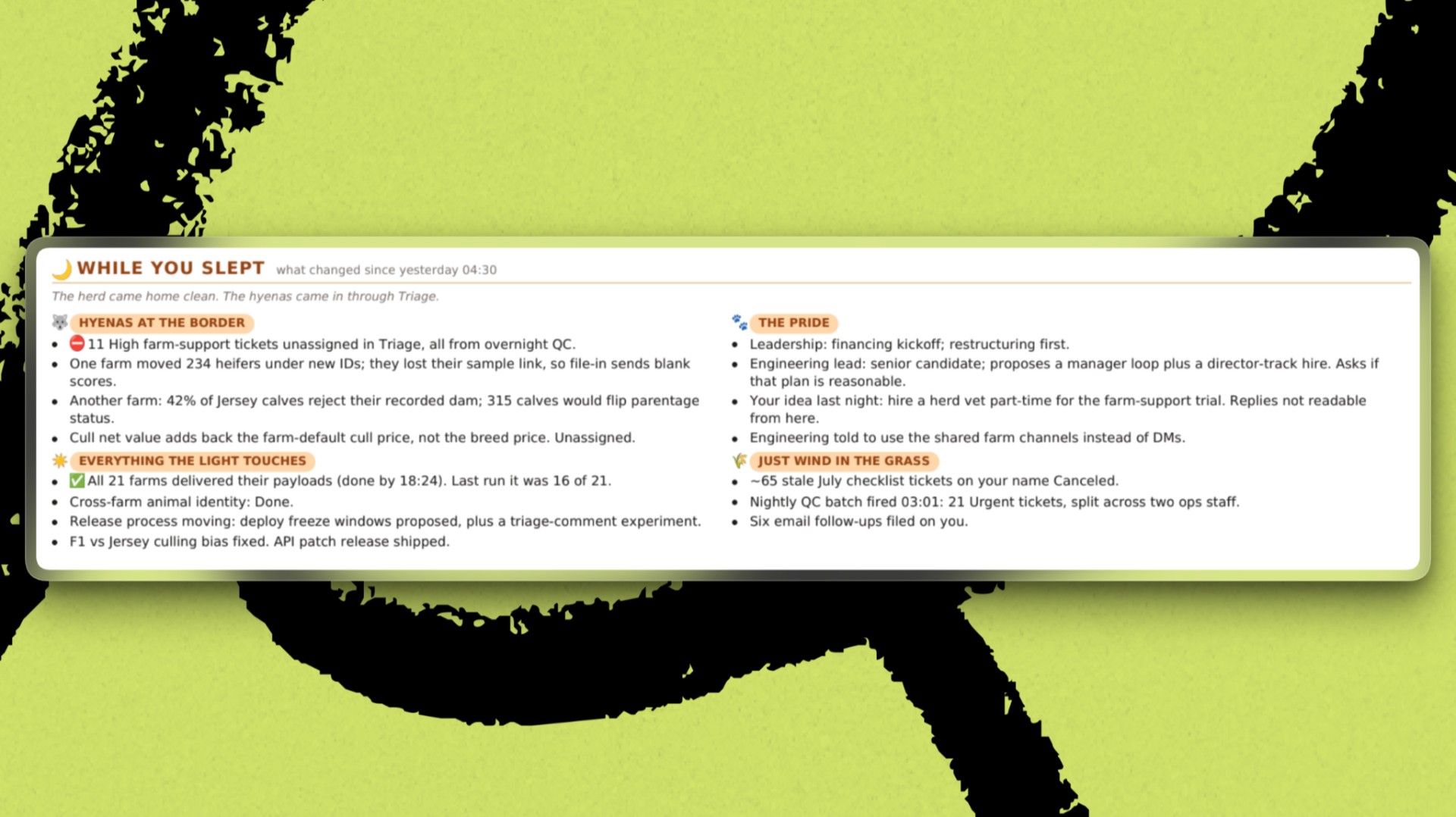
FeanixBio CEO Mitchell Angove woke up on a recent Wednesday to a report flagging an unhappy customer. A farmer had paid for the agricultural technology company’s parentage service—a bovine paternity test for his herd—but hadn’t received the results yet, despite asking for them twice. The report also noted that the engineer who usually handled troubleshooting was out sick and suggested which coworker should fill in.
The report came from the Every Agent, a shared AI agent that FeanixBio has used in Slack since August. Angove amused himself by asking the agent to give his report a Lion King theme, with the unhappy farmer filed under “Hyenas at the Border.”
Based in Scotts Valley, California, FeanixBio is a 28-person startup that uses genetic data to advise farmers on which cows to breed, keep, or remove from their herds. Its customers include about 35 family-owned farms, mostly operations with 10,000 or more animals in California’s Central Valley and in Arizona. It’s also an unusually AI-pilled company: Its agents work in the same Slack channels and threads as employees.
The AI roster
FeanixBio’s Slack is lousy with agents. Rumen, an agent built with OpenClaw by FeanixBio’s head of engineering, is available on the platform to everyone at the company. Named after the largest of a cow’s four stomach compartments (naturally), Rumen accesses FeanixBio’s data through the Model Context Protocol. Employees turn to it for business or data-specific questions ranging from “How does our stack work” to “What’s the deal with cow 2310?”
People also regularly use the project-management tool Linear’s agent to turn discussions into tickets, as well as their own AI assistants, including Angove’s OpenClaw Micah. And then there’s the Every Agent. With the Every Agent connected to the company’s calendar, Slack, Linear, and database of individual cow data, one of its main jobs is to flag operational and communication issues before they snowball.
Always-on monitoring
For chief technology officer Kate Chapman, the Every Agent’s daily sweep of her team’s work has allowed her to “relax a little bit,” knowing that details she needs to track won’t “float by” unnoticed in Slack.
She uses the Every Agent to generate her own daily report, which sorts tickets and other code-based tasks into green, yellow, and red buckets. A separate automation checks her team’s calendar and reminds employees a week before vacation to arrange coverage.
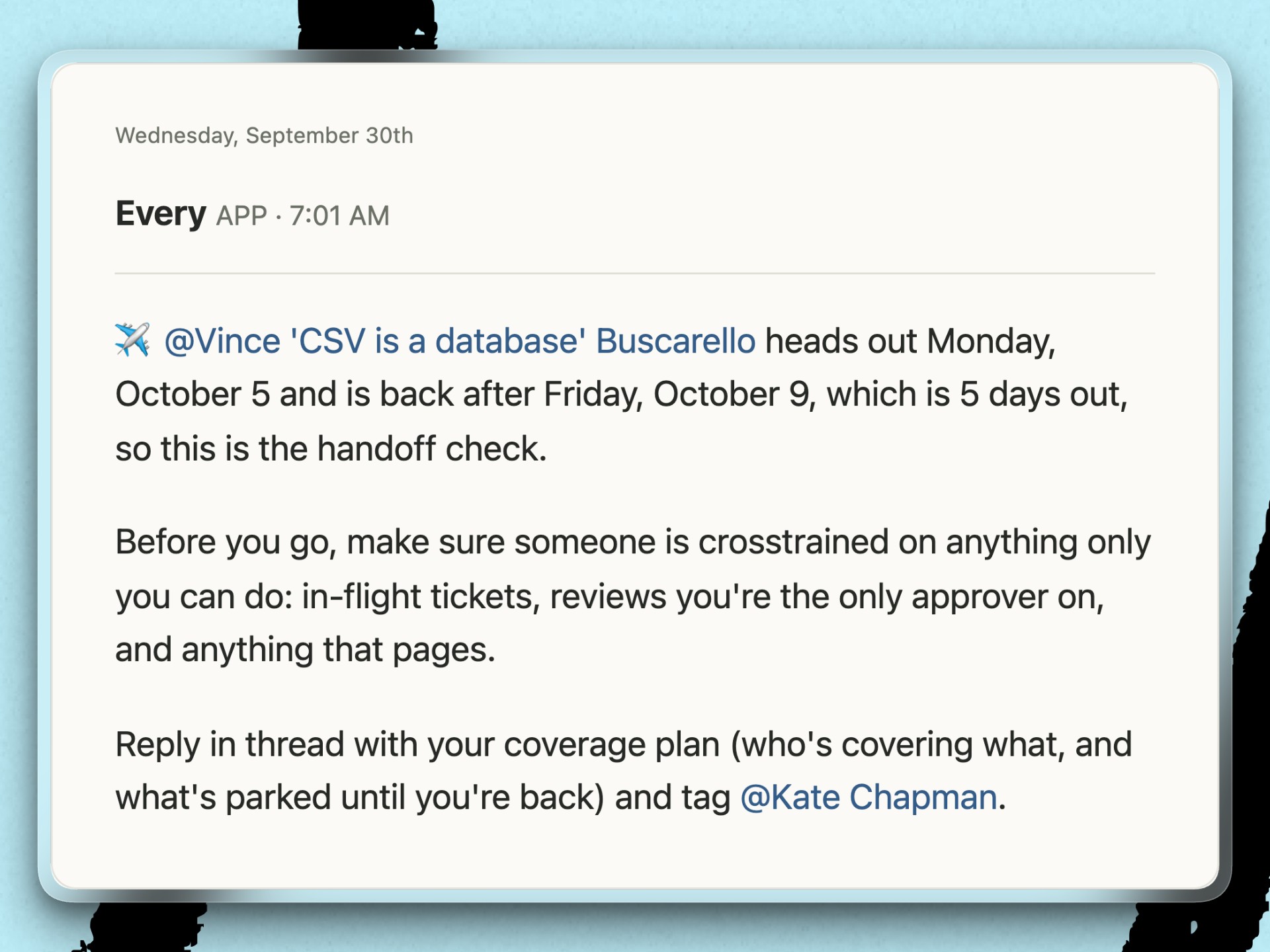
The briefs are especially helpful when she travels. FeanixBio’s team spends time on farms and at conferences, where the activity directly in front of her can crowd out everything happening back at headquarters. “It’s really around keeping on top of those regular things that you need to be aware of that maybe you would have an assistant do, that I do not have,” Chapman says.
An agent to summarize the agents
Certain Slack threads, mostly arguments about cow behavior or engineering problems, can balloon to 70-plus messages, half of which are agent-generated. Employees invoke Rumen to make a point, and the agent will obligingly post “some giant doc that says really nothing of any consequence,” Angove says.
When Rumen or a human posts something long-winded, Angove summons the Every Agent: “@Every, summarize this better.”
Useful enough to keep paying for?
Even at a company that is comfortable with agents, adoption is uneven. Everyone at FeanixBio has access to the Every Agent, and Angove and Chapman find it smart, capable, and easy to understand. For a while, Angove used the Every Agent to work through his Linear issues: to-dos such as replying to emails, messaging colleagues, and following up on partnerships. Each day, it sent him a list of the tickets assigned to him. He’d reply in Slack with how each should be handled, and the agent would reliably execute all of them.
But higher costs during the beta phase limited Angove’s use. He tried cheaper alternatives, including delegating the job to his assistant and OpenClaw, but their capabilities couldn’t match Every Agent’s.
Every Agent’s token costs have since fallen, and Every’s team continues work to make the agent cheaper to run. Token costs are passed through to customers without a markup, so making tasks more efficient lowers the cost. The agent’s token spend is down roughly 60 percent since Opus 5.5 was released in September, says engineer Marcus Moretti. Less expensive, open-weight models are improving: “You should expect that the token cost for the same use cases with the agent goes down over time,” he says.
When we spoke in early October, Angove was working through his tickets by hand. He misses the quality of the Every Agent’s responses—if the price drops enough, he says, he’s open to tagging it back in and getting his time back.
Inside Every
My onboarding buddy was an agent
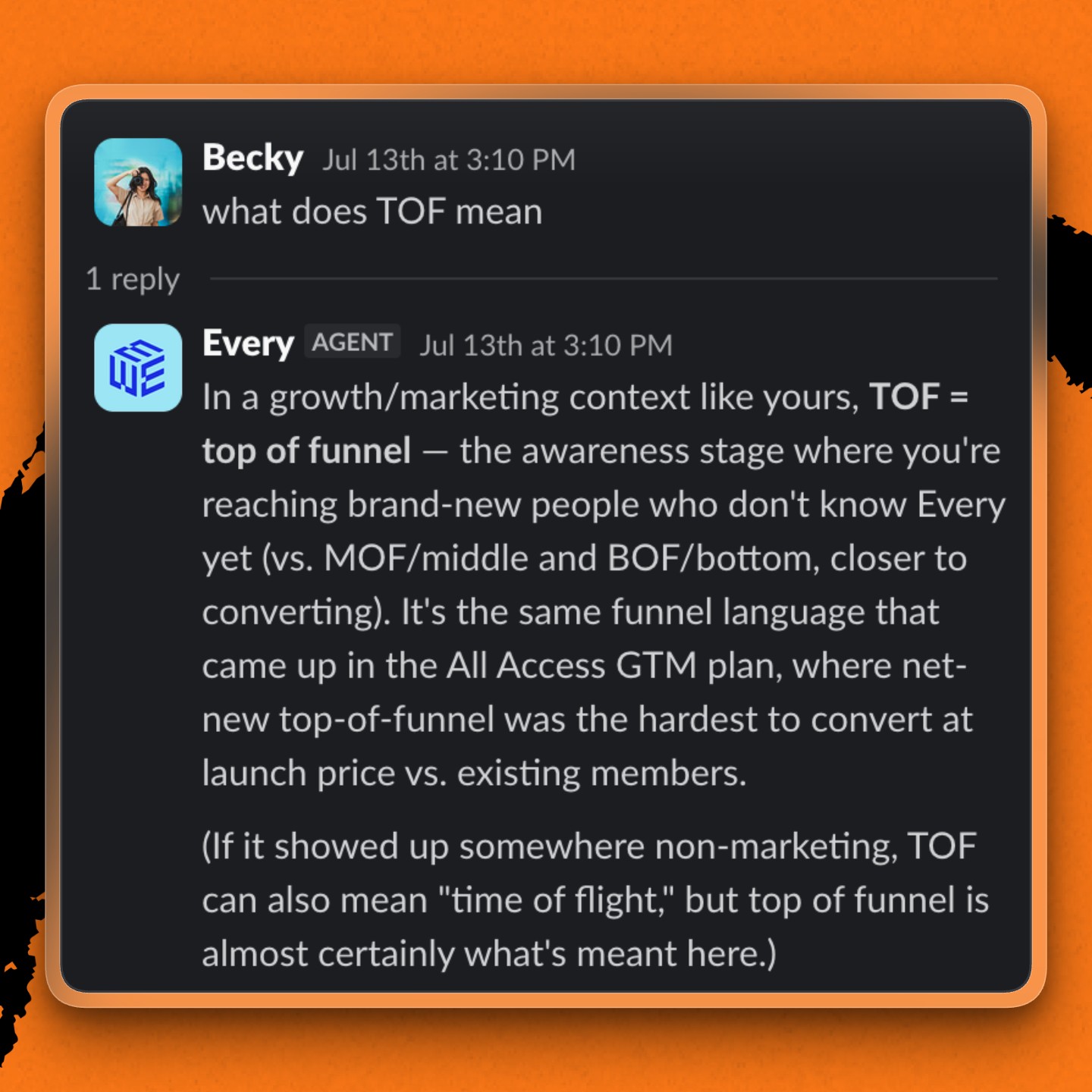
During my first weeks with Every, I worked from Hong Kong, so most of the team was offline by the time I logged on. There was no onboarding package, but I had lots of questions that felt silly to bother my manager with, like “who is Yash?” “What is this rebrand everyone is talking about?” and “what does TOF mean?”
I asked the @Every agent, which explained who people were, what they were working on, and what the unfamiliar terms meant.
Two things made that possible: First, the whole company uses the same agent, so it had accumulated knowledge from conversations and documents I didn’t know existed. Second, it had all this information because Every documents everything: Meeting notes, calendars, and decisions all live in Notion.
That also means Every Agent can repeat mistakes it finds in documents. A meeting transcript once credited Arielle Shipper with something Natalia said, the agent repeated it, and I DMed the wrong person.
It doesn’t replace people either. My first all-hands and my 1:1 with Kate Lee taught me things Every Agent didn’t tell me, like the reasons behind the team’s priorities for the week.
If you have the Every Agent hooked up to your company’s sources of truth, have your new hires try these prompts on day one:
1. I’ve just joined [team]. What are the main projects they are working on right now?
2. Who is [name], what do they own, and what should I ask them?
3. Summarize the last week of #[channel].
My role is [x] and my goals are [insert here].
4. Give me a briefing every weekday at 8 a.m. that summarizes Slack messages and meetings over the past 24 hours and orders them based on relevance to my role.
Thesis Statements
In Thesis Statements, builders, operators, and thinkers predict the future of great human work with AI. This week, we have seven new predictions:
- The only thing that can free us from algorithms will be our own by Riley Brown, founder of Agent Native
- We’ll look for cues to care by Jack Cheng, senior editor at Every
- The only real programming language will be English by Andrey Galko, engineering lead at Every
- AI will join the writers’ room, not replace it by Fred Graver, founder of AI Writers Studio
- We’ll follow people for their stories, not their expertise by Becky Isjwara, head of social media at Every
- Editing will become a creative act by Soren Iverson, designer and founder of the eponymous creative studio
- The best way to keep your job is to be the one who automates it by Kate Lee, editor in chief of Every
Our inaugural Thesis: 2027 conference is on November 5, 2026. Every subscribers can RSVP for the after-party that evening for free.
Laura Entis is a staff writer at Every. To read more essays like this, subscribe to Every, and follow us on X at @every and on LinkedIn.
Stop explaining AI to your team and start showing them. Every Agent does the work in Slack, where everyone can see it, so one good workflow quickly becomes the whole team’s.

See how good you are at using AI—and learn how to get better
Sign in to read for free and get your AI assessment prompt.
Continue with GoogleView all login options Continue with Google
 Sign in


